The short answer
You’ve finished Schedule CThe tax form where you report your business income and expenses. Its bottom line is your profit., your profit is on line 31, and now your tax software wants one more form: Schedule SEThe tax form that works out your self-employment tax from your Schedule C profit.. It’s shorter than it looks, and for most freelancers only about a dozen of its lines matter.
Schedule SE (Form 1040) is where you figure self-employment taxSocial Security and Medicare tax for people who work for themselves: 15.3% on 92.35% of your profit, on top of income tax., the Social Security and Medicare tax people who work for themselves pay. You file it once your net earnings from self-employmentYour business profit times 92.35%. Self-employment tax is figured on this amount, and if it’s under $400 for the year, you owe none. reach $400, and it charges 15.3% on 92.35% of your profit, then lets you deduct half of that tax for income tax. On a $72,825 profit, that comes to $10,289.84.
The line numbers below come from the 2025 Schedule SE, the latest the IRS has published. Our example uses 2026 numbers, including the 2026 Social Security wage baseThe yearly cap on earnings subject to the 12.4% Social Security tax: $184,500 for 2026 and $192,300 for 2027. Medicare has no cap. of $184,500. The 2026 form, which you’ll file in 2027, may move a line, so check it when it comes out.
Schedule SE, decoded: tap any line
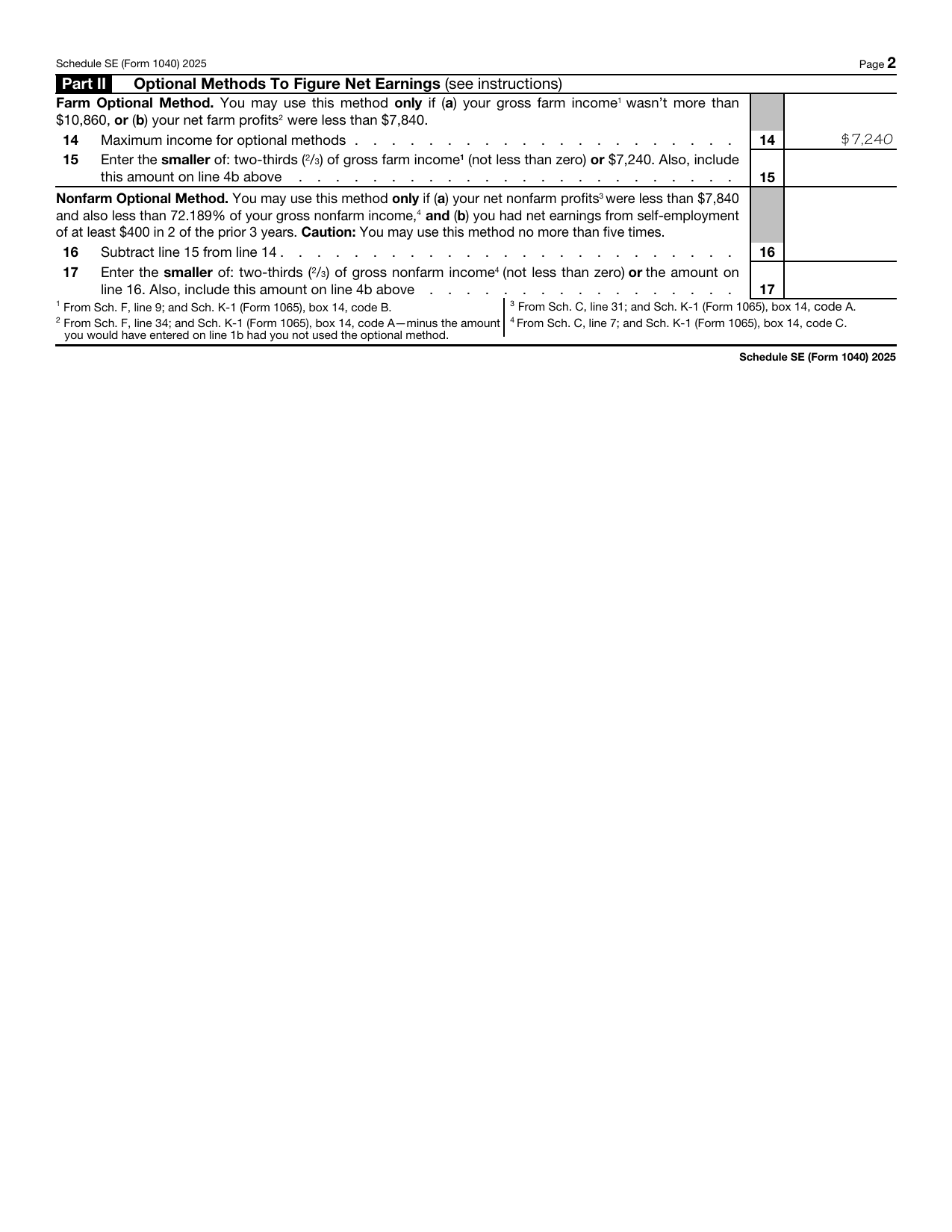
Here’s the real form from the IRS, both pages. Each line has a plain-English note and Maya’s numbers, so you can see what your tax software is doing with yours.
Tap any line on the formHover over any line on the form to see what it means. Click a line to pin its note open so you can use the links. to see what it means. Our example is Maya, the freelance designer from our Schedule C page: $72,825 of net profit in 2026 and no W-2 job, the same numbers as the walk-through further down.

Swipe sideways to see the whole form.
Every line, in plain English
Name Whose self-employment income this is
The name of the person who earned the self-employment income, as it appears on your Form 1040. On a joint return, that's the spouse with the business, not automatically the first name on the 1040.
ExampleMaya writes her own name.
Our tipIf you and your spouse both have self-employment income, each of you files your own Schedule SE.
SSN That person's Social Security number
The Social Security number of the same person named on the left. This is how your self-employment tax gets credited to your own Social Security record, so it has to match.
ExampleMaya enters her own Social Security number, not her business EIN.
Line A Ministers with an approved exemption
Only for ministers, members of a religious order and Christian Science practitioners who filed Form 4361 and were approved to be exempt from self-employment tax on their ministry pay, but who also had $400 or more of other self-employment earnings. Everyone else skips it.
ExampleMaya isn't a minister, so she leaves the box empty.
Line 1a Farm profit or loss
Your net farm profit or loss from Schedule F, line 34, plus farm partnership earnings from Schedule K-1. If you don't farm, leave it blank.
ExampleMaya isn't a farmer, so this is blank.
Line 1b Conservation Reserve Program payments
Only for people already getting Social Security retirement or disability benefits who also received Conservation Reserve Program payments. Those payments aren't taxed for self-employment tax, so you enter them here as a negative number, in parentheses.
ExampleMaya has no farm payments, so this is blank.
Line 2 Your business profit
The net profit or loss from Schedule C, line 31, plus any self-employment earnings from a partnership (Schedule K-1, box 14, code A). If you run more than one business, add their results together here: a loss in one lowers the profit from another.
ExampleMaya copies $72,825 from line 31 of her Schedule C.
Our tipEvery dollar of expenses you claim on Schedule C makes this line smaller, which lowers both your income tax and this tax.
Line 3 Your combined self-employment profit
Lines 1a, 1b and 2 added together. For most freelancers it's the same as line 2.
ExampleMaya: $72,825.
Line 4a The 92.35% step
If line 3 is more than zero, you multiply it by 92.35%. This trims your profit the way an employee's pay is figured before the employer's share of payroll tax, so you aren't taxed on the tax. The result is your net earnings from self-employment.
ExampleMaya: $72,825 × 92.35% = $67,253.89.
Our tipThis is why self-employment tax works out to about 14.1% of your profit, not the full 15.3%.
Line 4b Optional methods, if you use them
If you choose one of the optional methods in Part II on page 2, you enter the total of lines 15 and 17 here. Most people leave it blank.
ExampleMaya doesn't use an optional method, so this is blank.
Line 4c The $400 test
Lines 4a and 4b added together. If the total is under $400, you stop: you don't owe self-employment tax (unless you had church employee income). That works out to about $433 of profit. At $400 or more, you keep going.
ExampleMaya: $67,253.89, far above $400, so she continues.
Our tipYou still report a small business profit on Schedule C for income tax, even when this line says you owe no self-employment tax.
Lines 5a and 5b Church employee income
Only for people paid wages by a church that elected out of paying employer Social Security and Medicare tax. You enter that W-2 pay on 5a and multiply it by 92.35% on 5b. If the result is under $100, you enter zero. Pay as a minister doesn't count here.
ExampleMaya has no church wages, so both lines are blank.
Line 6 Earnings the tax is figured on
Lines 4c and 5b added together. This is the number the 12.4% and 2.9% rates apply to.
ExampleMaya: $67,253.89.
Line 7 The Social Security wage base
The most earnings that can be charged Social Security tax in the year, counting your wages and self-employment earnings together. It's printed on the form: $176,100 on the 2025 form. For 2026 it's $184,500.
ExampleFor Maya's 2026 return, line 7 is $184,500.
Our tipThe 2.9% Medicare part has no cap, so earnings above this line still pay Medicare.
Lines 8a to 8c Wages from a job
If you also had a W-2 job, your Social Security wages (boxes 3 and 7 of your W-2) go on 8a. Lines 8b and 8c are for unreported tips and for wages from Form 8919, which is for workers who were treated as contractors when they should have been employees. If your wages alone reach the line 7 amount, you skip ahead to line 11.
ExampleMaya has no W-2 job, so these lines are 0.
Our tipYour job uses up the wage base first. Your side business only pays the 12.4% on whatever room is left.
Line 8d Total wages
Lines 8a, 8b and 8c added together.
ExampleMaya: 0.
Line 9 Room left under the cap
Line 7 minus line 8d: how much of the wage base your wages haven't already used. If it's zero or less, enter 0 here and on line 10.
ExampleMaya: $184,500 − 0 = $184,500. If she also had a $150,000 W-2 job, line 9 would be $34,500.
Line 10 Social Security tax: 12.4%
You multiply the smaller of line 6 or line 9 by 12.4%. That's the Social Security part of the tax, both the employee and the employer share.
ExampleMaya: $67,253.89 is smaller than $184,500, so $67,253.89 × 12.4% = $8,339.48.
Our tipWith that $150,000 job, she would pay 12.4% on just $34,500, so $4,278.
Line 11 Medicare tax: 2.9%
Line 6 multiplied by 2.9%. Medicare has no cap, so this applies to all your net earnings.
ExampleMaya: $67,253.89 × 2.9% = $1,950.36.
Our tipAbove $200,000 single or $250,000 married filing jointly, an extra 0.9% Additional Medicare Tax applies. It's figured on Form 8959, not here.
Line 12 Your self-employment tax
Lines 10 and 11 added together. This is the tax you owe on top of income tax. It goes to Schedule 2 (Form 1040), line 4, and from there into the total tax on your Form 1040.
ExampleMaya: $8,339.48 + $1,950.36 = $10,289.84.
Our tipYour quarterly estimated payments need to cover this as well as your income tax.
Line 13 Deduct half of it
Half of line 12. It goes to Schedule 1 (Form 1040), line 15, where it lowers the income you pay income tax on. You get it even if you take the standard deduction. It doesn't lower the self-employment tax itself.
ExampleMaya: $10,289.84 × 50% = $5,144.92 off her income for income tax.
Lines 14 and 15 Farm optional method
A choice for farmers with small or negative farm income. If your gross farm income was $10,860 or less, or your net farm profits were under $7,840, you can report two-thirds of your gross farm income as your earnings, up to $7,240 on the 2025 form. Line 14 shows that limit, and line 15 carries the result to line 4b.
ExampleMaya doesn't farm, so she skips this section.
Our tipIt can mean more self-employment tax, but also Social Security credit for the year.
Lines 16 and 17 Nonfarm optional method
A choice for a low-profit year. You qualify if your nonfarm profit was under $7,840 and under 72.189% of your gross income, and you had $400 or more of net earnings in 2 of the 3 years before. You report two-thirds of your gross income instead, up to line 16. You can use it for only 5 years in total.
ExampleSay you brought in $9,000 and made $3,000 of profit. Two-thirds of $9,000 is $6,000, so you report $6,000 of earnings instead of about $2,771. Maya's profit is far too high to use it.
Our tipWhy pay more tax on purpose? It can earn Social Security credits and raise credits like the earned income credit. Run your numbers both ways first.
Footnotes Where the numbers above come from
The small notes tell you which lines feed Part II. For a sole proprietor, net nonfarm profit is Schedule C, line 31, and gross nonfarm income is Schedule C, line 7. Farmers use Schedule F, lines 9 and 34.
ExampleIn the example above, the $9,000 is Schedule C line 7 and the $3,000 is line 31.
Who files Schedule SE
You file Schedule SE if you work for yourself and made a profit. That includes freelancers, 1099 contractors, single-member LLC owners who file Schedule C, and partners with self-employment earnings on a K-1. Age doesn’t matter: the tax applies even if you already get Social Security or Medicare.
- More than one business? You still file one Schedule SE. The profits and losses from all of them are combined on it.
- Married filing jointly? Each spouse with self-employment income files their own Schedule SE, because the tax builds each person’s own Social Security record.
- An S-corpA tax status a business can elect. You pay yourself a salary through payroll, and profit above it skips Social Security and Medicare tax. owner? Your salary already has Social Security and Medicare taken out through payroll, so it doesn’t go on Schedule SE. How an S-corp changes this tax.
The $400 rule
Line 4c is the test. If your net earnings from self-employment (your profit times 92.35%) are under $400, you stop there and owe no self-employment tax. At $400 or more, you file the whole form.
Because of the 92.35% step, $400 of net earnings works out to about $433 of profit. Say your side business made $500 this year. That’s $461.75 of net earnings, so you owe self-employment tax of about $71. The rule has an exception for church employees: wages from a church that elected out of Social Security count once they reach $108.28.
Under the limit, you still report the profit on Schedule C for income tax. What to expect your first year self-employed.
Maya’s Schedule SE, line by line
Here’s the whole form filled in for Maya, a freelance designer with $72,825 of net profit in 2026 and no W-2The form an employer sends each January showing your wages and the tax withheld. As an S-corp owner, your own company sends you one. job. It’s the same Maya from our Schedule C walk-through.
| Line | What it does | Maya |
|---|---|---|
| 2 | Net profit from Schedule C, line 31 | $72,825.00 |
| 3 | Lines 1a, 1b and 2 combined | $72,825.00 |
| 4a | Line 3 × 92.35% | $67,253.89 |
| 4c / 6 | Net earnings the tax applies to | $67,253.89 |
| 7 | Social Security wage base (2026) | $184,500.00 |
| 8d | W-2 wages | $0 |
| 9 | Room left under the cap | $184,500.00 |
| 10 | Social Security: 12.4% of the smaller of line 6 or 9 | $8,339.48 |
| 11 | Medicare: 2.9% of line 6 | $1,950.36 |
| 12 | Self-employment tax | $10,289.84 |
| 13 | Deduction for half of it | $5,144.92 |
Notice that her tax is about 14.1% of her profit, not 15.3%, because of the 92.35% step. Want the full picture with income tax included? The self-employed tax calculator does both, and how self-employment tax works explains where each rate comes from.
If you also have a W-2 job
The 12.4% Social Security part stops at the wage base, and that cap covers your job and your business together. Your W-2 wages go on line 8a and use up the cap first.
Say Maya also earned $150,000 at a job in 2026. Line 9 leaves only $34,500 of room, so line 10 is 12.4% of $34,500, or $4,278, instead of $8,339.48. The 2.9% Medicare part still applies to all $67,253.89. The cap rises to $192,300 in 2027. What changes for self-employment tax in 2027.
How the deduction for half works
Line 13 is half of your self-employment tax. It goes to Schedule 1 as an adjustment to income, so you get it whether you take the standard deductionThe amount you subtract from income before tax without listing deductions. On your federal return: $16,100 if single, $32,200 if married filing jointly (2026). States set their own. or itemize. It mirrors the deduction an employer gets for its share of payroll tax. If a return deducts the whole tax instead of half, the IRS can correct it as a math error: you’d get a CP11 if the fix leaves you owing, or a CP12 if you still get a refund.
It lowers your income tax, not the self-employment tax itself. For Maya, $5,144.92 comes off the income she pays income tax on. In the 12% bracket that saves her about $617; in the 22% bracket, about $1,132.
Where lines 12 and 13 go
Schedule SE doesn’t stand alone. Two of its numbers travel to other forms on the 2025 return.
- Line 12, the tax, goes to Schedule 2 (Form 1040), line 4. From there it joins your income tax in the total tax on Form 1040.
- Line 13, the deduction, goes to Schedule 1 (Form 1040), line 15. From there it lowers your adjusted gross incomeYour total income minus a few specific deductions, like half your self-employment tax. Many limits and credits are based on it.. How Schedule 1 works, line by line.
Here’s what most people in your spot do: plan for line 12 all year, not in April. Your quarterly estimated payments have to cover it along with your income tax, and moving a share of every payment into a tax account makes that easy. How much to set aside.
FAQ
What is Schedule SE used for?
It figures your self-employment tax: 12.4% for Social Security and 2.9% for Medicare on 92.35% of your self-employment profit. The Social Security Administration also uses it to credit your earnings toward your future benefits.
Do I need to file Schedule SE if I made less than $400?
Not if line 4c, your net earnings from self-employment, is under $400. That’s about $433 of profit. Church employee income has a lower $108.28 limit.
Is Schedule SE the same as Schedule C?
No. Schedule C works out your business profit. Schedule SE takes that profit from line 31 and figures the Social Security and Medicare tax on it. Most freelancers file both.
Why is self-employment tax figured on 92.35% of profit?
An employee’s payroll tax is figured on pay before the employer’s share. Taking out 7.65% (half of 15.3%) gives you the same treatment.
Do both spouses file Schedule SE on a joint return?
Only the spouse with self-employment income files one. If you both have it, you each file your own, even on a joint return.
Does Schedule SE include the 0.9% Additional Medicare Tax?
No. That applies above $200,000 single or $250,000 married filing jointly and is figured on Form 8959. Schedule SE only covers the regular 15.3%.
Can I lower my Schedule SE tax?
Yes, by lowering your Schedule C profit with every real business expense you can claim. Here’s the full list of write-offs. At higher profits, an S-corp election can also cut it.
Sources
- IRS: About Schedule SE (Form 1040)
- IRS: 2025 Instructions for Schedule SE
- IRS: 2025 Schedule SE (PDF)
- IRS: Self-employment tax
- IRS: Topic 751, Social Security and Medicare withholding rates (2026 wage base)
- SSA: 2026 Social Security changes
General education, not legal or tax advice. Line numbers are from the 2025 Schedule SE; the wage base and examples are for 2026 and may change for later years.