The short answer
Bookkeeping for a one-person business is about 15 minutes a month if you set it up right: one business bank account, an app that pulls in your transactions, and a monthly routine to label them and save receipts. You don’t need an accountant to do it, and you don’t need to understand debits and credits.
The goal is simple: in April, you know your total income and every deductible expense, with proof, in under an hour.
Set it up once
- Use a separate business bank account for every business dollar in and out. This does 80% of the work. Here’s how to choose one.
- Pick one place to track it: a bookkeeping app or a spreadsheet (see the tools below).
- Connect your bank account and business card so transactions import automatically.
- Use the IRS’s own categories. Set your expense categories to match the lines on Schedule C (advertising, car expenses, office expenses, supplies, travel, meals and so on). At tax time, your totals drop straight onto the form.
- Pick a receipt habit: snap a photo with the app, or forward email receipts to one folder.
The 15-minute monthly routine
Put it on your calendar for the first weekday of each month.
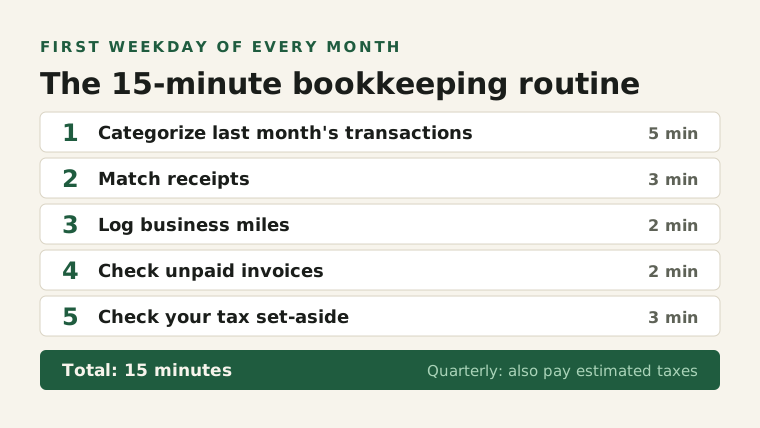
- Categorize last month’s transactions (5 minutes). Label each one. Mark personal ones as personal, or better, move them out of the business account.
- Match receipts (3 minutes). Any business purchase without a receipt photo or email gets one now, while you remember it.
- Log business miles (2 minutes). Date, miles and purpose for each trip, or let a mileage app track it. In 2026, each business mile is worth a 72.5¢ deduction.
- Check unpaid invoices (2 minutes). Anything past due gets a polite reminder today.
- Check your tax set-aside (3 minutes). Is 25 to 30% of last month’s income sitting in your tax account? If not, top it up.
Each quarter, add one step: look at your profit so far and pay your quarterly estimated taxes.
What records to keep
The IRS doesn’t require any particular system, only that your records support the income and deductions on your return.
- Income: invoices, payment records, and the 1099 forms clients and payment apps send you.
- Expenses: receipts or statements showing what you bought, when, from whom and how much.
- Meals and travel: add a note of who, where and the business reason.
- Car use: a mileage log with date, miles and purpose.
- Big purchases: receipts for equipment like a computer or camera, which you may deduct over several years.
- Tax payments: confirmation numbers for every quarterly payment.
How long to keep them
| Situation | Keep records for |
|---|---|
| Most people, most years | 3 years after you file |
| You left out income worth more than 25% of what you reported | 6 years |
| You claimed a bad debt or worthless securities loss | 7 years |
| You have employees (payroll records) | At least 4 years |
| You didn’t file, or filed a fraudulent return | Indefinitely |
Source: IRS, How long should I keep records? Keep records for equipment and other assets until 3 years after you sell or stop using them. Digital copies are fine.
Tools: what you actually need
Starting prices as of 2026; check current plans.
| Option | Cost | Good for |
|---|---|---|
| A spreadsheet | $0 | Very few transactions a month, and you like doing it by hand |
| Wave | Free | Most new one-person businesses: bank import, invoicing, reports |
| QuickBooks Solopreneur | About $20/month | Sole proprietors who want automatic categorizing, mileage tracking and quarterly tax estimates |
| FreshBooks | About $19/month | Service businesses that send a lot of invoices |
| A bookkeeper | Often $150–$300+/month | Busy owners with lots of transactions, or an S-corp with payroll |
Start free. Upgrade only when the monthly routine regularly takes more than 30 minutes.
Common mistakes
- Catching up once a year. Twelve months of mystery transactions in March is the reason people hate bookkeeping. Fifteen minutes a month is painless.
- Mixing personal and business purchases. Every personal charge in the business account is one more thing to sort out.
- No receipts for cash or small purchases. They add up. Snap a photo before you leave the store.
- Counting your owner’s draws as expenses. Paying yourself isn’t a business expense.
FAQ
Do I need an accountant? Not for day-to-day bookkeeping. Many one-person businesses use a tax preparer once a year, in April, and handle the books themselves. Here’s what filing day looks like.
Cash or accrual? Cash. You record income when you get paid and expenses when you pay them. It’s what almost every small business uses.
Are bank statements enough as receipts? They show the amount, date and store, but not what you bought. Keep the receipt for anything you deduct, especially larger purchases.
Sources
- IRS: How long should I keep records?
- IRS: Recordkeeping
- Bookkeeping software picks for freelancers (May 2026 prices)
General education, not tax advice.