The short answer
You can deduct any expense that is ordinary and necessary for your business: common in your line of work, and helpful for earning money. Every dollar you deduct comes off your profit before both self-employment tax and income tax are figured.
That makes a write-off worth more for you than for an employee: roughly 23 to 32 cents of federal tax saved per dollar, plus your state rate. But it’s still never free. Spending $1,000 to save $300 leaves you $700 poorer.
The biggest wins for most solo owners are the home office, business mileage, self-employed health insurance and retirement contributions. Most people miss at least one of them.
What a write-off actually saves you
A business expense lowers your profit, which lowers two taxes at once: self-employment tax and income tax. Here’s what $1,000 of deductions saves in 2026 federal tax, for a single filer with no other income:
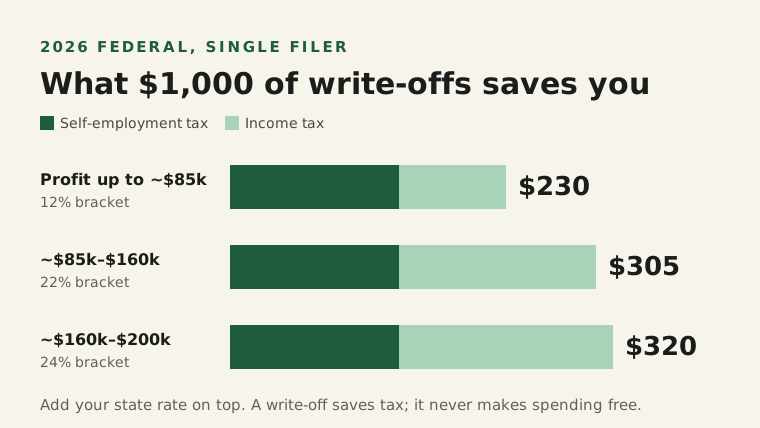
Income tax savings are smaller than your bracket suggests, because half of SE tax and the 20% QBI deduction already shield part of your profit. Add your state rate on top, usually 3% to 9%.
The takeaway: deduct everything you legitimately spend. Don’t buy things you don’t need just for the write-off.
The big four
1. Home office. If part of your home is used regularly and exclusively for business, you can deduct it. The simplified method is $5 per square foot, up to 300 square feet, so up to $1,500 a year with almost no paperwork. The regular method deducts a share of your actual rent or mortgage interest, utilities and insurance, and can be bigger in expensive cities. “Exclusively” is strict: a desk in the corner of the living room doesn’t qualify; a spare room used only for work does.
2. Business driving. For 2026, the standard mileage rate is 72.5 cents per mile. Driving to client meetings, the post office, or a supplier counts; your commute to a regular workplace doesn’t. 5,000 business miles is a $3,625 deduction. Keep a mileage log; an app that tracks trips automatically makes it painless.
3. Self-employed health insurance. If you pay for your own health, dental or long-term care insurance and aren’t eligible for an employer plan (yours or a spouse’s), you can deduct the premiums, often $5,000 to $10,000 a year or more. One catch: this one lowers your income tax, not your self-employment tax.
4. Retirement contributions. This is the biggest legal tax cut available to you. A Solo 401(k) lets you put in up to $24,500 of your own pay in 2026, plus an “employer” contribution of about 20% of your net self-employment earnings, up to a combined $72,000. A SEP-IRA is simpler but only allows the 20% part. Like health insurance, these lower income tax, not SE tax. And unlike other write-offs, the money is still yours.
Everyday write-offs
| Expense | Deductible? | The rule |
|---|---|---|
| Software and subscriptions | 100% | Design tools, accounting software, hosting, email, cloud storage |
| Computer, camera, equipment | 100% | Items up to $2,500 can be expensed right away; bigger items too, usually, with Section 179 or bonus depreciation |
| Phone and internet | Business share | If 60% of use is business, deduct 60% of the bill |
| Business meals | 50% | Meals with clients or while traveling for work; note who and why |
| Business travel | 100% | Flights, hotels, rideshares when the trip’s main purpose is business |
| Education and courses | 100% | Must improve skills in your current business |
| Professional services | 100% | Tax prep for the business, legal fees, bookkeeping |
| Advertising and marketing | 100% | Ads, website, business cards, sponsorships |
| Contractors you pay | 100% | Send a 1099-NEC to anyone you pay $2,000 or more in 2026 (it was $600 before) |
| Bank and payment fees | 100% | Stripe, PayPal and card processing fees |
| Business insurance | 100% | Liability, professional (E&O) insurance |
| Coworking space | 100% | Desk or membership fees |
If you’re unsure about something, ask: would a business like mine normally pay for this to make money? If yes, and you have a receipt, it’s probably deductible.
What you can’t deduct
- Personal expenses dressed up as business. Groceries, regular clothes (even if you wear them on camera), gym memberships, family vacations with one meeting attached.
- Your commute to a regular office or coworking space you go to every day.
- Entertainment. Concert or game tickets with clients aren’t deductible anymore, even if you talk business.
- Fines and penalties, including IRS penalties.
- The full cost of mixed-use things. Only the business share of your phone, car or internet counts.
Things that draw IRS attention: losses year after year from a business that looks like a hobby, very large meal or car deductions relative to income, a car claimed at 100% business use, and round numbers that look estimated. None of these are illegal if they’re true. Just make sure your records can prove them.
Keep the receipts
A deduction is only as good as the record behind it. Keep:
- Receipts or statements for every business purchase. A photo in an app or a bookkeeping tool is fine.
- A note on meals and travel: who, where, and the business reason.
- A mileage log: date, miles, purpose. Apps can track it automatically.
- Everything for at least 3 years after you file. That’s how far back the IRS usually looks.
The easiest system is a separate business bank account and card for every business expense, connected to bookkeeping software. Then your records build themselves.
FAQ
Can I deduct expenses from before my business made money? Yes. Up to $5,000 of startup costs can be deducted in your first year, with the rest spread over 15 years.
Do I need receipts for everything under $75? For most expenses under $75, a record of the amount, date, place and business purpose is enough. Lodging always needs a receipt. A bank statement entry plus a note is usually fine.
I forgot deductions last year. Can I fix it? Yes. You can amend a return within 3 years to claim missed deductions.
Sources
- IRS: Simplified home office deduction
- IRS: 2026 standard mileage rate
- PSCA: 2026 401(k) limits
- IRS: Instructions for Schedule C
- IRS Publication 463: Travel, gift and car expenses
- Western CPE: 1099 thresholds under the 2025 tax law
General education, not tax advice. Numbers are 2026 federal figures.