The short answer
If your business clears about $80,000 a year in profit, an S-corp will probably save you $2,000 to $4,000+ a year. Under about $60,000, it usually isn’t worth it. Between $60,000 and $80,000, it’s close, and your state decides it.
Most articles say the breakeven is $40,000. That number ignores two things: what it costs to run an S-corp every year, and the income-tax deduction you partly give up when you switch. This guide counts both.
Not tax advice. Numbers are 2026 federal figures for a single filer. Run your own numbers with a CPA before you file anything.
What an S-corp actually changes
An S-corp is not a new kind of business. It’s a tax election your LLC (or corporation) makes with the IRS. The business stays the same. What changes is how the money you take out gets taxed.
As a sole proprietor or single-member LLC, all of your profit is hit with self-employment tax: 15.3% (12.4% Social Security + 2.9% Medicare) on 92.35% of profit. Social Security stops at the 2026 wage base of $184,500; Medicare doesn’t stop.
As an S-corp, you split your profit in two:
- A salary, paid through payroll. It gets the same 15.3% (half from you, half from the company).
- Distributions, the rest of the profit. No Social Security or Medicare tax at all.
You pay regular income tax on both either way. The savings come only from the slice you take as distributions.
Example: $100,000 of profit. As a sole prop, self-employment tax is about $14,130. As an S-corp paying yourself $50,000, payroll tax is $7,650. That’s $6,480 less, before the catches below.
The real math at five profit levels
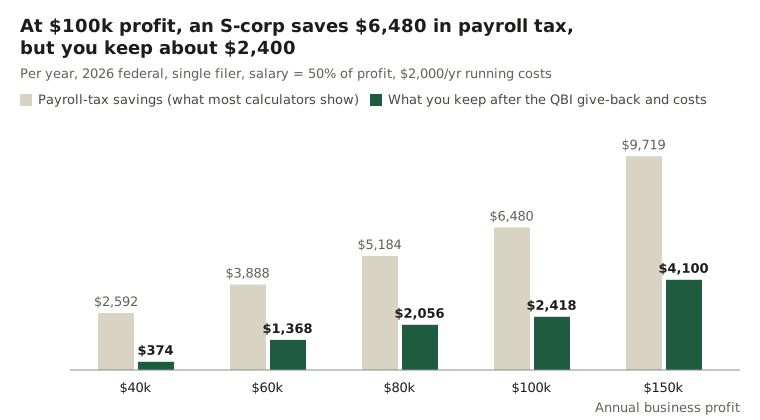
The grey bars are what most calculators show you. The green bars are what you actually keep after two costs: about $2,000 a year to run the S-corp, and the extra income tax from a smaller QBI deduction (explained below). At $40,000 of profit you keep a few hundred dollars for a lot of paperwork. At $80,000 it’s about $2,000 a year, and it grows from there.
Want your own number? Try the free calculator. It runs the same math.
What it costs to run
Budget about $2,000 a year in extra costs. That’s what the math above assumes.
| Cost | Typical per year | Why |
|---|---|---|
| Payroll software | $600 to $1,000 | You must run real payroll for yourself. Gusto Simple is $49/month + $6 per person. |
| Business tax return (Form 1120-S) | $800 to $2,000 | A separate return from your personal one. Most people pay a CPA for it. |
| Unemployment taxes | $100 to $500 | Federal unemployment is $42 max; state rates vary. |
| State taxes and fees | $0 to a lot | Depends entirely on your state (below). |
States that change the answer:
- California taxes S-corps at 1.5% of net income, with an $800 minimum. At $100,000 of profit, that’s $1,500 a year, which eats most of the savings.
- New York City doesn’t honor the S-corp election for city corporate tax, so you pay city corporate tax on the profit.
- Tennessee charges franchise and excise tax on LLCs either way, so switching mostly doesn’t change it.
In most other states, the state cost is small. Check your state’s revenue department before you decide.
How much salary to pay yourself
Pay yourself what you’d have to pay someone else to do your job. That’s the IRS test, called reasonable compensation. If you set it too low, the IRS can reclassify your distributions as wages and bill you the back payroll tax plus penalties.
There is no official percentage. The IRS and courts look at:
- Your training, experience and duties
- How much time you put into the business
- What comparable businesses pay for similar work
- How much of the revenue comes from your own work, compared with employees or equipment
A practical way to set it:
- Look up the market wage for your role (the Bureau of Labor Statistics publishes these by job and state).
- Adjust for your hours. Part-time work supports a lower salary.
- Write down how you got the number and keep it with your records.
The 50/50 split used in this guide is a common starting point, not a rule. If nearly all of your revenue comes from your own hands-on work, expect the right number to be higher. A $0 salary with big distributions is the pattern that gets audited.
The catches nobody mentions
1. You give back part of the QBI deduction. Pass-through owners can deduct 20% of their qualified business income, and the 2025 tax law made that permanent. But your S-corp salary doesn’t count as business income. At $100,000 of profit with a $50,000 salary, that costs about $2,060 in extra income tax, which is roughly a third of the payroll-tax savings. This is the main reason the real breakeven is higher than the $40,000 you’ll see elsewhere.
2. Smaller retirement contributions. With a Solo 401(k), you can defer $24,500 of your own pay in 2026 either way. The employer contribution on top of that is different. A sole prop can add about 20% of net self-employment earnings. An S-corp can add 25% of salary only. At $100,000 profit and a $50,000 salary, that drops from about $18,600 to $12,500. If you max out retirement savings, raise your salary or skip the S-corp.
3. A smaller Social Security check later. Your future benefit is based on the earnings you paid Social Security tax on. Less taxed income now means a smaller benefit when you retire. This matters most if Social Security will be a big part of your retirement income.
4. Health insurance gets fiddly. If the S-corp pays your health insurance premiums, they go on your W-2 as wages. You still deduct them on your personal return, and they’re exempt from Social Security and Medicare tax. But your payroll provider has to set it up right.
5. More paperwork, forever. Payroll every month or quarter, quarterly payroll filings, W-2s every January, a separate business return every March. Software handles most of it, but it’s never zero.
When the answer is no
Skip the S-corp, at least for now, if any of these are true:
- Profit is under about $60,000, or it swings a lot from year to year. You pay the costs every year, including bad ones.
- You’re in California or New York City and profit is under about $100,000.
- You’re maxing out retirement contributions and want the biggest employer contribution you can get.
- The business is brand new. Run a year as an LLC first, learn what it really earns, then decide. You can elect later.
- You won’t run payroll on time. Missed payroll deadlines bring penalties that can wipe out a year of savings.
How to switch
- Form an LLC first if you don’t have one. It takes a day or two in most states.
- Get an EIN from the IRS. It’s free and takes minutes online.
- File Form 2553 to elect S-corp status. For the election to count for the current year, file it no later than 2 months and 15 days after the year starts. For a calendar-year business, that’s March 15. You can fax or mail it.
- Set up payroll before your first salary payment, and pay yourself on a regular schedule.
- Open (or keep) a separate business bank account. Salary and distributions both come out of it. Never pay personal bills straight from it.
- Tell your CPA, and file Form 1120-S every year by March 15.
Missed the deadline? The IRS offers late-election relief within 3 years and 75 days if you had reasonable cause. Mark the form “FILED PURSUANT TO REV. PROC. 2013-30” and explain why it’s late.
Tools that make it easy
| Job | Pick | Why |
|---|---|---|
| Payroll for one | Gusto | Has a Solo plan built for S-corp owners paying themselves; files payroll taxes and W-2s for you. |
| All-in-one S-corp service | Collective | Handles the election, payroll, bookkeeping, quarterly estimates and the business tax return. $349/month, or about $296/month billed annually (roughly $3,550/year). That’s more than the $2,000 assumed above, so it pays off at around $150k+ profit, or if you’d otherwise hire a CPA and a bookkeeper anyway. |
| Business banking | Relay or Mercury | Free business checking; keeps salary, distributions and tax money separate. |
| Bookkeeping | QuickBooks Online | What most CPAs expect you to use. |
FAQ
Do I need an LLC to be an S-corp? You need a legal entity: an LLC or a corporation. A plain sole proprietorship can’t elect S-corp status.
Can I switch back? Yes, you can revoke the election. But you generally have to wait 5 years to elect S-corp status again.
Does an S-corp protect me from lawsuits? No more than your LLC already does. The S-corp is only a tax choice.
Does my spouse’s income matter? Yes. Married couples filing jointly have wider tax brackets, which changes the QBI give-back. Run it with your joint numbers.
Can I pay myself $0 in a slow year? If the business truly has no profit to pay you from, a low or zero salary can be fine. You can’t take distributions while paying no salary.