The short answer
Maybe you just realized you skipped the September payment, or your tax software flagged an estimated taxTax you send the IRS yourself during the year, usually four times, because no employer is withholding it from a paycheck. penalty on your return. Either way, you’re probably wondering how bad it is. Here’s the good news.
The IRS underpayment penalty is usually small. It works like interest: 7% a year (the rate for the last quarter of 2026) on the amount you were short, only for the days it was late. Being $2,000 short for three months costs about $35. And if you paid the safe harborA payment amount that protects you from IRS underpayment penalties, such as paying 100% of last year’s tax (110% if your AGI was over $150,000). amount, or you owe less than $1,000 when you file, there’s no penalty at all.
Most people in your spot pay whatever they missed as soon as they notice, then set up their quarterly payments so it doesn’t happen again next year.
Form 2210, decoded: tap any line
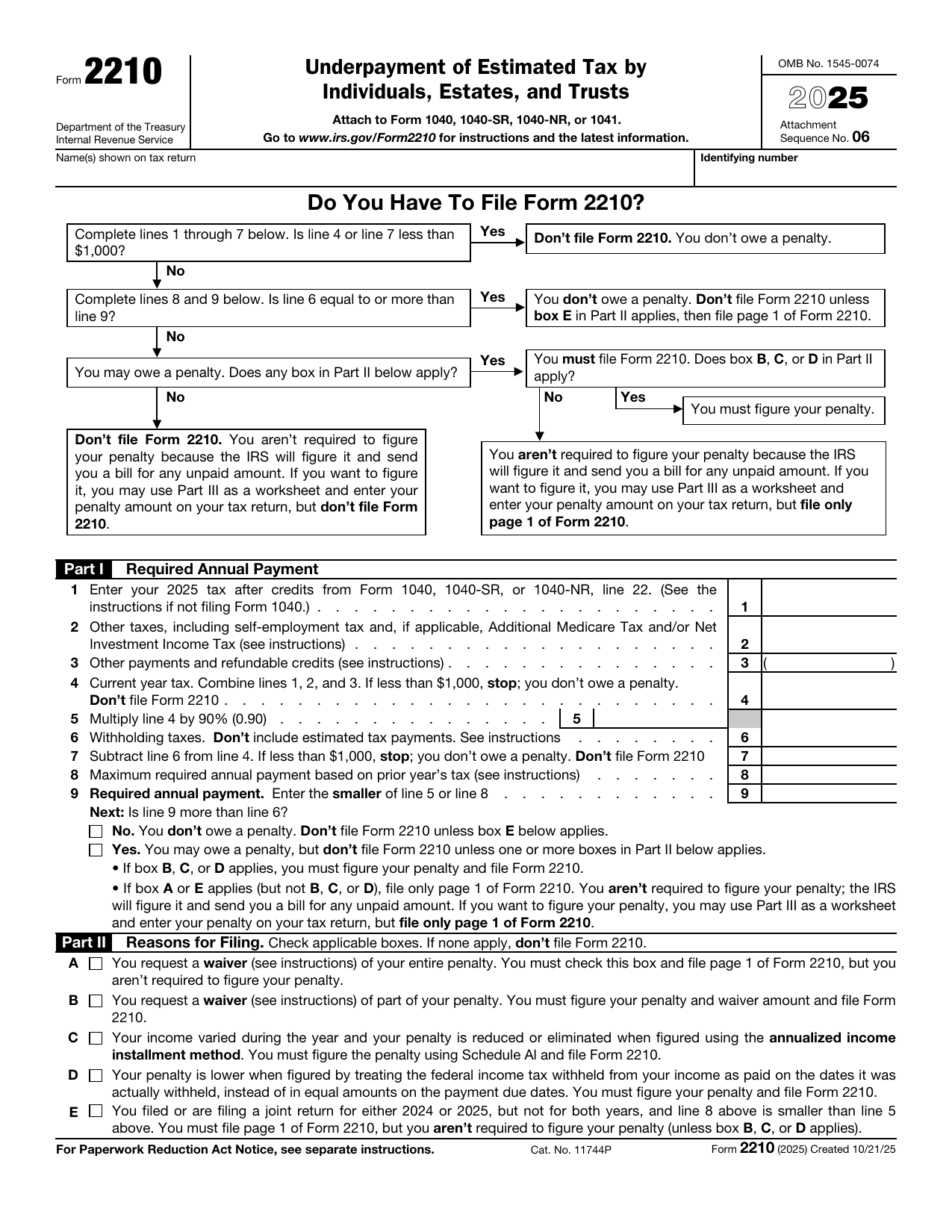
Form 2210The IRS form that figures the penalty for paying too little estimated tax during the year. Tax software fills it in for you. is the IRS form that checks whether you paid enough during the year and works out the penalty if you didn’t. Here’s the real 2025 form, all three pages, with a plain-English note on every line. We use Maya from our Form 1040-ES walk-through with 2026 numbers: she owed $12,000 in quarterly payments but stopped after June, so she paid in only $6,000.
Tap any line on the formHover over any line on the form to see what it means. Click a line to pin its note open so you can use the links. to see what it means. Our example is Maya, the freelance designer from our Form 1040-ES page: $14,993 of total tax for 2026, $12,000 of total tax on her 2025 return, and no withholding. She paid $3,000 on April 15 and June 15, then nothing more, so she paid in only $6,000. These are 2026 numbers on the 2025 form.

Swipe sideways to see the whole form.
Every line, in plain English
Name Your name, as on your return
The name or names exactly as they appear on the tax return you attach this to. On a joint return, both spouses' names go here.
ExampleMaya writes her own name, as on her Form 1040.
Identifying number Your Social Security number
For a person, this is your Social Security number (or ITIN). On a joint return, use the first number shown on the return. Estates and trusts use their EIN.
ExampleMaya enters her Social Security number.
Flowchart Do you even have to file this form?
Most people who owe the penalty never file Form 2210. The flowchart sends you through Part I first. If line 4 or line 7 is under $1,000, or your withholding on line 6 already covers line 9, you owe nothing. If you might owe, you only file the form when a box in Part II applies. Otherwise the IRS works out the penalty and mails you a bill.
ExampleMaya's lines 4 and 7 are $14,993 and her line 6 is 0, so she may owe a penalty. None of the Part II boxes apply to her, so she doesn't have to file Form 2210 at all.
Our tipYou can still use Part III as a worksheet and put the penalty on your return yourself. Tax software usually does exactly that.
Line 1 Your income tax after credits
Your income tax for the year after nonrefundable credits like the child tax credit. On the 2025 form it comes from Form 1040, line 22. Self-employment tax isn't in this number yet. It comes on line 2.
ExampleMaya's 2026 income tax is $4,704.
Line 2 Other taxes, including self-employment tax
Taxes from Schedule 2 that count toward the penalty, the biggest one for freelancers being self-employment tax from Schedule SE. It also picks up the Additional Medicare Tax, the Net Investment Income Tax and, in some cases, household employment taxes for a nanny.
ExampleMaya's self-employment tax is $10,289.
Our tipFor most freelancers this is the bigger of the first two lines.
Line 3 Refundable credits
Credits that can be paid out to you even beyond your tax, such as the earned income credit, the additional child tax credit, the refundable part of the American opportunity credit and the premium tax credit. You enter them in parentheses because they reduce your tax.
ExampleMaya has none, so she enters 0.
Line 4 This year's tax
Lines 1 and 2 minus line 3. This is the tax the penalty is measured against. If it's under $1,000, you stop: there's no penalty and no form to file.
ExampleMaya: $4,704 + $10,289 − $0 = $14,993, the same total as her Form 1040-ES worksheet.
Line 5 90% of this year's tax
Line 4 times 90%. Paying this much on time is the first of the two safe harbors. Farmers and fishers use 66⅔% instead, on Form 2210-F.
ExampleMaya: $14,993 × 90% = $13,494.
Line 6 Tax withheld from paychecks
Federal income tax withheld from a W-2 job, a pension or other payments (Form 1040, line 25d on the 2025 form). Don't include your estimated tax payments here. They go in Part III.
ExampleMaya has no job and no withholding, so line 6 is 0.
Our tipHave a day job too? Withholding counts as paid evenly through the year, even if it came out late, so raising it in the fall can cover earlier quarters.
Line 7 The $1,000 test
Line 4 minus line 6: what you'd owe if you hadn't made any estimated payments. If it's under $1,000, you stop. There's no penalty.
ExampleMaya: $14,993 − $0 = $14,993, far above $1,000, so she keeps going.
Line 8 Last year's tax
Your total tax from the year before, the second safe harbor. It's roughly last year's Form 1040, line 22 plus the same Schedule 2 taxes, minus refundable credits. If last year's adjusted gross income was over $150,000 ($75,000 married filing separately), use 110% of it. If you didn't file last year, or it wasn't a full 12 months, leave line 8 blank.
ExampleMaya's total tax on her 2025 return was $12,000, and her income was under $150,000, so she enters $12,000.
Our tipYou know this number in January, which is why it's the safe harbor we'd plan around.
Line 9 Your required annual payment
The smaller of line 5 or line 8. This is what you needed to pay in during the year, through withholding and estimated payments, to owe no penalty at all. If you skipped line 8, enter line 5 here.
ExampleMaya: the smaller of $13,494 and $12,000 is $12,000. That's $3,000 per due date.
Our tipThis is the number to aim for next year, split into four payments.
Next Is line 9 more than line 6?
If your withholding already covers line 9, you check No and owe no penalty. If not, you check Yes: you may owe one, but you only file Form 2210 when a box in Part II applies. With box B, C or D you must figure the penalty yourself. With only A or E, you file page 1 and the IRS figures it.
ExampleMaya: $12,000 is more than $0, so she checks Yes.
Box A Asking to waive the whole penalty
For when the IRS might waive the penalty: you retired after age 62 or became disabled this year or last and had a reasonable cause, or a casualty, disaster or other unusual event caused the shortfall. You check the box, file page 1 and attach a statement with your reasons and proof, like your retirement date or an insurance report. You don't have to figure the penalty.
ExampleMaya forgot two payments, which isn't a reason the IRS waives this penalty, so she leaves it blank.
Our tipIn a federally declared disaster area the IRS usually applies relief on its own, so you don't need this box.
Box B Asking to waive part of the penalty
The same reasons as box A, but for only part of the penalty, such as one quarter. Here you have to figure the whole penalty, write the amount you want waived next to line 19, and attach your explanation.
ExampleMaya leaves it blank.
Box C The annualized income method
For when your income came late in the year. Instead of four equal installments, Schedule AI on page 3 sets each one by what you had actually earned by then, which can shrink or wipe out the penalty for early quarters. You must figure the penalty and file the whole form.
ExampleMaya earned steadily all year, so it wouldn't help her. If most of her income had come in the fall, it could.
Our tipIf you use it for one due date, you have to use it for all four.
Box D Withholding on the dates it was taken
Normally withholding counts as paid in four equal parts on the due dates. If more of yours was taken early in the year, you can count it on the actual dates instead. You must figure the penalty and file the form.
ExampleMaya has no withholding, so it doesn't apply.
Box E A joint return one year but not the other
For when you filed jointly last year but not this year, or the other way round, and line 8 is smaller than line 5. You file page 1, but you don't have to figure the penalty unless box B, C or D also applies.
ExampleMaya files single both years, so she skips it.
Columns (a) to (d) The four due dates
Each column is one quarterly due date, and every line below is worked out for each one separately. The 2025 form shows April 15, June 15 and September 15, 2025 and January 15, 2026. For 2026 they're April 15, June 15 and September 15, 2026 and January 15, 2027.
ExampleMaya fills in a column for each of her four 2026 due dates.
Our tipThe penalty is figured per payment, so paying extra in January doesn't erase a penalty on an earlier quarter.
Line 10 What you should have paid each time
A quarter of line 9 in each column, unless you checked box C, in which case these come from Schedule AI, line 27.
ExampleMaya: $12,000 × 25% = $3,000 in each column.
Line 11 What you actually paid
The estimated payments you made in each period, plus a quarter of your withholding in each column (unless you checked box D). A refund from last year that you applied to this year usually counts as paid on April 15. Column (a) is payments through April 15, (b) through June 15, (c) through September 15 and (d) through January 15. If line 11 is at least line 10 in every column, you stop: no penalty.
ExampleMaya: $3,000, $3,000, 0 and 0.
Our tipMailed payments count on the postmark date.
Line 12 Extra carried in from the last column
Any overpayment from line 18 of the column before. Paying ahead in one quarter carries forward to the next. Column (a) is shaded because nothing comes before it.
ExampleMaya never paid more than $3,000 at a time, so line 12 is 0 in every column.
Line 13 Total available for this due date
Lines 11 and 12 added together.
ExampleMaya: $3,000 in column (b), 0 in columns (c) and (d).
Line 14 Shortfalls carried in from before
Lines 16 and 17 from the column before. Your payments always go to the oldest shortfall first, even if you meant them for a later quarter.
ExampleMaya: 0 in columns (b) and (c). In column (d) it's $3,000, the September shortfall.
Line 15 What's left to count toward this payment
Line 13 minus line 14, never less than 0. In column (a) you just copy line 11.
ExampleMaya: $3,000 in columns (a) and (b), 0 in columns (c) and (d).
Line 16 A shortfall still unpaid
If line 15 is 0, this is how much of an earlier shortfall your payments still haven't covered (line 14 minus line 13). It carries to line 14 of the next column.
ExampleMaya: 0 in columns (b) and (c).
Line 17 Your underpayment
If line 15 is less than line 10, the difference is your underpayment for that due date. This is the amount the penalty is charged on. If line 17 is 0 in every column, you owe no penalty.
ExampleMaya: 0 for April and June, $3,000 for September and $3,000 for January, $6,000 in all.
Our tipPay a missed amount as soon as you notice: the penalty on it stops growing the day it's paid.
Line 18 Your overpayment
If line 15 is more than line 10, the extra goes here and carries to line 12 of the next column.
ExampleMaya paid exactly $3,000 twice, so she has no overpayment.
Line 19 The penalty
The total from the penalty worksheet in the Form 2210 instructions. For each underpayment on line 17, it multiplies the amount by the IRS interest rate and by the number of days it stayed unpaid, up to the April filing deadline. The rate is set each quarter: 7% a year for the last quarter of 2026. On the 2025 form, the total goes on Form 1040, line 38.
ExampleMaya pays the rest of her tax with her return on April 15, 2027. Her September shortfall is late 212 days and her January one 90 days. At 7% that's about $122 + $52, or roughly $174. The exact figure depends on the rates the IRS sets for early 2027.
Our tipUnless you checked a box in Part II, you can leave this line blank and let the IRS send a bill. There's no interest on that penalty if you file on time and pay it by the date on the bill.
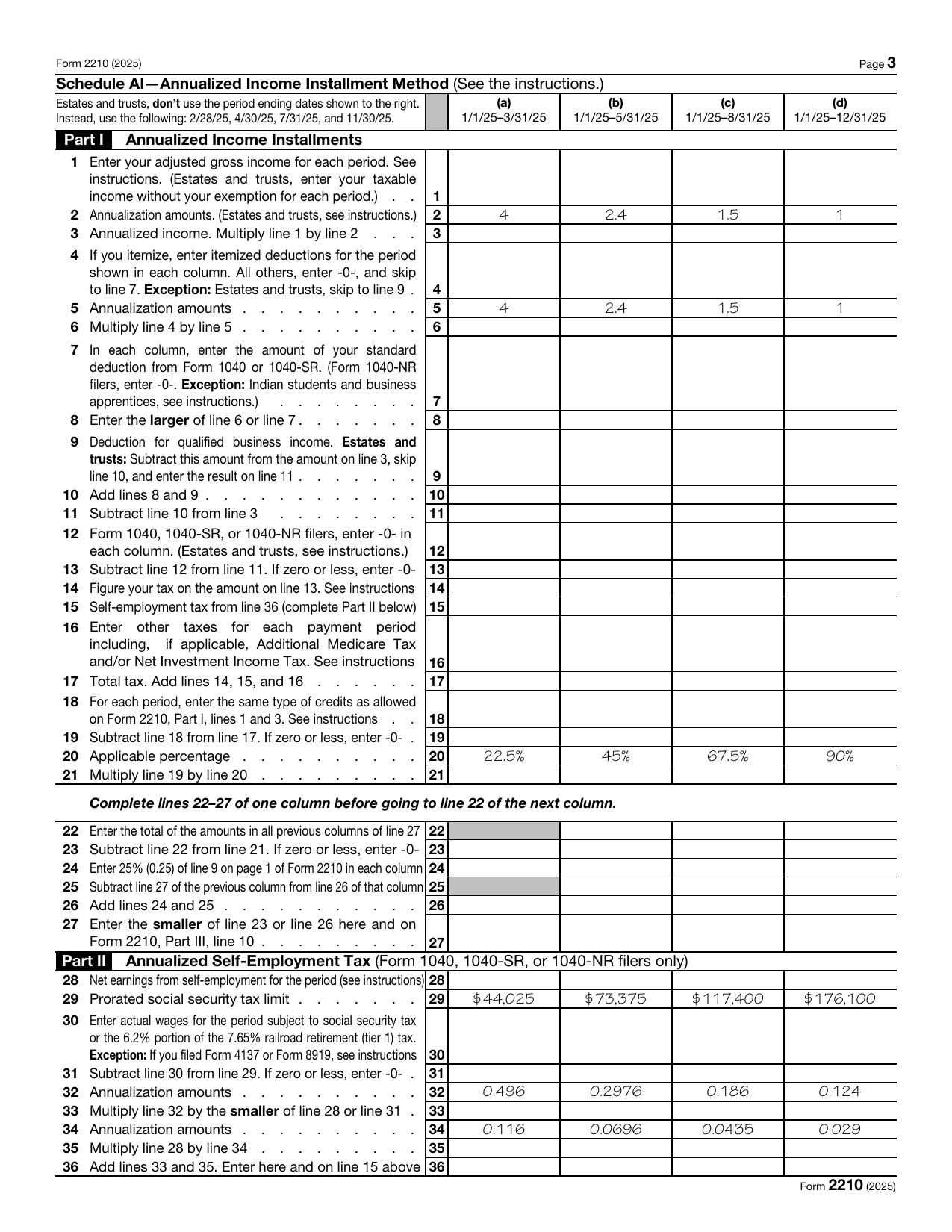
Schedule AI columns Four periods that each start on January 1
Each column covers the year so far: through March 31, May 31, August 31 and December 31. Every column includes everything from the earlier ones. You only fill in Schedule AI if you checked box C.
ExampleMaya earned steadily, so she'd skip this page. The examples below show what it would look like if her income had come late.
Lines 1 to 3 Your income so far, scaled up to a full year
Line 1 is your adjusted gross income for each period (after the deduction for half your self-employment tax). Line 2 multiplies it by 4, 2.4, 1.5 and 1, which turns three months of income into a full year's worth, five months into a year, and so on. Line 3 is the result.
ExampleSay Maya's adjusted gross income through March 31 was only $8,000. Column (a), line 3: $8,000 × 4 = $32,000 a year, far less than her real $67,680.
Lines 4 to 8 Deductions for each period
If you itemize, you enter what you'd paid so far and scale it up the same way. Everyone else enters 0 on line 4 and puts the full standard deduction on line 7 in each column. Line 8 is the larger of the two.
ExampleMaya doesn't itemize, so line 8 is her full standard deduction in every column.
Lines 9 to 13 Annualized taxable income
Line 9 is the qualified business income deduction for each period, figured the way Form 8995 does it. Line 13 is your annualized income minus your deductions: the taxable income you'd have if you kept earning at that pace all year. Individuals enter 0 on line 12.
ExampleFor Maya's slow first quarter, column (a) would show a much smaller taxable income than her real one.
Lines 14 to 17 Tax on that income
Line 14 is income tax on line 13, using the normal tax tables. Line 15 is self-employment tax from Part II below. Line 16 is other taxes for the period, such as the Additional Medicare Tax. Line 17 adds them up.
ExampleLower annualized income in column (a) means lower tax there too.
Lines 18 to 21 How much of it was due so far
Line 18 subtracts credits for each period. Line 20 is the share of the year's tax that was due by each date: 22.5%, 45%, 67.5% and 90%. Those are just the 90% safe harbor split into quarters. Line 21 multiplies the two.
ExampleIf Maya's annualized tax in column (a) were $5,000, line 21 would be $5,000 × 22.5% = $1,125, instead of the regular $3,000.
Lines 22 to 27 Your installment for each due date
Line 24 is the regular installment, a quarter of line 9 on page 1. The schedule compares it with the annualized amount and keeps the smaller one on line 27. Anything a smaller installment saves you is added back in later columns, so the year still adds up to the full amount. Line 27 goes to Part III, line 10.
ExampleMaya's line 24 is $3,000 in every column. With the slow first quarter above, line 27 in column (a) would be $1,125.
Lines 28 to 31 Self-employment earnings so far
Line 28 is your business profit for each period times 92.35%, the same step as Schedule SE. Line 29 is the Social Security wage base, split by period: $176,100 for the full year on the 2025 form ($184,500 for 2026). Line 30 is any W-2 wages that already used part of it, and line 31 is what's left.
ExampleIf Maya's profit through March 31 were $8,000, line 28 in column (a) would be $8,000 × 92.35% = $7,388.
Lines 32 to 36 Annualized self-employment tax
The printed amounts combine the 12.4% Social Security rate and the 2.9% Medicare rate with each period's scaling factor (0.496 is 12.4% × 4). Line 33 is the Social Security part, line 35 the Medicare part, and line 36 adds them and goes to line 15 above.
ExampleColumn (a) for Maya: $7,388 × 0.496 = $3,664 plus $7,388 × 0.116 = $857, so $4,521 of annualized self-employment tax.
Who owes the penalty, and who doesn’t
The IRS wants tax paid as you earn it. An employer does that through withholding. When you work for yourself, you do it with quarterly estimated tax payments, and the penalty is what the IRS charges when those payments come up short.
You won’t owe it if any one of these is true:
- You owe less than $1,000 when you file, after subtracting withholding and credits.
- You paid at least 90% of this year’s tax on time, spread across the four due dates.
- You paid at least 100% of last year’s total tax on time, or 110% if last year’s adjusted gross incomeYour total income minus a few specific deductions, like half your self-employment tax. Many limits and credits are based on it. was over $150,000 ($75,000 if married filing separately).
- You owed no tax last year, and last year was a full 12 months as a U.S. citizen or resident. That covers a lot of people in their first year self-employed.
The third one is the safe harbor most people lean on. You already know last year’s tax on day one, so you can pay it in four equal pieces and be covered against the penalty, even if this year turns out much bigger. (You’d still owe the rest of the tax when you file.)
How the penalty is calculated
The IRS looks at each of the four payments on its own. For each one, it takes the amount you were short, applies the interest rate, and counts the days until you paid it, stopping at the April filing deadline. That’s why paying late is much cheaper than not paying at all.
The rate is the federal short-term rate plus 3 percentage points, and the IRS resets it every quarter. For October through December 2026 it’s 7% a year. Here’s what that means in dollars.
At 7% a year, 2026
What a short payment really costs
Rough figures: shortfall × 7% × time late. The IRS works it out to the day and uses each quarter’s rate, which can change in 2027.
Here’s how that plays out on Form 2210 for Maya. Her required annual payment is $12,000, the smaller of 90% of her 2026 tax ($13,494) and her 2025 tax ($12,000), so $3,000 was due on each date. She paid April and June, then nothing.
| Due date | Required (line 10) | Paid (line 11) | Short (line 17) |
|---|---|---|---|
| April 15, 2026 | $3,000 | $3,000 | $0 |
| June 15, 2026 | $3,000 | $3,000 | $0 |
| September 15, 2026 | $3,000 | $0 | $3,000 |
| January 15, 2027 | $3,000 | $0 | $3,000 |
If she pays everything with her return on April 15, 2027, the September shortfall is 212 days late and the January one 90 days. At 7%, that’s about $122 plus $52, or roughly $174. The exact amount depends on the rates the IRS sets for early 2027. Had she caught up on October 15 instead, the September part would have cost about $17. The IRS penalty calculator works this out for any short payment, to the day.
So the penalty itself rarely hurts. What hurts is the April bill that comes with it: skip all four payments and you owe the full $12,000 at once, plus the $560. That’s the real reason to pay as you go.
How to avoid it next year
This takes about ten minutes once a year. Here’s what most people in your spot do:
- Find last year’s total tax on line 24 of your Form 1040. That’s your total tax, not what you owed in April.
- Divide it by four. Use 110% of it first if last year’s adjusted gross income was over $150,000.
- Pay that amount on each due date: April 15, June 15 and September 15, then January 15 of the next year. Here are all the quarterly tax dates.
- Keep setting aside 25 to 30% of every payment you receive, so the April balance is waiting for you. Here’s how much to set aside.
Say last year’s total tax was $9,000. You pay $2,250 on each due date. If this year you end up owing $15,000, you pay the other $6,000 in April with no penalty. Our quarterly tax calculator does this math for you.
Income lands late in the year? If a big contract only paid in November, the annualized income installment methodA way to figure each estimated tax payment from what you actually earned by then, so income that arrives late in the year doesn't cause a penalty for earlier quarters. Claimed on Form 2210, Schedule AI. on Form 2210 can shrink or erase the penalty for the earlier quarters. Tax software can do it, but you have to choose that option.
You or your spouse also have a W-2The form an employer sends each January showing your wages and the tax withheld. As an S-corp owner, your own company sends you one. job? Withholding counts as if it were paid evenly through the year, even if it comes out of a December paycheck. So raising your withholding late in the year can fix quarters you missed earlier.
Missed a payment? What to do now
Don’t wait for the next deadline. The sooner you pay, the less it costs.
- Pay the missed amount now, separately, through IRS Direct Pay or your IRS online account. Choose “estimated tax” and the right tax year. The penalty stops growing for that quarter once it’s paid.
- Make the next payment on time as usual. Catching up on one quarter doesn’t cover the next.
- You can skip the January payment only if you file your 2026 return and pay everything you owe by February 1, 2027.
- At tax time, let your software figure it. You usually don’t have to file Form 2210 yourself. If you leave it off, the IRS works out the penalty and mails you a bill.
You do need Form 2210 if you’re asking for a waiver, using the annualized method, or counting withholding on the dates it was actually taken. Good tax software walks you through all three. Here’s the tax software we’d use.
Can the penalty be waived?
Sometimes, but it’s harder than with other IRS penalties. The IRS says this one generally can’t be waived for reasonable cause, and first-time penalty reliefIRS relief that removes a failure-to-file, failure-to-pay or failure-to-deposit penalty for one tax year, if you had no penalties in the three years before and have filed every required return. doesn’t cover it. It may be removed or reduced if:
- A casualty, disaster or other unusual event caused the underpayment and charging it wouldn’t be fair.
- You (or your spouse, on a joint return) retired after age 62 or became disabled in the tax year or the year before, and the shortfall had a reasonable cause.
To ask, check the waiver box in Part II of Form 2210 and attach a signed explanation. If you already have a bill, send the explanation to the address on the notice.
The other two penalties: filing late and paying late
The estimated tax penalty is the mildest of the three. Here’s how they compare.
| Penalty | What triggers it | What it costs |
|---|---|---|
| Underpayment of estimated tax | Quarterly payments too small or late | 7% a year on the shortfall (late 2026), until you pay or April 15 |
| Failure to pay | Tax still unpaid after April 15 | 0.5% of the unpaid tax per month, up to 25%, plus interest |
| Failure to file | Return filed after the deadline (or extension) | 5% of the unpaid tax per month, up to 25%. More than 60 days late: at least $535 or 100% of the tax owed, whichever is less (2026 returns, due in 2027) |
Notice how much bigger the late-filing penalty is. If you can’t pay in April, file on time anyway and set up a payment plan. If it’s the paperwork that isn’t ready, a free Form 4868 extension gives you until October 15 to file, though not to pay. Here’s what to do on filing day.
FAQ
Is the estimated tax penalty deductible?
No. Penalties paid to the IRS aren’t a business expense, so you can’t write them off.
Do I owe a penalty in my first year self-employed?
Not if you owed no tax at all last year and it was a full 12-month year as a U.S. citizen or resident. You still owe this year’s tax in April, so keep setting money aside. More on first year self-employed taxes.
I paid late but in full. Do I still owe something?
Usually a small amount for the days you were late, unless one of the exceptions above applies.
Will the IRS send me a bill?
If your return doesn’t include the penalty, the IRS figures it and mails a notice, such as a CP30. Pay by the date on the notice so interest doesn’t build on top of it.
Do I have to file Form 2210?
Usually not. If none of the boxes in Part II apply, you can leave it off and the IRS will figure the penalty and bill you, or your tax software can put the penalty on your return for you. You must file it to ask for a waiver, use the annualized income method, or count withholding on the dates it was taken. See the flowchart in the decoder above.
Does my state charge one too?
Most states with an income tax have their own quarterly payments and their own underpayment penalty. The rules don’t always match the IRS’s: Illinois, for example, never raises its prior-year safe harbor to 110% for higher earners. Our guides to Illinois, Pennsylvania, Ohio, Georgia, North Carolina and New Jersey walk through those states’ rules. For anywhere else, check your state revenue department’s website.
Sources
- IRS: Underpayment of estimated tax by individuals penalty
- IRS: Instructions for Form 2210
- IRS: 2025 Form 2210 (PDF)
- IRS: Interest rates remain the same for the fourth quarter of 2026
- IRS: Failure to file penalty
- IRS: Failure to pay penalty
- IRS: Estimated taxes
General education, not tax advice. Rates and dates are for the 2026 tax year; line numbers are from the 2025 Form 2210.