The short answer
Your return went in, the refund was on its way, and then a letter from the IRS arrives with CP30 in the corner. It says you’ve been charged a penalty, and the refund is smaller than you expected. It feels like you did something wrong, but it’s more ordinary than that.
A CP30 notice means the IRS charged you the estimated taxTax you send the IRS yourself during the year, usually four times, because no employer is withholding it from a paycheck. penalty because you didn’t pay enough tax during the year, or paid it late. If the penalty only reduced your refund, the IRS says you don’t have to do anything. If it left a balance, pay it by the due date on the notice. And if your income came in unevenly, Form 2210The IRS form that figures the penalty for paying too little estimated tax during the year. Tax software fills it in for you. may shrink the penalty.
How worried to be
It's a penalty that's already worked out, not an audit. If it only shrank your refund, the IRS says there's nothing to do. If it left a balance, pay by the due date on the notice.
Reply needed?
The IRS's CP30 page: if you're owed a refund or have no balance, you don't have to do anything. If the notice shows a balance due, pay it by the due date printed on the notice. To ask for a smaller penalty, the notice says to send Form 2210.
CP30, decoded: tap any part of the letter
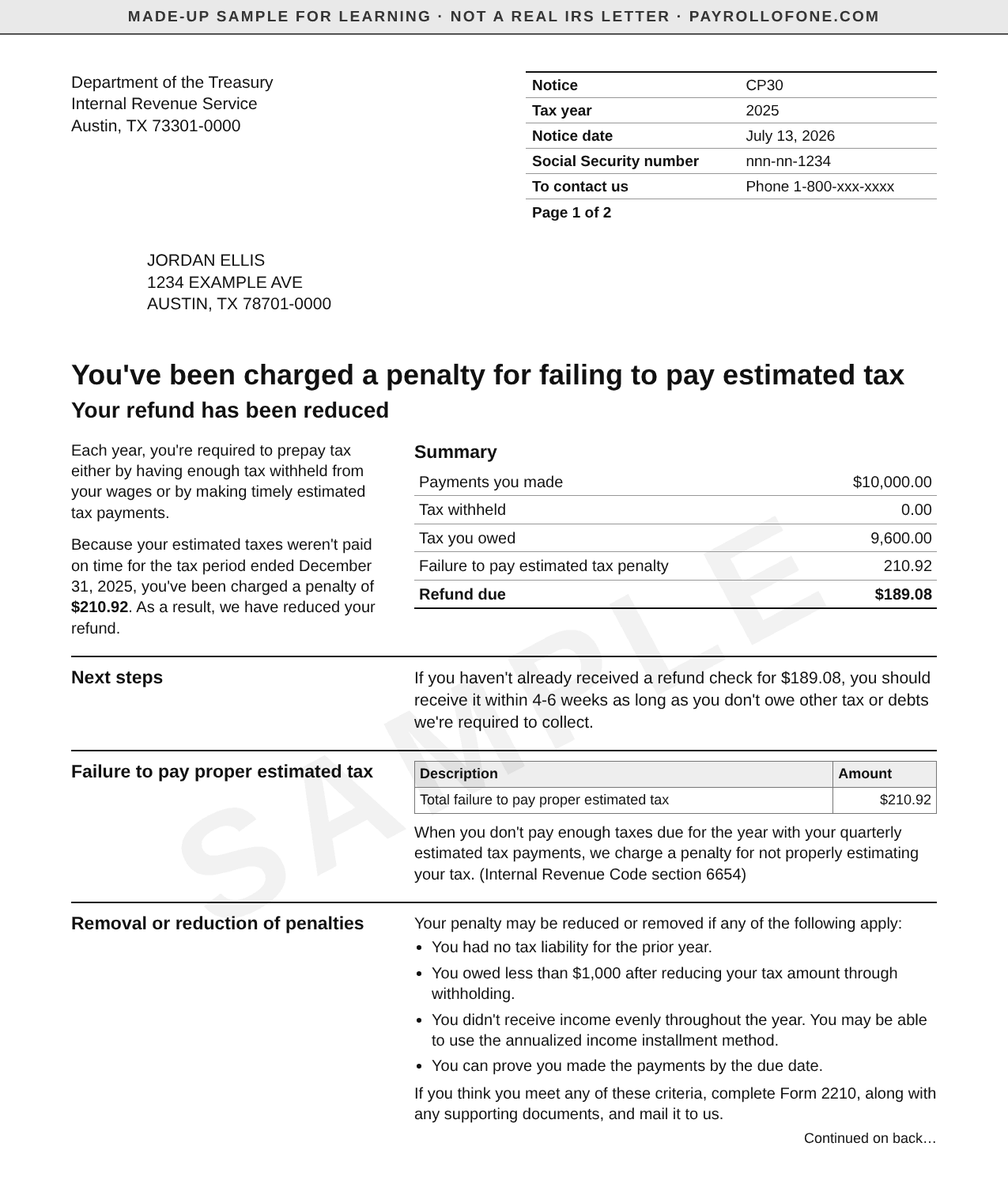
The IRS no longer shows sample letters on its notice pages, so we rebuilt this one from its older official sample, with made-up details. It’s the version that reduced a refund. Yours will have different numbers but the same parts in about the same places.
Tap any part of the letterHover over any part of the letter to see what it means. Click a part to pin its note open so you can use the links. to see what it means. Our made-up example: Jordan Ellis, a freelance photographer, paid all of 2025's tax in one payment on January 15, 2026.
Swipe sideways to see the whole letter.
Every part, in plain English
Notice The notice code
CP30 means the IRS charged you the estimated tax penalty: you didn't pay enough tax during the year, through withholding or quarterly estimated payments, or you paid it late. If the penalty isn't figured on your return, the IRS works it out and tells you with a notice like this.
ExampleType CP30 into our lookup and you land on this page.
Tax year The year the payments were short
The year whose estimated payments were late or too small. It arrives after the IRS processes that year's return.
ExampleJordan's notice is about 2025, the return filed in April 2026.
Notice date When the notice was sent
A CP30 that reduced your refund has no reply date. If yours shows a balance due instead, it prints a date to pay by, and interest grows on anything unpaid after that.
ExampleJordan's notice is dated July 13, 2026.
Good to knowKeep the notice with that year's return. If you ask the IRS to reduce the penalty, you'll refer to it.
To contact us The number to call if it looks wrong
Call if the penalty doesn't match your records, for example if you made a payment on time that the IRS doesn't show.
ExampleIf Jordan had a bank record of a September payment, a call with that record in hand would be the start.
Good to knowThe notice says proof such as cancelled checks showing you paid by the due date can get the penalty reduced or removed.
Headline A penalty for paying tax late
This isn't an audit or a fine for a mistake on your return. The law asks you to pay tax through the year as you earn. When that doesn't happen, the penalty works like interest on the amount that was short, for the days it was late.
ExampleJordan was charged $210.92 for 2025.
Refund reduced Which version you have
This version took the penalty out of your refund. The IRS's CP30 page says that if you're owed a refund, or have no balance, you don't have to do anything. If your CP30 says you owe instead, it's a bill: pay by the due date on the notice.
ExampleJordan expected a $400 refund and will get $189.08.
Good to knowOwe and can't pay it all? The IRS points to its payment options, including payment plans.
Why you got it The rule in two sentences
Each year you have to prepay your tax, through withholding from wages or estimated payments made on time. Freelancers have no paycheck withholding, so the four quarterly payments are how they prepay.
ExampleJordan made no payments for 2025 until one $10,000 payment on January 15, 2026. That covered the whole year's tax, but the April, June and September installments were late.
Good to knowPaying it all at the end doesn't avoid the penalty. Each quarter is measured on its own.
Payments What you paid in
Your estimated tax payments for the year, then tax withheld from wages. Estimated payments count on the day you make them. Withholding counts as paid evenly through the year, even if it came out late.
ExampleJordan's one $10,000 estimated payment, and no withholding.
Tax you owed Your total tax for the year
The total tax on your return, including self-employment tax. The penalty is measured against a safe harbor: generally 90% of this year's tax or 100% of last year's, whichever is less (110% of last year's if last year's AGI was over $150,000).
ExampleJordan's 2025 tax was $9,600 and 2024's was $7,200, so $1,800 paid by each of the four due dates would have avoided the penalty.
Penalty Failure to pay estimated tax penalty
Figured like simple interest: the IRS's underpayment rate on each installment that was short, for each day it was late. The rate was 7% a year all through 2025 and in early 2026.
Example$1,800 late 275 days, $1,800 late 214 days and $1,800 late 122 days, all at 7%: $94.93 + $73.87 + $42.12 = $210.92.
Good to knowOwe less than $1,000 when you file and there's generally no penalty at all.
Refund due What you'll get back now
Your payments minus your tax and the penalty. If this line shows an amount you owe instead, the notice is a bill with a due date.
Example$10,000 − $9,600 − $210.92 = $189.08.
Next steps When the refund arrives
The IRS says a refund should arrive within 4 to 6 weeks, as long as you don't owe other tax or debts it's required to collect.
ExampleJordan's $189.08 should arrive by late August 2026.
The penalty Where the penalty comes from
The penalty for not paying enough estimated tax is set by Internal Revenue Code section 6654. It's separate from the penalties for filing late and paying late, and it can apply even when your return was on time and fully paid.
ExampleJordan filed on time and paid in full, and still owes this penalty because the payments came late.
Reduce it How to have it reduced or removed
The notice lists the main reasons: no tax liability last year, owing less than $1,000 after withholding, income that came in unevenly (the annualized income installment method), or proof you paid on time. If one applies, you complete Form 2210 with any supporting documents and mail it to the IRS.
ExampleIf most of Jordan's 2025 income had come in after September, the annualized method on Form 2210 could shrink the penalty.
Good to knowUnlike the penalties for filing or paying late, this one generally can't be removed just because you had a good reason. The IRS lists narrow exceptions: a casualty, disaster or other unusual circumstance, or retiring after 62 or becoming disabled with a good reason.
Why you got a CP30
The IRS treats taxes as pay-as-you-go: you’re expected to pay most of your tax during the year, as you earn it. Employees do that through withholding. Freelancers do it with four quarterly estimated payments, and a CP30 is what happens when those payments come up short or late.
The surprise for many people is that paying everything by the end doesn’t fix it. Each quarter is measured on its own. Here’s how that played out for Jordan in our sample, who owed $1,800 a quarter under the safe harborA payment amount that protects you from IRS underpayment penalties, such as paying 100% of last year’s tax (110% if your AGI was over $150,000). and paid nothing until one $10,000 payment on January 15, 2026.
| Installment | Due | Short by | Days late | Penalty at 7% |
|---|---|---|---|---|
| 1st | April 15, 2025 | $1,800 | 275 | $94.93 |
| 2nd | June 15, 2025 | $1,800 | 214 | $73.87 |
| 3rd | September 15, 2025 | $1,800 | 122 | $42.12 |
| 4th | January 15, 2026 | $0 | 0 | $0 |
| Total | $210.92 |
The penalty works like simple interest: the IRS’s underpayment rate, 7% a year through 2025, on each amount that was short, for each day it was late. If the penalty isn’t figured on your return, the IRS works it out and sends a notice like this one. Here’s how the estimated tax penalty works in full.
What to do, in the IRS’s order
CP30s come in two versions, and the headline tells you which one you have. Here’s what the IRS says to do with each.
| “Your refund has been reduced” or no balance | “You owe” a balance | |
|---|---|---|
| Do you need to reply? | No. The IRS says you don’t have to do anything | No reply, but you need to pay |
| Deadline | None | The due date printed on the notice |
| What happens next | The smaller refund arrives, usually within 4 to 6 weeks | Interest builds on anything unpaid after the due date |
| Can’t pay it all? | Not an issue | Pay what you can and set up a payment plan |
Either way, check the penalty against your records first. If you made a payment on time that the IRS doesn’t show, call the number on the notice with the bank record. Here’s what most people in your spot do with a CP30: read it once, check the payment dates, and file it with that year’s return. If you owe and can’t pay it all, here’s what to do if you can’t pay the IRS.
Can you get the penalty reduced?
Sometimes. The notice lists the main reasons the IRS will reduce or remove it, and the way to ask is Form 2210, mailed with any supporting documents.
- Your income came in unevenly. The annualized income installment methodA way to figure each estimated tax payment from what you actually earned by then, so income that arrives late in the year doesn't cause a penalty for earlier quarters. Claimed on Form 2210, Schedule AI. on Form 2210 matches each payment to what you’d actually earned by then. It can help freelancers whose income was heavier late in the year.
- You had no tax liability last year. The notice lists this as a reason to remove it.
- You owed less than $1,000 after withholding. Below that, there’s generally no penalty.
- You paid on time and can prove it. Cancelled checks or bank records showing the payment dates.
- A casualty, disaster or other unusual circumstance, or you retired after 62 or became disabled and had a good reason. The IRS asks for a signed explanation.
What usually doesn’t work is a good reason on its own. Unlike the penalties for filing or paying late, the IRS says this one generally can’t be waived for reasonable cause. Our Form 2210 decoder walks through the form line by line.
How to avoid a CP30 next year
The fix is a safe harbor: pay at least the smaller of 90% of this year’s tax or 100% of last year’s (110% if last year’s AGIAdjusted gross income: your total income minus a few specific deductions, like half your self-employment tax. Many limits and credits are based on it. was over $150,000), spread over the four due dates. Last year’s number is the easy one, because you already know it.
Say Jordan’s 2025 tax was $9,600. Paying $2,400 by each of the 2026 due dates covers the safe harbor, however much Jordan earns this year. Here’s how quarterly estimated taxes work, and here are the due dates for 2026 and 2027.
FAQ
Do I need to respond to a CP30?
Not if it reduced your refund or you have no balance. The IRS says you don’t have to do anything. If it shows a balance due, pay by the date on the notice, and if you think the penalty is wrong, call or send Form 2210.
Why was I charged a penalty if I paid all my tax?
Because the penalty is about timing, not the total. Payments are due through the year, and paying in January or April doesn’t cover the months the earlier installments were late.
Is a CP30 an audit?
No. It’s an automatic penalty notice based on your return and your payment dates. Nobody is examining your books.
How is the estimated tax penalty calculated?
At the IRS’s underpayment interest rate, 7% a year for all of 2025, on each quarterly amount that was short, for the number of days it stayed unpaid.
When will I get the rest of my refund?
The IRS says within 4 to 6 weeks, as long as you don’t owe other tax or debts it’s required to collect. You can track it with Where’s My Refund.
Can a CP30 be wrong?
Yes. A payment applied to the wrong year or missing from the IRS’s records changes the math. Compare the notice with your own payment dates, and call with proof if they don’t match. Our IRS letter decoder explains other codes too.
Sources
- IRS: Understanding your CP30 notice
- IRS: Underpayment of estimated tax by individuals penalty
- IRS: Instructions for Form 2210 (2025) (PDF)
- IRS: About Form 2210
- IRS: Quarterly interest rates
The letter above is a made-up sample for learning, laid out like the IRS’s own CP30. It isn’t a real notice and nothing on this page reads or answers yours. The penalty uses the IRS’s 7% underpayment rate for 2025 and early 2026. General education, not tax advice.