The short answer
You open the mailbox and there’s an envelope from the IRS. Inside, the top corner says CP2000, and the page says you owe more for a year you thought was done. Take a breath before you do anything.
A CP2000 notice means the income the IRS has on file from your clients, employers and banks doesn’t match what’s on your return. It’s a proposal, not a bill: you reply by the date on the notice, usually 30 days from the notice date, and either agree or explain why the IRS is wrong. For freelancers, it’s often a 1099 that didn’t match your Schedule CThe tax form where you report your business income and expenses. Its bottom line is your profit., and sometimes the IRS is the one that’s off.
How worried to be
It's a proposal, not a bill, and it can be wrong. But it has a reply date, and if nobody answers, it turns into a bill.
When your reply is due
The IRS's usual window is 30 days from the notice date. Enter the date to see yours.
IRS Tax Topic 652: respond within 30 days of the notice date, or 60 days if you live outside the United States. You can ask the IRS for more time.
CP2000, decoded: tap any part of the letter
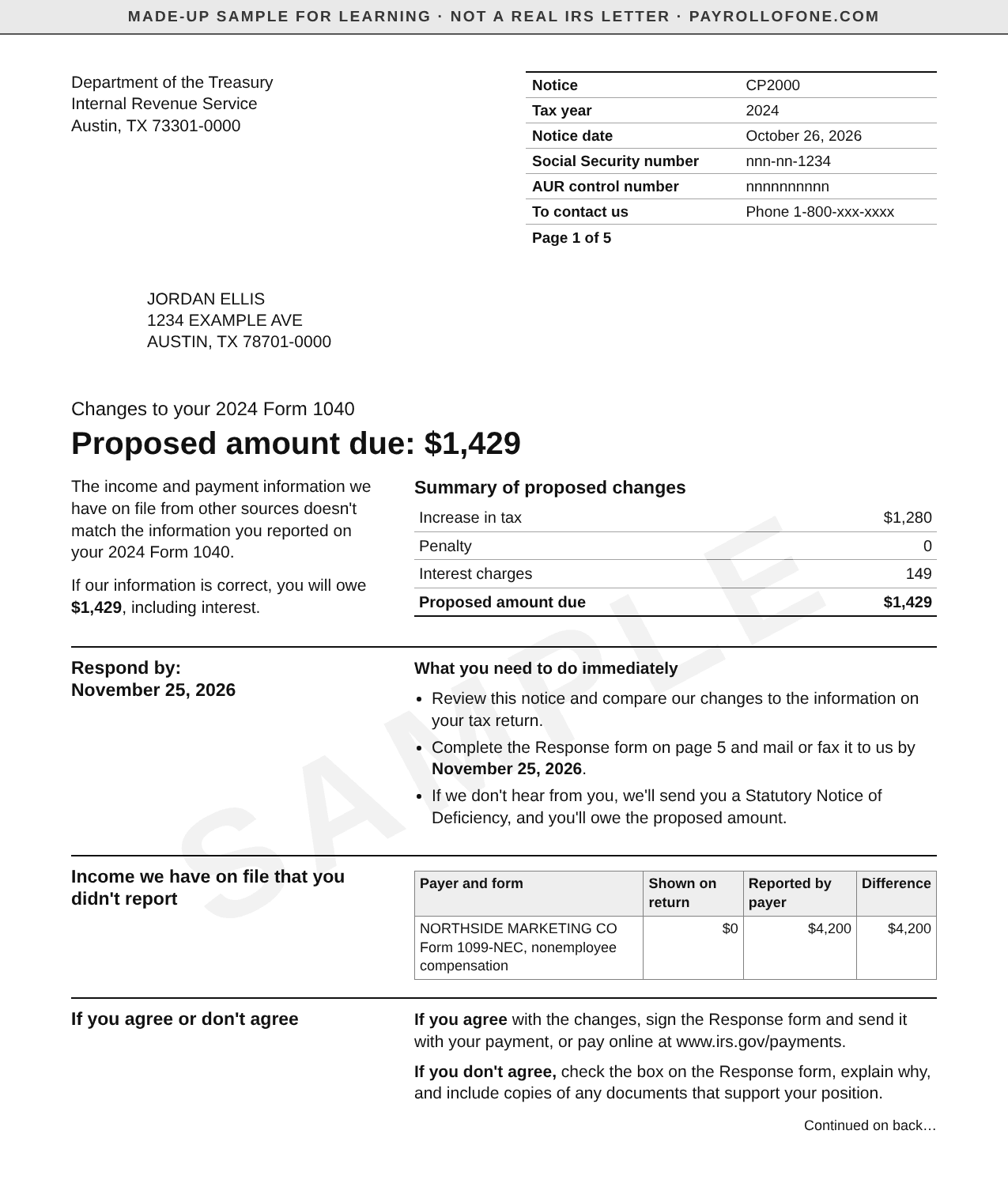
The IRS no longer shows sample letters on its notice pages, so we rebuilt this one from its older official samples, with made-up details. Every part has a plain-English note. Yours will have different numbers but the same parts in about the same places.
Tap any part of the letterHover over any part of the letter to see what it means. Click a part to pin its note open so you can use the links. to see what it means. Our made-up example: Jordan Ellis, a freelance photographer, left a $4,200 client payment off a 2024 return.
Swipe sideways to see the whole letter.
Every part, in plain English
Top left Which IRS office sent it
The IRS campus that's handling your case. It matters more than it looks: if you reply by mail, you send your answer to this address, and if you fax, you use the fax number for this location.
ExampleJordan's letter came from Austin, Texas, so a faxed reply goes to the Austin number the IRS lists for CP2000 replies.
Good to knowThe fastest way to reply is the IRS Document Upload Tool, using the access code printed on your notice or listed on the IRS's CP2000 page.
Notice The notice code
CP2000 is the code for an automated underreporter notice: the IRS's computer matched the forms other people sent in about you against your return and found a difference. The series also includes CP2000A through CP2000E, and the IRS gives the same instructions for all of them.
ExampleType CP2000 into our lookup or the IRS's notice search and you land on the right instructions.
Tax year Which return it's about
The year of the return the IRS is questioning. CP2000s often arrive a year or more after you file, so this is usually not the return you filed most recently.
ExampleJordan's letter is about the 2024 return, filed in April 2025.
Good to knowPull out your copy of that year's return and the forms you used for it before you read any further.
Notice date The date that starts the clock
Your reply window counts from this date, not from the day the letter reached your mailbox. The IRS also figures the interest on the notice up to 30 days after this date.
ExampleJordan's notice is dated October 26, 2026, so 30 days later is November 25, 2026.
Good to knowEnter this date in the box above the letter to see your own 30-day date.
Your number Social Security number
The IRS prints your taxpayer ID on the notice. Our sample hides it. A real letter that gets your name or number wrong is worth a call to the IRS before you do anything else.
Good to knowNot sure a letter is real? The IRS says it starts contact by mail, never by email, text or social media. Call the IRS at a number listed on irs.gov, not one you only found in the letter, or look for the notice in your IRS Online Account.
To contact us The phone number for your case
The number for the team handling CP2000s. Call it if something in the notice doesn't make sense, or to ask for more time to gather your records.
ExampleJordan wants a few extra weeks to find a deposit record, so a call to this number (or a written request) asks for an extension.
Good to knowHave the notice and your return in front of you when you call.
Headline Proposed amount due
The word that matters is "proposed." A CP2000 isn't a bill. The IRS is proposing a change to your return and asking whether you agree. The change can also lower your tax or leave it the same.
ExampleThe IRS proposes that Jordan owes $1,429 more for 2024.
Why you got it The mismatch, in one sentence
Employers, clients, banks and payment apps send the IRS a copy of every W-2, 1099 and 1098 they give you. The IRS's matching program compares those with your return. When the totals don't line up, a tax examiner reviews it and sends this notice.
ExampleA client sent the IRS a 1099-NEC for $4,200, and that $4,200 isn't on Jordan's return.
Good to knowFor freelancers, the most common cause is a 1099 total that doesn't match the gross receipts on Schedule C, even when the money was reported.
Summary How the amount adds up
The extra tax from the change, plus interest from the return's due date to 30 days after the notice date. Some penalties can apply and may not be shown here. For self-employment income, the increase includes self-employment tax as well as income tax.
ExampleOn Jordan's $4,200: about $593 of self-employment tax and $687 of income tax, so $1,280 more tax, plus $149 of interest.
Good to knowPaying the proposed amount within 30 days stops more interest from building up.
Respond by Your reply date
The IRS asks for a reply within 30 days of the notice date, or 60 days if you live outside the United States. Your notice prints the exact date. If you need more time, you can ask for an extension.
ExampleJordan's date is November 25, 2026.
Good to knowAgreeing still needs a reply: you sign the response form either way.
What to do What you need to do immediately
Read the whole notice, compare it with your return, then fill in the response form at the back: agree, partly agree or disagree. Send it by the IRS Document Upload Tool, fax or mail. If the IRS hears nothing, it sends a Statutory Notice of Deficiency, the formal step before it bills you.
ExampleJordan checks the $4,200 against bank deposits and Schedule C before deciding which box to check.
Good to knowYou don't need to file an amended return if you agree and have nothing else to add. The IRS makes the change for you.
The details Who reported what
The heart of the notice: each payer, the form they filed, what your return showed and what they reported. Check every line against your own records. A payer can make a mistake, and so can a return.
ExampleNorthside Marketing reported $4,200 on a 1099-NEC. If that $4,200 was already counted in Jordan's Schedule C gross receipts, Jordan can disagree and send a statement with the records that show it.
Good to knowIf you find the same mistake on another year's return, the IRS suggests amending that year too.
Agree or not Your two answers
If you agree, sign the response form and pay, or set up a payment plan and still send the form. If you disagree with some or all of it, check that box, explain why in a signed statement and include copies of documents that back you up. If the notice is right but you also have expenses or credits you missed, the IRS says to send a Form 1040-X with "CP2000" written at the top.
ExampleIf Jordan agrees, it's a signature and a $1,429 payment. If Jordan finds the $4,200 was already reported, it's a short statement and copies of records.
Good to knowCan't pay it all at once? A payment plan is an option, and you still return the response form by the date.
Why freelancers get a CP2000
Every business client who pays you $2,000 or more in 2026 (it was $600 through 2025) sends the IRS a copy of your 1099-NECThe form a client sends you (and the IRS) showing what they paid you. Required for payments of $2,000 or more in 2026., and payment apps send 1099-Ks. The IRS’s matching program adds those up and compares them with your return. Here are the mismatches that trip up one-person businesses most often.
- A client you forgot. A small job early in the year that never made it into your books.
- Your totals are right but don’t line up. You reported every dollar on Schedule C, but the 1099s add up to a different number than your gross receiptsAll the money your business took in during the year, before subtracting any expenses., for example because a client counted a January payment in the wrong year.
- The same money reported twice. A client paid you through a payment app, and both the client and the app sent a form for it.
- Bank interest. A 1099-INT from a high-yield savings account that holds your tax money.
- A wrong form. A payer typed the wrong amount or the wrong taxpayer ID.
The second and third are why a CP2000 isn’t always bad news. If the money was already on your return, you can disagree and show where it is. Here’s how the 1099-NEC and 1099-K work.
What to do, in the IRS’s order
The IRS’s own instructions boil down to five steps. None of them is hard, but the order matters.
- Read the whole notice. The payer table near the front shows exactly which form caused the change.
- Compare it with your return and your records. Look at the return for the tax year printed on the notice, your Schedule C, your bank deposits and the 1099s you received.
- Decide: agree, partly agree or disagree. Check the matching box on the response form.
- Reply by the date on the notice. Use the IRS Document Upload Tool, fax or mail. Include a signed statement and copies of documents if you disagree.
- Pay what you agree you owe, or set up a payment plan. Interest keeps building until it’s paid.
Here’s what most people in your spot do with a CP2000: lay the payer table next to your own income records before deciding anything. Clean books make this a ten-minute job. Here’s a bookkeeping routine that takes 15 minutes a month.
If you agree, and if you don’t
Here’s how the two answers compare.
| If you agree | If you don’t agree | |
|---|---|---|
| On the response form | Check “agree,” sign and date it | Check “disagree” (or partly), sign and date it |
| What to include | Your payment, or Form 9465 if you want a payment plan | A signed statement saying why, plus copies of records that support it |
| Amended return? | Not needed, unless you also have expenses or credits to add (then a Form 1040-X marked “CP2000”) | Not needed |
| What happens next | The IRS adjusts your return and sends a bill for anything unpaid | The IRS reviews your reply and writes back, sometimes with a revised proposal |
In our made-up example, Jordan agrees and owes $1,429. Paying it within 30 days stops more interest. If Jordan couldn’t pay it all, the response form still goes back by the date, with a payment plan set up separately. Here’s what to do if you can’t pay the IRS.
What happens if you don’t reply
Silence doesn’t make a CP2000 go away. If the IRS doesn’t hear from you by the response date, it sends a Statutory Notice of Deficiency, often a CP3219A. That notice gives you 90 days (150 if it’s addressed to you outside the United States) to take the case to the U.S. Tax Court. After that, the IRS assesses the tax and the billing letters start.
That’s why the CP2000 stage is the cheapest place to sort it out. A short reply now beats a string of bills, each with more interest. Here’s what the first bill, the CP14, looks like.
When to get help
Plenty of people answer a simple CP2000 themselves, especially when they agree. A tax professional earns their fee when the amounts are large, several years are involved, or you disagree and the records are messy. You can let someone talk to the IRS for you by filling in the authorization section of the response form, or with Form 2848.
If you can’t afford help, the Taxpayer Advocate Service and Low Income Taxpayer Clinics are free options the IRS lists on the notice page. Here’s when a tax pro is worth it, and what one costs.
FAQ
Is a CP2000 an audit?
Not in the usual sense. It’s an automated mismatch review done by mail, not an examination of your books. You answer one specific question about specific forms.
How long do I have to respond to a CP2000?
The date is printed on the notice. The IRS says to respond within 30 days of the notice date, or 60 days if you live outside the United States. If you need more time, ask for an extension before the date passes.
Do I have to file an amended return?
No, if you agree and have nothing else to add. The IRS makes the change. If you also have income, expenses or credits to report, send a Form 1040-X with “CP2000” written on top, along with the response form.
Can a CP2000 lower my tax?
Yes. The IRS says the change can increase your tax, decrease it or leave it the same, for example when a payer reported withholding you didn’t claim.
How do I know the letter is really from the IRS?
The IRS starts contact by mail, not by email, text or social media. Check the notice in your IRS Online Account, or call the IRS at a number listed on irs.gov rather than one printed in a letter you’re unsure of. Payment always goes to the United States Treasury.
I already paid. Why is there interest?
Interest runs from the return’s original due date until the extra tax is paid, and the notice figures it to 30 days past the notice date. Paying within those 30 days stops it there.
Will I get a CP2000 every year now?
No. Each notice is about one tax year’s return. Matching your gross receipts to your 1099s before you file is the best way to avoid the next one. Here’s how Schedule C works, line by line.
Sources
- IRS: Understanding your CP2000 series notice
- IRS: Tax Topic 652, Notice of underreported income, CP2000
- IRS: Publication 5181, Tax Return Reviews by Mail (PDF)
- IRS: Publication 594, The IRS Collection Process (PDF)
- IRS: Quarterly interest rates
- IRS: How to know it’s really the IRS
The letter above is a made-up sample for learning, laid out like the IRS’s own CP2000. It isn’t a real notice and nothing on this page reads or answers yours. Interest uses the IRS’s 2026 rates (6% in the second quarter, 7% the rest of the year). General education, not tax advice.