The short answer
It’s January, and an IRS envelope arrives about a tax year you’d rather forget. The corner says CP71, and the headline calls it an annual reminder. Maybe you’re paying the balance off, or maybe it slipped down the list a while ago.
A CP71 notice is the IRS’s yearly reminder that you still owe a balance on an old tax return, with the penalty and interest added so far. If you’re on a payment plan or the IRS has paused collection, you don’t need to do anything. If not, the notice asks you to pay by the date printed on it. It isn’t a new tax, but the balance it shows keeps growing until it’s paid.
How worried to be
It's a yearly reminder of an old balance, not a new tax bill. If you're on a payment plan or the IRS has paused collection, there's nothing to do. Otherwise the balance keeps growing.
When your reply is due
The IRS's usual window is 21 days from the notice date. Enter the date to see yours.
The IRS's CP71 page gives no reply date: it says the balance needs your immediate attention. The notice prints a pay-by date, which was 21 days after the notice date in the IRS's own sample CP71. Paying by then keeps more interest and penalty off.
CP71, decoded: tap any part of the letter
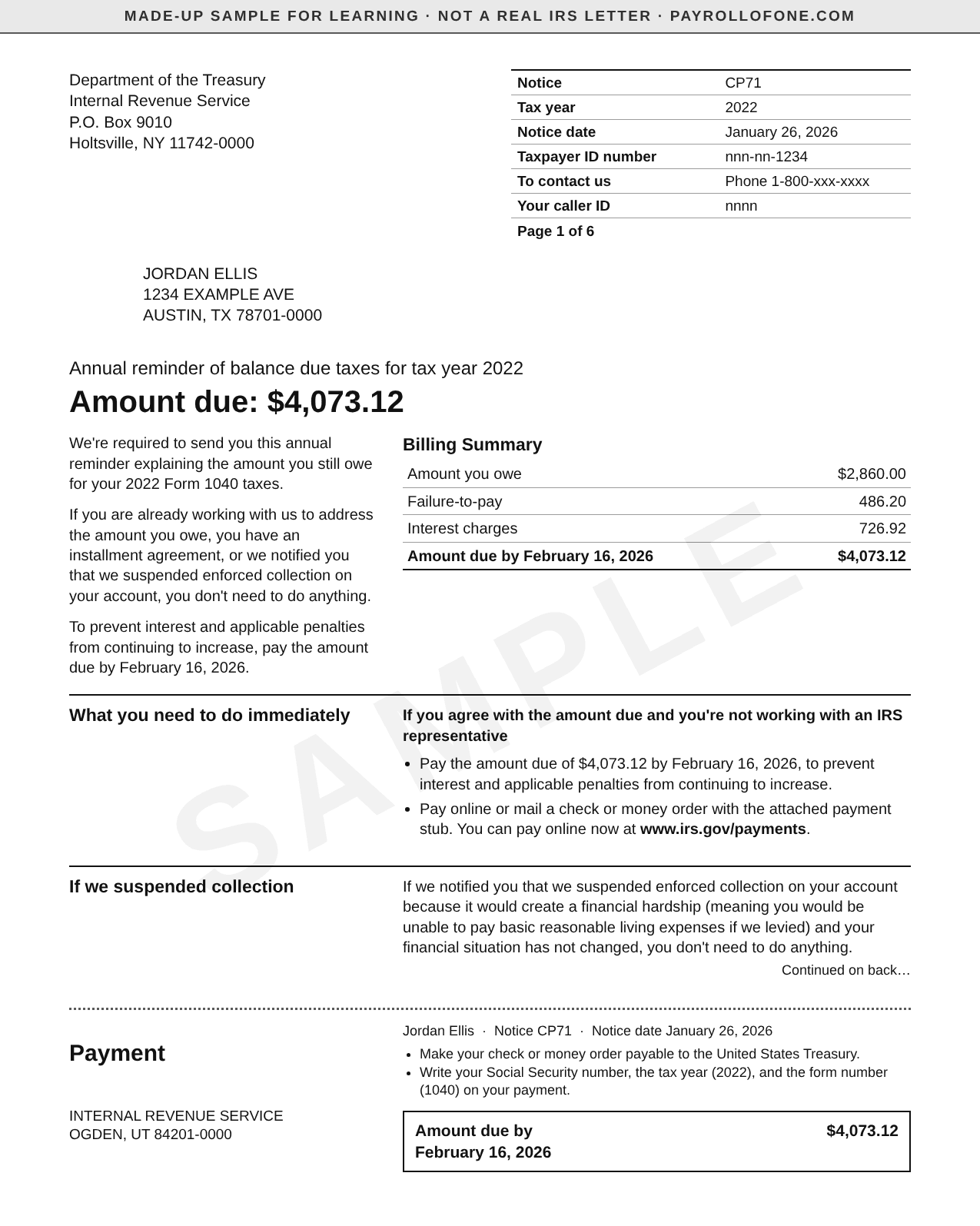
The IRS no longer shows sample letters on its notice pages, so we rebuilt this one from its older official CP71 sample, with made-up details. The versions with a letter after the number, like CP71C, share this first page. Yours will have different numbers but the same parts in about the same places.
Tap any part of the letterHover over any part of the letter to see what it means. Click a part to pin its note open so you can use the links. to see what it means. Our made-up example: Jordan Ellis, a freelance photographer, still owes $2,860 of tax from the 2022 return.
Swipe sideways to see the whole letter.
Every part, in plain English
Notice The notice code
CP71 is the IRS's annual reminder of a balance due. The law requires the IRS to tell you at least once a year how much you owe on a delinquent account. Other versions, CP71A, CP71C, CP71D and CP71H, carry a letter after the number.
ExampleType CP71 or any version, like CP71C, into our lookup and you land on this page.
Good to knowThe article below the letter explains what the IRS says about each version.
Tax year Which return the balance is from
The return the old balance comes from. You get a separate reminder for each year that still has a balance.
ExampleJordan's reminder is for the 2022 return, filed in April 2023.
Good to knowThe IRS's older CP71 sample says the reminders keep coming each year until the balance is paid or the time the IRS has to collect runs out, generally 10 years from when the tax was assessed.
Notice date The date the pay-by date counts from
The pay-by date in the billing summary counts from this date. In the IRS's own sample CP71, it was 21 days later.
ExampleJordan's notice is dated January 26, 2026, and the pay-by date is February 16, 2026.
Good to knowEnter this date in the box above the letter to see the date 21 days later. The date printed on your notice is the one that counts.
To contact us The number to call if it looks wrong
Call this number if you disagree. The IRS's CP71 page says to have your paperwork ready, such as proof you paid or don't owe the tax. The notice says the IRS will assume you agree if you don't contact it.
ExampleIf Jordan had paid the 2022 balance years ago, this is where to start, with the bank record in hand.
Good to knowPayments can take up to 21 days to post. The IRS says that if you paid in full within the last 21 days, you can disregard the reminder.
Annual reminder What "annual reminder" means
The IRS sends this once a year on an account with an unpaid balance. It isn't a new tax. It shows where an old balance stands today, with the penalty and interest added since.
ExampleJordan knew about the 2022 balance. The reminder shows how much it has grown.
Amount due Everything owed for that year
The unpaid tax plus all the penalty and interest added since the return was due. This is the payoff amount if you pay by the date in the billing summary.
Example$4,073.12, about $1,213 more than the tax Jordan left unpaid.
Good to knowIf you can't pay it all, the IRS says to pay what you can now and set up a payment plan for the rest.
Do I need to act? When you don't need to do anything
The notice says that if you're already working with the IRS on the balance, have an installment agreement, or were told the IRS suspended enforced collection, you don't need to do anything. Anyone else is asked to pay by the date shown.
ExampleJordan has no plan in place, so this reminder is asking for payment.
Good to knowOn an approved payment plan? The IRS says to keep making those payments. If you've applied but aren't approved yet, it says to pay what you can now.
Amount you owe The tax still unpaid
The tax from that year's return that hasn't been paid yet, after any payments and credits.
ExampleJordan left $2,860 of 2022 tax unpaid.
Good to knowIf a payment you made isn't reflected, call the number on the notice with proof.
Penalty Failure-to-pay penalty
The late-payment penalty: 0.5% of the unpaid tax for each month or part of a month since the return was due, rising to 1% a month after a notice of intent to levy. It stops at 25% of the tax.
Example34 months at 0.5% on Jordan's $2,860, from April 18, 2023: $486.20, or 17% of the tax. Our sample assumes Jordan never got a notice of intent to levy.
Good to knowFiled on time and set up an approved payment plan? The penalty drops to 0.25% a month while the plan is in effect.
Interest Interest charges
Interest compounds daily on the unpaid balance at the IRS's rate for each quarter, and it keeps running until the balance is paid in full. The rate was 8% a year for all of 2024 and 7% for 2025.
Example$726.92 of interest on Jordan's tax and penalty since April 18, 2023.
Good to knowUnlike the penalty, interest has no cap. It's the main reason an old balance keeps growing.
Amount due by Your pay-by date
Pay the full amount by this date and no more interest or penalty is added. After it, both keep building on whatever is unpaid.
ExamplePaying $4,073.12 by February 16, 2026 clears Jordan's 2022 balance.
Good to knowA short-term plan of 180 days or less has no setup fee.
What to do What you need to do immediately
The IRS's steps: pay online or by mail, pay what you can and set up a payment plan if you can't pay it all, and call if you disagree. The CP71 page also mentions an offer in compromise, settling for less than the full amount, for people who can't pay.
ExampleJordan could pay at irs.gov/payments, or mail a check with the stub below.
Good to knowThe IRS's CP71 page says that if you don't act, future tax refunds may be applied to the balance until it's paid.
Hardship If the IRS paused collection
If the IRS agreed that paying would leave you unable to cover basic living expenses, it may have placed your account in currently not collectible status. Most collection stops, but the debt isn't forgiven, and penalties and interest keep adding up.
ExampleThis paragraph doesn't apply to Jordan, who never asked for a hardship pause.
Good to knowPeople in that status usually get a CP71A, the version for currently not collectible accounts. The IRS says no action is needed if your finances haven't changed, though it may still apply refunds to the debt.
Payment stub The tear-off stub
If you pay by mail, this goes in the envelope with your check or money order so the payment lands on the right year. Make it payable to the United States Treasury, with your Social Security number, the tax year and the form number.
ExampleJordan's check would carry the Social Security number, 2022 and 1040.
Good to knowPaying online gives you instant confirmation, and you don't need the stub.
What a CP71 means
The law requires the IRS to tell you, at least once a year, how much you owe on a tax debt that’s past due. A CP71 is that reminder. The IRS’s page puts it simply: you still have an unpaid balance on one of your tax accounts, and it requires your immediate attention.
Here’s what it doesn’t mean. It isn’t a new bill for new tax, and it isn’t an audit. It often reaches people who already know about the balance, including people with a payment plan, which is why the notice tells them they don’t need to do anything.
What it does show is the cost of time. In our made-up sample, Jordan left $2,860 of 2022 tax unpaid. By February 2026 the balance is $4,073.12: $486.20 of late-payment penalty and $726.92 of interest added in under three years.
CP71A, CP71C, CP71D and CP71H: which version you have
The letter after the number tells you a bit about where your account stands. Here’s what the IRS’s notice pages, and its internal manual for phone staff, say about each one.
| Notice | What the IRS says it is | What the IRS says to do |
|---|---|---|
| CP71 | The yearly reminder of a balance due, with penalty and interest | Pay, or pay what you can and set up a plan. Nothing if you’re on a plan or collection is paused |
| CP71A | A yearly reminder for an account in currently not collectible status, where collection is paused for hardship | Nothing, if your financial situation hasn’t changed. Keep filing on time |
| CP71C | A yearly reminder with a passport warning, for a delinquent account that has waited in the collection queue for at least a year | Pay or set up a plan. The IRS may file a lien or assign the account to a private collection agency |
| CP71D | A yearly reminder, sent separately for each tax period with a balance of $25 or more | If you’re already working with a revenue officer, contact them. Otherwise pay or set up a plan |
| CP71H | A yearly reminder of an unpaid shared responsibility payment, the health coverage penalty for years before 2019 | Pay or set up a plan. No penalty, lien or levy applies, but interest runs and refunds can be applied to it |
The IRS doesn’t publish a page for a CP71X. If a notice carries a code we haven’t listed, the phone number on it is the place to ask what it covers.
What to do, in the IRS’s order
The IRS’s CP71 page lists the steps below. Start by checking whether the notice even asks anything of you.
- Check your situation. On an approved payment plan? Keep making the payments. Paid in full in the last 21 days? The IRS says to disregard the notice, since payments can take that long to post.
- Pay the balance. Online for instant confirmation, or by mail with the stub at the bottom of the notice.
- Pay what you can and set up a plan for the rest. You can apply online and find out right away if it’s approved.
- Ask about other options if you truly can’t pay. The IRS may delay collection for financial hardship, and an offer in compromiseAn agreement to settle a tax debt for less than you owe, for people who can’t realistically pay it in full. The IRS checks your income, expenses and assets first, and turns many offers down. can settle the debt for less in some cases.
- Call if you disagree. Have your paperwork ready, such as proof you paid or don’t owe the tax.
Here’s what most people in your spot do with a CP71: compare the amount with your IRS Online Account, then pick a monthly amount you can actually keep up. A plan you finish beats a bigger one that defaults. Here’s how IRS payment plans work and what each one costs.
What happens if you ignore it
A CP71 isn’t a new step in the collection sequence, but the old balance keeps growing and the IRS keeps its tools. Here’s what its notice pages say can happen.
- Interest and penalties continue. The late-payment penalty stops at 25% of the tax. Interest has no cap.
- Your refunds go to the debt. Future federal refunds may be applied to the balance until it’s paid.
- A tax lien. The CP71C and CP71D pages say the IRS may file a Notice of Federal Tax LienA public notice the IRS files to tell your creditors it has a legal claim against your property for unpaid tax. It can make it harder to borrow, sell property or get credit., a public notice to your creditors.
- A private collection agency. The CP71C and CP71D pages also say the IRS may assign the account to one of its private collection agencies.
- Your passport. The State Department can deny or revoke a passport for a seriously delinquent tax debt: more than $66,000 in 2026, with a lien filed and appeal rights used up, or a levy issued.
The reminders themselves keep coming each year until the balance is paid or the IRS’s time to collect runs out, generally 10 years after the tax was assessed. If your balance is newer and you’ve only had a first bill so far, the CP14 notice page explains that stage. If you’re on a plan and miss payments, the IRS sends a CP523, which is far more urgent.
When to get help
Most people handle a CP71 themselves: check the balance, then pay or set up a plan online. Help earns its cost when several years are involved, the balance is near the passport line, or you think the amount is wrong and the records are old.
Low Income Taxpayer Clinics represent people who qualify for free or a small fee, and the Taxpayer Advocate Service helps when a tax problem is causing financial hardship. Here’s when a tax pro is worth it, and what one costs.
FAQ
Is a CP71 notice serious?
It’s a reminder, not a new escalation. But the balance it shows keeps growing, and while it’s unpaid the IRS can still apply your refunds, file a lien or, subject to your hearing rights, levy.
I’m on a payment plan. Why did I get a CP71?
The law requires a yearly notice of a past-due balance, and the Taxpayer Advocate Service says the reminder goes out even to people on a payment plan. The notice says you don’t need to do anything if you have an installment agreementThe IRS name for a long-term payment plan: you pay what you owe in monthly amounts, with interest and a reduced penalty.. Keep making your payments.
Do I have to respond to a CP71?
Only if you aren’t on a plan or in a hardship pause. Then the notice asks you to pay by its pay-by date, which was 21 days after the notice date in the IRS’s own sample, or to arrange a plan.
What’s the difference between CP71 and CP71C?
Both are yearly reminders with the same first page, and the IRS says both explain passport denial and revocation for seriously delinquent tax debt. The CP71C is for an account that has waited in the collection queue for at least a year, and its IRS page adds that the IRS may file a lien or use a private collection agency.
What does CP71A mean?
Your account is in currently not collectibleAn IRS status for a tax debt it has stopped actively collecting because paying would leave you unable to cover basic living expenses. The debt isn't forgiven, and penalties and interest keep adding up. status, so the IRS has paused most collection because of financial hardship. The IRS says you don’t need to do anything if your finances haven’t changed, though interest and penalties still add up.
Will the IRS keep sending CP71s forever?
No. The IRS’s older sample says reminders continue until the statute of limitations for collection expires, which is generally 10 years from when the tax was assessed.
How do I know a CP71 is really from the IRS?
Check the balance in your IRS Online Account, or call a number listed on irs.gov. Payment always goes to the United States Treasury. Our IRS letter decoder explains other codes too.
Sources
- IRS: Understanding your CP71 notice
- IRS: Understanding your CP71A notice
- IRS: Understanding your CP71C notice
- IRS: Understanding your CP71D notice
- IRS: Understanding your CP71H notice
- Taxpayer Advocate Service: Notice CP71C
- IRS: Internal Revenue Manual 21.3.1, Taxpayer contacts resulting from notice issuance
- IRS: Publication 594, The IRS Collection Process (PDF)
- IRS: Temporarily delay the collection process
- IRS: Payment plans, installment agreements
- IRS: Revocation or denial of passport in cases of certain unpaid taxes
- IRS: Quarterly interest rates
The letter above is a made-up sample for learning, laid out like the IRS’s own CP71. It isn’t a real notice and nothing on this page reads or answers yours. Interest uses the IRS’s quarterly rates from April 2023 to February 2026 (7% or 8% a year). General education, not tax advice.