The short answer
You filed in April, paid what your return said you owed, and moved on. A few weeks later an envelope arrives with CP11 in the corner and a headline that says “Amount due.” It can feel like the IRS is saying you did something wrong.
A CP11 notice means the IRS found a miscalculation on your return, corrected it, and the correction left you owing money. If you agree, pay by the due date on the notice. If you don’t, you have 60 days from the notice date to ask the IRS to reverse the change, and by law it has to. It’s a fix to the math, not an audit, and the dispute right is real.
How worried to be
It's a bill from a correction the IRS already made, and the correction can be wrong. Pay by the due date if you agree. If you don't, you have 60 days to have the change reversed.
When your reply is due
The IRS's usual window is 60 days from the notice date. Enter the date to see yours.
If you disagree: by law (IRC section 6213(b)), you have 60 days from the notice date to ask the IRS to reverse a math-error change, and the IRS's CP11 page says to contact it by the date on your notice. If you agree, pay by the due date on the notice instead, 21 days after the notice date in the IRS's own sample.
CP11, decoded: tap any part of the letter
The IRS no longer shows sample letters on its notice pages, so we rebuilt this one from its older official sample, with made-up details. Every part has a plain-English note. Yours will have different numbers but the same parts in about the same places.
Tap any part of the letterHover over any part of the letter to see what it means. Click a part to pin its note open so you can use the links. to see what it means. Our made-up example: Jordan Ellis, a freelance photographer, copied the self-employment tax onto the 2025 return as $7,760 instead of $8,760.
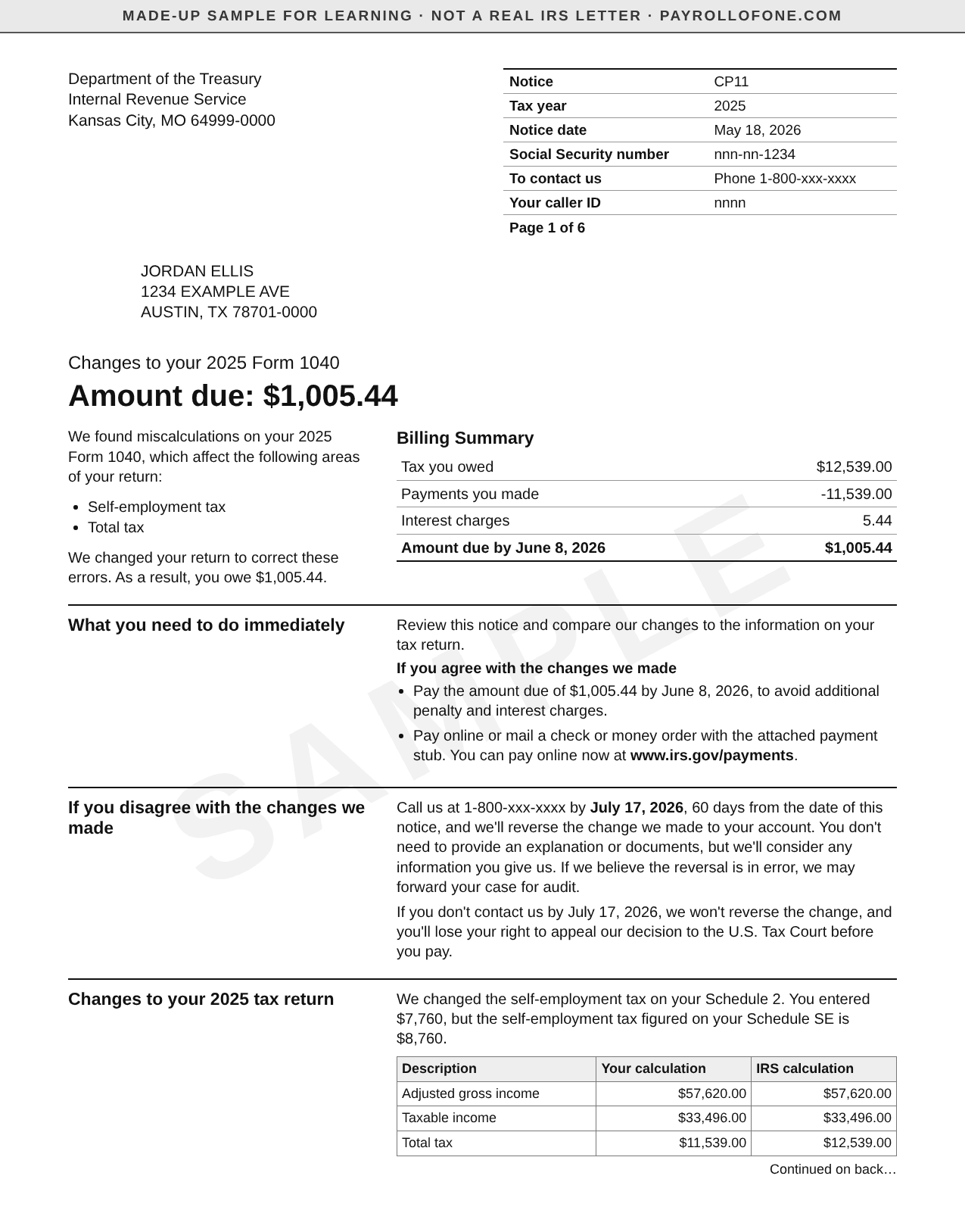
Swipe sideways to see the whole letter.
Every part, in plain English
Top left Which IRS office sent it
The IRS campus that processed your return and found the error. If you mail a payment or a letter about the notice, use the address the notice gives for it, not one from an old form.
ExampleJordan's notice came from Kansas City.
Good to knowThe IRS says the fastest way to sort out most return errors is by phone, using the number on the notice.
Notice The notice code
CP11 means the IRS found a miscalculation while processing your return, corrected it, and the correction left you owing money. It's a math-error notice: a fix to the numbers on the return, not an audit of your records.
ExampleType CP11 into our lookup or the IRS's notice search and you land on the right instructions.
Good to knowIf the correction gave you a refund, or changed one, the IRS sends a CP12 instead.
Tax year Which return was changed
The year of the return the IRS corrected. The IRS checks returns for math errors while it processes them, so it's usually the return you filed most recently.
ExampleJordan's notice is about the 2025 return, filed in April 2026.
Good to knowPull out your copy of that return, with every schedule, before you read further.
Notice date The date that starts both clocks
Two dates count from here: the due date to pay, and the 60 days you have to ask the IRS to reverse the change. Both run from the notice date, not from the day the letter reached you.
ExampleJordan's notice is dated May 18, 2026. The payment is due June 8, and the last day to dispute is July 17.
Good to knowEnter this date in the box above the letter to see your own 60-day date.
To contact us The number to call if you disagree
Call this number to ask about the change or to dispute it. The IRS's CP11 page says the fastest way to resolve many return errors is by phone, and if it needs a form or document, you can often fax it while you're still on the call.
ExampleIf Jordan thought the $7,760 was right, this call is where the dispute would start.
Good to knowHave the notice and your return in front of you when you call. Not sure a letter is real? Call the IRS at a number listed on irs.gov instead.
Headline Amount due
The extra tax from the correction, plus interest so far. Unlike a CP2000, this isn't a proposal: the IRS has already made the change and is billing you for it. You keep the right to dispute it for 60 days.
ExampleJordan's amount due is $1,005.44.
Good to knowIf the amount is right but more than you can pay at once, a payment plan is the usual answer.
What changed The parts of your return the IRS fixed
A short list of the areas the correction touched. The details are in the "Changes to your tax return" section further down. Math errors include arithmetic slips, a number copied wrong from one form to another, and a deduction or credit claimed over its legal limit.
ExampleJordan's error affected two areas: self-employment tax, and the total tax it flows into.
Good to knowFor freelancers, numbers that move between Schedule C, Schedule SE and Schedule 2 are an easy place for a copying slip.
Tax and payments The corrected tax, minus what you paid
The total tax after the IRS's correction, then everything you've paid for the year: estimated payments, withholding and anything you paid with the return. The difference is the extra tax from the fix.
ExampleAfter the fix, Jordan's 2025 tax is $12,539. Jordan paid $11,539, the full amount the return showed, so $1,000 is unpaid.
Good to knowIf a payment you made is missing here, that's a different problem from the math error. Call the number on the notice with proof of payment.
Interest Interest charges
Interest on the extra tax from the return's due date to the notice date, compounded daily at the IRS's quarterly rate. The IRS's CP11 page says to pay the full amount by the due date on the notice to avoid further interest.
ExampleApril 15 to May 18, 2026 is 33 days of interest on $1,000 at 6%: $5.44.
Good to knowThere's no late-payment penalty on this bill yet: for tax that wasn't on your return, that penalty starts only if you miss the due date on the notice.
Amount due by Your pay-by date
The date to pay if you agree. For tax that wasn't on your return, the IRS says due dates are generally 21 calendar days after the notice. After this date, the late-payment penalty of 0.5% a month starts and interest keeps adding up.
ExamplePaying $1,005.44 by June 8, 2026 closes out the change.
Good to knowDisputing? The pay-by date comes well before the 60-day deadline, so it's worth calling early rather than waiting for the last day.
What to do What you need to do immediately
Compare the IRS's changes with your return. If you agree, pay by the due date, or set up a payment plan if you can't pay it all. The IRS also says to correct the copy of the return you kept, but not to send it in.
ExampleJordan checks Schedule SE, sees $8,760, and agrees: it's a payment, online at irs.gov/payments.
Good to knowYou don't need to file an amended return to agree with a CP11. The IRS has already made the change.
If you disagree Your 60-day right to a reversal
Federal law (IRC section 6213(b)) gives you 60 days from the notice date to ask the IRS to reverse a math-error change, and it must do so. You don't have to explain, though it helps. If the IRS still thinks you owe, it may send your case to audit, and you then get the full deficiency process, including the right to go to Tax Court before you pay.
ExampleIf Jordan believed the $7,760 was right, a call by July 17, 2026 would undo the change.
Good to knowMiss the date and you lose the formal right to the reversal and to Tax Court before paying. The IRS says it will still look at information you send later and may reverse the change if it agrees.
The reason Exactly what the IRS changed
The plain-language reason for the correction, usually naming the line or schedule. This is the part to check against your own copy of the return.
ExampleJordan's Schedule SE shows $8,760 of self-employment tax, but $7,760 was typed onto Schedule 2.
Good to knowIf you use tax software, the same mistake can repeat next year if you start from this year's file. Fix your copy.
Your numbers Your calculation and the IRS's
The key totals from your return next to the IRS's corrected ones, so you can see where they part ways. Here only the total tax changed.
ExampleJordan's income and taxable income are unchanged. The total tax goes from $11,539 to $12,539, exactly the $1,000 typo.
Good to knowIf a column you didn't expect has changed, that's worth a question when you call.
What a CP11 means: a math error, not an audit
The IRS checks returns for mathematical accuracy while it processes them. When it finds a mistake it can fix from the return itself, it corrects the numbers and mails you a notice. If the fix means you owe, that notice is a CP11.
The law calls these “mathematical or clerical errors,” and the list is fairly narrow. Here are the main kinds.
- Arithmetic: a mistake adding, subtracting, multiplying or dividing.
- A number that doesn’t match another one: an entry that’s inconsistent with another entry on the return, like a total copied wrong from a schedule.
- Missing information: something the return needs to back up an entry that isn’t there.
- Over a limit: a deduction or credit bigger than a limit the law sets as a dollar amount or a percentage.
- A missing or wrong ID number: for example, for a child claimed for the child tax credit or the earned income credit.
For freelancers, the usual suspect is a number that travels between forms. Say your Schedule SEThe tax form that works out your self-employment tax from your Schedule C profit. shows $8,760 of self-employment taxSocial Security and Medicare tax for people who work for themselves: 15.3% on 92.35% of your profit, on top of income tax., like Jordan’s in our sample, but $7,760 lands on Schedule 2. Total tax comes out $1,000 short, and the IRS’s computer spots it. Here’s how self-employment tax works, and here’s Schedule SE, line by line.
What to do, in the IRS’s order
The IRS’s CP11 page splits the steps by whether you agree. Start the same way either time: read the “Changes to your tax return” section next to your own copy of the return.
- Read what was changed. The notice names the line or schedule. Find that line on your copy and see whether the IRS is right.
- If you agree, pay by the due date on the notice. Pay online at irs.gov/payments, or mail a check to the United States Treasury with the payment stub.
- If you can’t pay it all, set up a payment plan. Pay what you can now and arrange the rest, online for most people.
- Correct the copy of the return you kept. The IRS says to fix your copy but not to send it in.
- If you disagree, contact the IRS by the date on the notice. Call the number in the notice. The 60-day rule below is what makes this worth doing.
Here’s what most people in your spot do the day a CP11 arrives: find the changed line on your return before deciding anything, then put both dates on your calendar, the pay-by date and the 60-day date. If you can’t pay it all, here’s how IRS payment plans work.
The 60-day window to dispute a math-error change
This is the part of a CP11 that’s easy to miss. A math-error notice isn’t the end of the conversation. Under federal law (Internal Revenue Code section 6213(b)), you can ask the IRS to reverse the change within 60 days of the notice date, and when you do, the IRS must reverse it.
- You don’t have to prove anything to get the reversal. The IRS says you don’t need an explanation or documents, though sending them may help resolve it faster.
- A phone call counts. The IRS’s own procedures say a request can be written or oral. The CP11 page says calling is often the fastest way, and you can fax documents during the call.
- If you mail it, the postmark counts. The IRS uses the postmark date to decide whether a mailed request is on time.
- No levy during the 60 days. The law bars the IRS from levying or going to court to collect the change while you can still ask for the reversal.
Here’s what can happen after you ask. The table follows the IRS’s description.
| You contact the IRS within 60 days | You don’t | |
|---|---|---|
| The change | Reversed. The IRS says it reverses most changes that increased what you owe | Stays, and the amount becomes a normal balance due |
| If the IRS still thinks you owe | It may send the case to audit. The IRS says audit staff contact you within 6 weeks | No audit step. The bill stands |
| Your appeal rights | Full deficiency process: an appeal, and a notice of deficiency you can take to the U.S. Tax Court before paying | You lose the formal right to the reversal and to Tax Court before paying |
| Later information | Considered as part of the review | The IRS says it will still consider it and may reverse the change if it agrees |
A reversal request only makes sense if you actually think the IRS is wrong. If the IRS is right, as it was in Jordan’s case, a reversal can send the same number to an audit, and interest keeps building on any tax that’s finally owed.
What happens after the 60 days
If you agreed and paid by the due date, that’s the end of it. The IRS’s CP11 page says paying in full by the date on the notice avoids more interest charges.
If the balance isn’t paid by the due date, two things start. Interest keeps running from the return’s due date, and the late-payment penalty starts at 0.5% a month: for tax that wasn’t on your return, the IRS charges it only after the notice’s due date. From there, the IRS’s usual collection letters follow, the same ones that follow any unpaid bill. Here’s what the first IRS bill and its reminders look like.
If you missed the 60 days and later decide the IRS was wrong, you still have options. The IRS says it will consider information you send after the date. You can also pay and file a claim for a refund, generally within 3 years of filing the return or 2 years of paying the tax, whichever is later.
CP11, CP12, CP2000: how they differ
Three notices about changes to a return get mixed up often. Here’s how they compare.
| Notice | What happened | Already changed? | Usual window |
|---|---|---|---|
| CP11 | The IRS fixed a miscalculation, and you now owe | Yes | Pay by the due date; 60 days to dispute |
| CP12 | The IRS fixed a miscalculation, and your refund changed | Yes | Nothing if you agree; 60 days to dispute |
| CP2000 | Income reported by others doesn’t match your return | No, it’s a proposal | 30 days to respond (60 if you live abroad) |
A CP2000 is about income someone else reported, so it asks you first. Here’s how a CP2000 works. If your notice shows a refund instead of a bill, here’s the CP12, decoded.
When to get help
Most people handle a CP11 on their own: check one line, then pay or call. Help earns its cost when the change is large, involves credits or rules you don’t understand, or you’ve asked for a reversal and the case has gone to audit.
If you can’t afford a professional, the Taxpayer Advocate Service and Low Income Taxpayer Clinics are free options the IRS lists. Here’s when a tax pro is worth it, and what one costs. To catch copying slips before the IRS does, tax software for self-employed people carries numbers between forms for you.
FAQ
Is a CP11 an audit?
No. It’s an automatic correction of a math or clerical error found while your return was processed. An audit only comes into it if you ask for a reversal and the IRS still believes it was right.
How long do I have to dispute a CP11?
60 days from the notice date, under Internal Revenue Code section 6213(b). The IRS’s CP11 page says to contact it by the date shown on your notice.
How long do I have to pay a CP11?
Until the due date in the billing summary. For tax that wasn’t on your return, the IRS says due dates are generally 21 calendar days after the notice. That’s well before the 60-day dispute date.
Do I need to file an amended return?
Not to agree with a CP11: the IRS has already changed the return. The IRS says to correct your own copy and not send it. If you find a different mistake on the return, that one needs a Form 1040-X.
Will I be charged a penalty?
Not if you pay by the due date on the notice. After that date, the late-payment penalty is 0.5% of the unpaid tax for each month or part of a month. If circumstances beyond your control stop you from paying, the IRS says to call by the due date to ask about removing the penalty.
Can the IRS take my money during the 60 days?
No. The law says the IRS can’t levy or go to court to collect a math-error change while you can still ask for it to be reversed.
How do I know a CP11 is really from the IRS?
The IRS starts contact by mail, and payment always goes to the United States Treasury. Check the notice in your IRS Online Account, or call the IRS at a number listed on irs.gov. Our IRS letter decoder explains other codes too.
Sources
- IRS: Understanding your CP11 notice
- IRS: Internal Revenue Manual 21.5.4, General Math Error Procedures
- IRS: Tax Topic 653, IRS notices and bills, penalties and interest charges
- IRS: Failure to pay penalty
- IRS: Time you can claim a credit or refund
- IRS: Quarterly interest rates
- IRS: Publication 594, The IRS Collection Process (PDF)
The letter above is a made-up sample for learning, laid out like the IRS’s own CP11. It isn’t a real notice and nothing on this page reads or answers yours. Interest uses the IRS’s 2026 rate for April to June (6%). General education, not tax advice.