The short answer
A letter from the IRS arrives by certified mail. The corner says LT11, or Letter 1058, and the headline talks about a levy and a hearing. You’ve probably seen a few bills about this balance already.
An LT11 notice is the IRS’s final notice of intent to levy: after 30 days it can take wages, bank accounts and other property for an unpaid balance, unless you pay, set up a payment plan or ask for a Collection Due ProcessYour right to a hearing with the IRS Independent Office of Appeals before most levies. You ask for it on Form 12153 within 30 days of the final notice. hearing on Form 12153 by the date on the notice. Letter 1058 is the same notice, usually from a revenue officer. It’s the most serious letter in the sequence, and you still have real options.
How worried to be
This is the last notice the law requires before the IRS can levy wages, bank accounts and other property. You have 30 days to ask for a hearing. Paying, or setting up a payment plan, still stops it.
When your reply is due
The IRS's usual window is 30 days from the notice date. Enter the date to see yours.
The IRS's LT11 page says to contact it immediately. To keep your right to a Collection Due Process hearing, Form 12153 has to be sent by the date on the notice, which Publication 594 says is 30 days from the notice date. After that, you can ask for an equivalent hearingA hearing with the IRS Independent Office of Appeals you can ask for within one year of a levy or lien notice if you missed the 30-day Collection Due Process deadline. The IRS isn't barred from levying meanwhile, and you can't take the result to court. within one year of the notice date.
LT11, decoded: tap any part of the letter
The IRS no longer shows sample letters on its notice pages, so we rebuilt this one from its older official LT11 sample, with made-up details. A Letter 1058 has the same parts. Yours will have different numbers but the same sections in about the same places.
Tap any part of the letterHover over any part of the letter to see what it means. Click a part to pin its note open so you can use the links. to see what it means. Our made-up example: Jordan Ellis, a freelance photographer, got a CP504 in October 2025 for an unpaid 2024 balance and didn't pay or set up a plan.
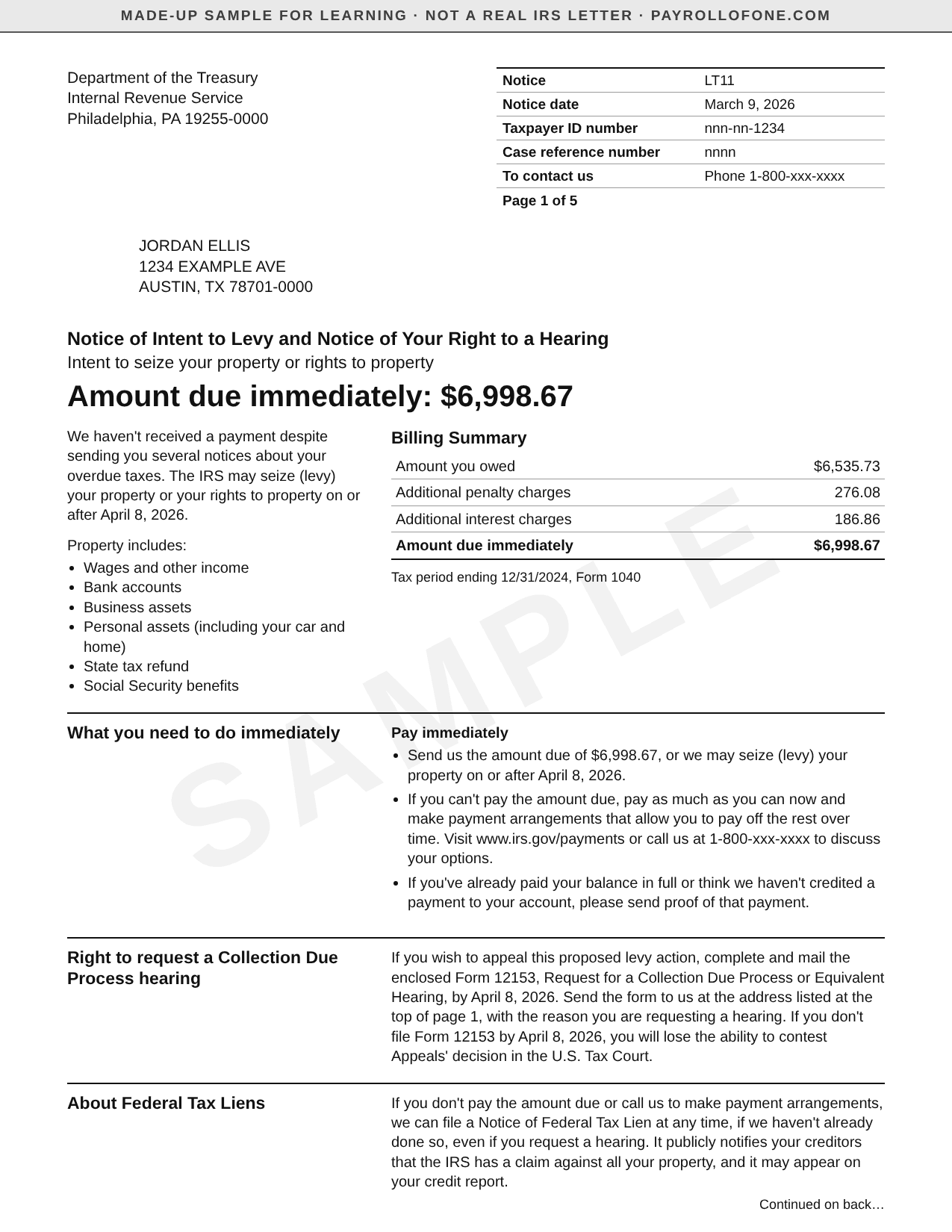
Swipe sideways to see the whole letter.
Every part, in plain English
Notice The notice code
LT11 is the IRS's Final Notice of Intent to Levy and Notice of Your Right to a Hearing. Letter 1058 is the same notice, usually sent by a revenue officer, an IRS employee assigned to your case. By law, the IRS has to send one of them before it levies most property.
ExampleType LT11, L1058 or 1058 into our lookup and you land on this page.
Good to knowThe law says this notice must be handed to you, left at your home or business, or sent by certified or registered mail. That's why it often arrives by certified mail.
Notice date The date your 30 days count from
Publication 594 says the deadline to ask for a Collection Due Process hearing on a proposed levy is 30 days from the date of the letter. The notice prints the exact date. The same date is the earliest the IRS can levy.
ExampleJordan's notice is dated March 9, 2026, so the hearing request has to go out by April 8, 2026.
Good to knowEnter this date in the box above the letter to see your own 30-day date. The date printed on your notice is the one that counts.
Case number Case reference number
A reference number for this collection notice. Our sample hides it. Have it and the notice in front of you when you call or write.
Good to knowNot sure the notice is real? Check your IRS Online Account for the balance, and call a number listed on irs.gov. Payment always goes to the United States Treasury.
To contact us The number to call now
The IRS's LT11 page says to contact it immediately. Call this number to pay, to set up a payment plan, or if you can't pay. If you've already paid, the page says to send proof to the address at the top of the notice.
ExampleIf Jordan calls on March 12 to set up a plan, that's well inside the 30 days.
Good to knowA phone call doesn't extend the 30 days to ask for a hearing. Publication 1660 says the written request still has to go out on time.
Final notice Intent to levy, and your right to a hearing
A levy is the IRS legally taking property to pay a tax debt. This notice does two things: it warns that a levy can come after 30 days, and it gives you the right to a Collection Due Process hearing with the IRS Independent Office of Appeals before it happens.
ExampleJordan got a CP504 in October. This is the next and last notice in the sequence.
Good to knowYou get one Collection Due Process hearing for a levy notice for each tax period, so this is the moment to use it if you need it.
Amount due Amount due immediately
Everything the IRS says you owe for the tax period on the notice: the unpaid tax plus all the penalty and interest added so far. There's no new pay-by date. The IRS asks for it now.
Example$6,998.67 for Jordan's 2024 return.
Good to knowIf you can't pay it all, the IRS says to pay what you can now. Payments cut the interest and penalty added to what's left.
What it can take The levy date and the property list
From the date printed here, the IRS may levy. Its LT11 page lists wages and other income, bank accounts, business assets, personal assets including your car and home, Alaska Permanent Fund Dividends and state tax refunds, and Social Security benefits. Some things can't be taken, such as unemployment benefits and workers' compensation.
ExampleFor Jordan, that date is April 8, 2026: client payments and the business bank account are both on the list.
Good to knowPublication 594 says a bank levy holds the money for 21 days before the bank sends it, and a wage levy keeps going each payday until the debt is paid or other arrangements are made.
Amount you owed The balance from earlier notices
What the IRS billed you last time: the unpaid tax plus the penalty and interest charged by then.
Example$6,535.73, the amount on Jordan's October 13, 2025 CP504: $6,135 of unpaid tax, $184.05 of penalty and $216.68 of interest.
Penalty Additional penalty charges
The late-payment penalty is 0.5% of the unpaid tax for each month or part of a month. If you don't pay within 10 days of a notice of intent to levy, such as the CP504, it rises to 1% a month. It stops at 25% of the tax.
ExampleOne more month at 0.5% and four at 1% on Jordan's $6,135: $276.08. That's $460.13 of penalty so far.
Good to knowFiled on time and set up an approved payment plan? The penalty drops to 0.25% a month while the plan is in effect.
Interest Additional interest charges
Interest compounds daily on everything unpaid, at the IRS's rate for each quarter. That rate was 7% a year from April 2025 through March 2026.
Example$186.86 of interest in the 147 days since Jordan's CP504.
Good to knowBy law, the IRS can't remove interest just because you had a good reason. Paying down the balance is what slows it.
What to do Pay, or make payment arrangements
The IRS's steps: pay the amount due, or pay what you can and set up a payment plan for the rest. If you've already paid or think a payment is missing, send proof. A pending or approved payment plan generally stops new levies.
ExampleJordan could set up a plan online, since the balance is under $50,000.
Good to knowThe IRS says that if you owe less than $50,000, its Online Payment Agreement tool is the fastest way to get a plan approved. You need to be current on your tax filings.
Hearing Your Collection Due Process hearing
Mail Form 12153 by the date shown to get a hearing with the IRS Independent Office of Appeals. There you can propose a payment plan, an offer in compromise or a pause for hardship, and dispute the amount only if you haven't had a chance to before. During the 30 days and a timely hearing, the IRS generally can't levy for that tax period.
ExampleIf Jordan mails Form 12153 by April 8, 2026, the levy waits while Appeals hears the case.
Good to knowMiss the date and you can still ask for an equivalent hearing within one year, but the IRS can levy meanwhile and you can't take the result to the U.S. Tax Court.
Tax lien Notice of Federal Tax Lien
Separate from a levy, the IRS can file a Notice of Federal Tax Lien, a public notice to your creditors that it has a claim against your property. The notice says it can do this even if you ask for a hearing. A lien filing comes with its own hearing right.
ExampleA lien filing could make it harder for Jordan to borrow money or get credit.
Good to knowWhen the IRS files a lien notice, it sends Letter 3172, which gives you 30 days to ask for a Collection Due Process hearing about the lien.
What an LT11 or Letter 1058 means
The IRS’s own summary is short: it hasn’t received your payment for overdue taxes, it intends to seize your property, and you must contact it immediately. By law, the IRS has to send this notice, with your right to a hearing, at least 30 days before it levies most property.
A levy is the IRS legally taking property to pay a tax debt. Here’s what the IRS’s LT11 page says it can take.
- Wages and other income, including payments owed to you. A wage levy keeps going each payday until the debt is paid or other arrangements are made.
- Bank accounts. The bank holds the money for 21 days before sending it to the IRS.
- Business assets and personal assets, including your car and home.
- Alaska Permanent Fund Dividends and state tax refunds.
- Social Security benefits.
Some things are off limits. Publication 594 lists unemployment benefits, workers’ compensation, certain disability and public assistance payments, and court-ordered child support income among the property the IRS can’t take.
Say you’re a freelancer like Jordan in our sample. The levy that hurts most is usually on the business bank account or on payments from clients, because that’s where the money comes in.
What to do, in the IRS’s order
The IRS’s page for these letters lists the steps below. Each one works best before the date on the notice.
- Pay the balance if you can. Paying in full stops interest and penalties. Your IRS Online Account shows the current balance.
- Pay what you can and ask for a payment plan. If you’re current on your tax filings and owe less than $50,000, the IRS says its Online Payment Agreement tool is the fastest way to get one approved.
- Send proof if you’ve already paid. Mail it to the address at the top of the notice.
- Call if you can’t pay. Use the number on the notice.
Here’s what most people in your spot do the day this arrives: put the hearing date on the calendar, then decide that week between paying, a plan and a hearing. A payment plan request generally stops new levies while it’s pending and once it’s approved. Here’s how to set up an IRS payment plan, step by step.
Your right to a hearing: Collection Due Process
This is the part of the letter that sets it apart from every bill before it. You can ask the IRS Independent Office of Appeals, which is separate from the collection office, to review the proposed levy before it happens.
To ask, mail Form 12153, Request for a Collection Due Process or Equivalent Hearing, to the address on the notice by the date it shows. Publication 594 says that date is 30 days from the date of the letter, and Publication 1660 says calling the IRS doesn’t extend it. At the hearing you can propose a payment plan, an offer in compromiseAn agreement to settle a tax debt for less than you owe, for people who can’t realistically pay it in full. The IRS checks your income, expenses and assets first, and turns many offers down. or a pause for hardship. You can dispute the amount itself only if you haven’t had an earlier chance to.
Miss the date and there’s a second route, with less protection. Here’s how the two compare.
| Collection Due Process hearing | Equivalent hearing | |
|---|---|---|
| Deadline | The date on the notice, 30 days from the notice date | Within one year of the notice date |
| How to ask | Form 12153 | Form 12153, with the equivalent hearing box checked |
| Can the IRS levy meanwhile? | Generally no, for that tax period | Yes, though Publication 594 says it normally won’t |
| The 10-year collection clock | Paused during the hearing | Keeps running |
| If you disagree with Appeals | 30 days to go to the U.S. Tax Court | No court review |
If you can’t pay and a plan hasn’t been set up yet, the timely hearing is the step most people in your spot use. It keeps a levy off while Appeals looks at your options. Appeals will want a financial statement, Form 433-A for individuals, to weigh a plan or an offer.
The ways out, if you can’t pay in full
The IRS has four standard answers for a balance you can’t pay right now. Any of them can come up with the collection office or at a hearing.
| Option | What it is | Keep in mind |
|---|---|---|
| Pay in full | Clear the balance now | Stops interest and penalties |
| Payment plan | Monthly payments over time. A short-term plan of 180 days or less has no setup fee | Generally stops new levies. Interest continues, and the late-payment penalty drops to 0.25% a month if you filed on time |
| Currently not collectible | The IRS pauses most collection because paying would leave you unable to cover basic living expenses | The debt isn’t forgiven. Penalties and interest continue, and the IRS may file a lien and keep your refunds |
| Offer in compromise | Settling for less than the full amount | $205 application fee plus a first payment, unless you qualify as low income. All returns have to be filed first |
Say Jordan, in our sample, can manage $300 a month. A plan set up online before April 8 would keep the IRS from levying the business account, and Jordan’s $6,998.67 would be paid off in a little over two years, plus interest.
Where this letter sits: the last notice before a levy
An LT11 or Letter 1058 usually comes after a series of bills that weren’t paid or arranged. Here’s the IRS’s order.
If a balance stays unpaid
The IRS's letters, in order
- CP14First bill: you owe
- CP501Reminder
- CP503Second reminder
- CP504Notice of intent to levy
- LT11 or 1058Final notice, with the right to a hearingYou are here
Each letter has its own date to act by. Paying the balance, or setting up a payment plan with the IRS, ends the sequence. Sources: IRS Publication 594, The IRS Collection Process, and the IRS's page for each notice.
The letter before this one is the CP504 notice of intent to levy, which can lead to a state refund levy but not to most other property. After the final notice and its 30 days, the IRS can levy without another warning. If you already have a payment plan and fall behind on it, the warning comes as a CP523 notice instead.
When to get help
Plenty of people answer an LT11 themselves by paying or setting up a plan online. A tax professional earns the cost when the balance is large, several years are involved, you dispute the amount, or you want to use the hearing well. Only a hearing request mailed on time keeps your right to go to the Tax Court.
The Taxpayer Advocate Service, an independent office inside the IRS, helps for free when a tax problem is causing financial hardship, and Low Income Taxpayer Clinics can represent you if you qualify. Here’s when a tax pro is worth it, and what one costs.
FAQ
How long do I have after an LT11?
Thirty days from the notice date to ask for a Collection Due Process hearing, and the notice prints the exact date. The IRS can levy on or after that date if the balance isn’t paid, arranged or under a timely hearing.
What’s the difference between LT11 and Letter 1058?
They’re the same kind of notice, Notice of Intent to Levy and Notice of Your Right to a Hearing, with the same 30-day hearing window. The Taxpayer Advocate Service says Letter 1058 is usually sent by a revenue officer assigned to your case.
Can the IRS take money from my bank account after an LT11?
Yes, once the 30 days pass without payment, a plan or a timely hearing request. The bank holds the levied money for 21 days before sending it, which gives time to sort out disputes about the account.
Does a payment plan stop an LT11 levy?
Generally, yes. The IRS can’t issue a new levy while a payment plan request is pending or while a plan is in effect, as long as you keep it up.
What if I miss the 30-day hearing deadline?
You can still ask for an equivalent hearing within one year of the notice date. Appeals reviews the same issues, but the IRS isn’t barred from levying meanwhile and you can’t take the result to court.
Will an LT11 affect my passport?
Only for large debts. In 2026, the IRS can certify a debt over $66,000 to the State Department once a lien is filed and appeal rights are used up, or a levy is issued. Debts on an approved payment plan aren’t certified.
How do I know an LT11 is really from the IRS?
Check the balance in your IRS Online Account, or call a number listed on irs.gov. Payment always goes to the United States Treasury. Our IRS letter decoder explains other codes too.
Sources
- IRS: Understanding your LT11 notice or Letter 1058
- IRS: Collection Due Process (CDP) FAQs
- IRS: Publication 594, The IRS Collection Process (PDF)
- IRS: Publication 1660, Collection Appeal Rights (PDF)
- IRS: Form 12153, Request for a Collection Due Process or Equivalent Hearing (PDF)
- Taxpayer Advocate Service: Letter 1058
- IRS: Payment plans, installment agreements
- IRS: Temporarily delay the collection process
- IRS: Offer in compromise
- IRS: Failure to pay penalty
- IRS: Revocation or denial of passport in cases of certain unpaid taxes
The letter above is a made-up sample for learning, laid out like the IRS’s own LT11. It isn’t a real notice and nothing on this page reads or answers yours. Interest uses the IRS’s rate of 7% for April 2025 through March 2026. General education, not tax advice.