How worried to be
This is the last notice the law requires before the IRS can levy wages, bank accounts and other property. You have 30 days to ask for a hearing. Paying, or setting up a payment plan, still stops it.
When your reply is due
The IRS's usual window is 30 days from the notice date. Enter the date to see yours.
The IRS's LT11 page says to contact it immediately. To keep your right to a Collection Due Process hearing, Form 12153 has to be sent by the date on the notice, which Publication 594 says is 30 days from the notice date. After that, you can ask for an equivalent hearing within one year of the notice date.
Tap any part of the letterHover over any part of the letter to see what it means. Click a part to pin its note open so you can use the links. to see what it means. Our made-up example: Jordan Ellis, a freelance photographer, got a CP504 in October 2025 for an unpaid 2024 balance and didn't pay or set up a plan.
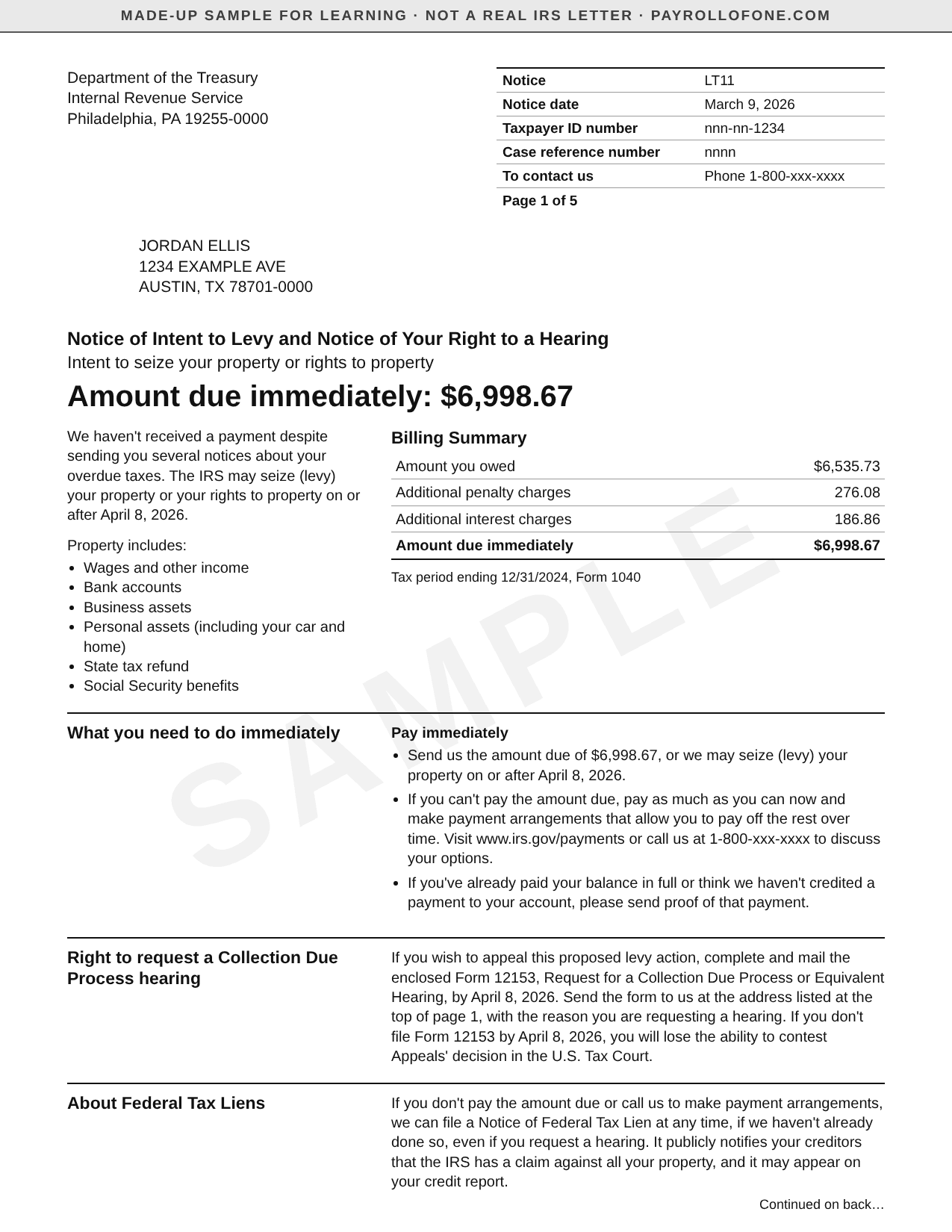
Swipe sideways to see the whole letter.
Every part, in plain English
Notice The notice code
LT11 is the IRS's Final Notice of Intent to Levy and Notice of Your Right to a Hearing. Letter 1058 is the same notice, usually sent by a revenue officer, an IRS employee assigned to your case. By law, the IRS has to send one of them before it levies most property.
ExampleType LT11, L1058 or 1058 into our lookup and you land on this page.
Good to knowThe law says this notice must be handed to you, left at your home or business, or sent by certified or registered mail. That's why it often arrives by certified mail.
Notice date The date your 30 days count from
Publication 594 says the deadline to ask for a Collection Due Process hearing on a proposed levy is 30 days from the date of the letter. The notice prints the exact date. The same date is the earliest the IRS can levy.
ExampleJordan's notice is dated March 9, 2026, so the hearing request has to go out by April 8, 2026.
Good to knowEnter this date in the box above the letter to see your own 30-day date. The date printed on your notice is the one that counts.
Case number Case reference number
A reference number for this collection notice. Our sample hides it. Have it and the notice in front of you when you call or write.
Good to knowNot sure the notice is real? Check your IRS Online Account for the balance, and call a number listed on irs.gov. Payment always goes to the United States Treasury.
To contact us The number to call now
The IRS's LT11 page says to contact it immediately. Call this number to pay, to set up a payment plan, or if you can't pay. If you've already paid, the page says to send proof to the address at the top of the notice.
ExampleIf Jordan calls on March 12 to set up a plan, that's well inside the 30 days.
Good to knowA phone call doesn't extend the 30 days to ask for a hearing. Publication 1660 says the written request still has to go out on time.
Final notice Intent to levy, and your right to a hearing
A levy is the IRS legally taking property to pay a tax debt. This notice does two things: it warns that a levy can come after 30 days, and it gives you the right to a Collection Due Process hearing with the IRS Independent Office of Appeals before it happens.
ExampleJordan got a CP504 in October. This is the next and last notice in the sequence.
Good to knowYou get one Collection Due Process hearing for a levy notice for each tax period, so this is the moment to use it if you need it.
Amount due Amount due immediately
Everything the IRS says you owe for the tax period on the notice: the unpaid tax plus all the penalty and interest added so far. There's no new pay-by date. The IRS asks for it now.
Example$6,998.67 for Jordan's 2024 return.
Good to knowIf you can't pay it all, the IRS says to pay what you can now. Payments cut the interest and penalty added to what's left.
What it can take The levy date and the property list
From the date printed here, the IRS may levy. Its LT11 page lists wages and other income, bank accounts, business assets, personal assets including your car and home, Alaska Permanent Fund Dividends and state tax refunds, and Social Security benefits. Some things can't be taken, such as unemployment benefits and workers' compensation.
ExampleFor Jordan, that date is April 8, 2026: client payments and the business bank account are both on the list.
Good to knowPublication 594 says a bank levy holds the money for 21 days before the bank sends it, and a wage levy keeps going each payday until the debt is paid or other arrangements are made.
Amount you owed The balance from earlier notices
What the IRS billed you last time: the unpaid tax plus the penalty and interest charged by then.
Example$6,535.73, the amount on Jordan's October 13, 2025 CP504: $6,135 of unpaid tax, $184.05 of penalty and $216.68 of interest.
Penalty Additional penalty charges
The late-payment penalty is 0.5% of the unpaid tax for each month or part of a month. If you don't pay within 10 days of a notice of intent to levy, such as the CP504, it rises to 1% a month. It stops at 25% of the tax.
ExampleOne more month at 0.5% and four at 1% on Jordan's $6,135: $276.08. That's $460.13 of penalty so far.
Good to knowFiled on time and set up an approved payment plan? The penalty drops to 0.25% a month while the plan is in effect.
Interest Additional interest charges
Interest compounds daily on everything unpaid, at the IRS's rate for each quarter. That rate was 7% a year from April 2025 through March 2026.
Example$186.86 of interest in the 147 days since Jordan's CP504.
Good to knowBy law, the IRS can't remove interest just because you had a good reason. Paying down the balance is what slows it.
What to do Pay, or make payment arrangements
The IRS's steps: pay the amount due, or pay what you can and set up a payment plan for the rest. If you've already paid or think a payment is missing, send proof. A pending or approved payment plan generally stops new levies.
ExampleJordan could set up a plan online, since the balance is under $50,000.
Good to knowThe IRS says that if you owe less than $50,000, its Online Payment Agreement tool is the fastest way to get a plan approved. You need to be current on your tax filings.
Hearing Your Collection Due Process hearing
Mail Form 12153 by the date shown to get a hearing with the IRS Independent Office of Appeals. There you can propose a payment plan, an offer in compromise or a pause for hardship, and dispute the amount only if you haven't had a chance to before. During the 30 days and a timely hearing, the IRS generally can't levy for that tax period.
ExampleIf Jordan mails Form 12153 by April 8, 2026, the levy waits while Appeals hears the case.
Good to knowMiss the date and you can still ask for an equivalent hearing within one year, but the IRS can levy meanwhile and you can't take the result to the U.S. Tax Court.
Tax lien Notice of Federal Tax Lien
Separate from a levy, the IRS can file a Notice of Federal Tax Lien, a public notice to your creditors that it has a claim against your property. The notice says it can do this even if you ask for a hearing. A lien filing comes with its own hearing right.
ExampleA lien filing could make it harder for Jordan to borrow money or get credit.
Good to knowWhen the IRS files a lien notice, it sends Letter 3172, which gives you 30 days to ask for a Collection Due Process hearing about the lien.
