The short answer
You open your tax software for your first year of freelancing, and it says you need a “Schedule CThe tax form where you report your business income and expenses. Its bottom line is your profit..” It looks like a long, dense form, but it’s mostly a list of questions you already know the answers to.
Schedule C (Form 1040) is the tax form where a sole proprietor or single-member LLC reports business income and expenses. Its bottom line, net profit on line 31, is what you pay income tax and self-employment taxSocial Security and Medicare tax for people who work for themselves: 15.3% on 92.35% of your profit, on top of income tax. on. It’s part of your personal return, not a separate business return, and you file one for each business you run.
The line numbers below come from the 2025 Schedule C, the latest the IRS has published. The 2026 form, which you’ll file in 2027, may shift a line or two, so check against it when it comes out.
Schedule C, decoded: tap any line
Here’s the real form from the IRS, both pages. Every line has a plain-English note with an example, so you can read along before your tax software asks you anything.
Tap any line on the formHover over any line on the form to see what it means. Click a line to pin its note open so you can use the links. to see what it means. Our example is Maya, a freelance designer who brought in $80,000 in 2026, the same numbers as the walk-through further down.
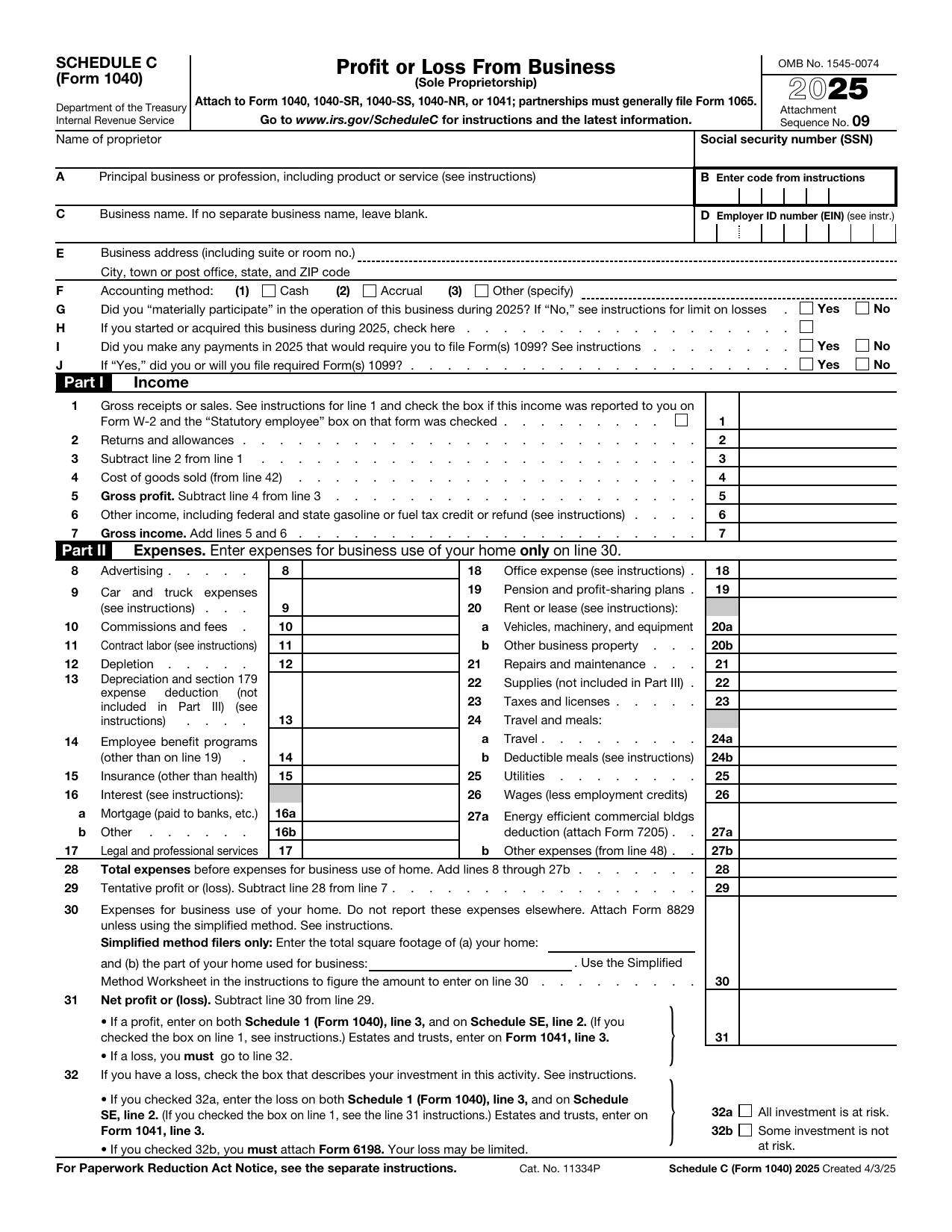

Swipe sideways to see the whole form.
Every line, in plain English
Name Your name
Your name exactly as it appears on your Form 1040, even if your business has its own name.
SSN Your Social Security number
Your own Social Security number goes here, even if your business has an EIN. The IRS uses it to match this form to your personal return.
Line A What your business does
A few words on what you sell or do. Keep it plain and specific.
ExampleMaya writes: Graphic design for small businesses.
Our tipUse the same description every year so the IRS sees one steady business.
Line B Your business code
A six-digit code for your type of work, from the list at the end of the Schedule C instructions. Tax software has a search box for it.
ExampleGraphic design falls under 541400, specialized design services.
Our tipPick the closest match. A near miss is fine.
Line C Business name
Fill this in only if your business uses a name that is different from your own. If you work under your own name, leave it blank.
ExampleMaya works as "Bright Line Design", so she writes that.
Line D EIN, if you have one
Your Employer Identification Number from the IRS, only if you have one. Don't put your Social Security number here. Most sole proprietors without employees leave it blank.
Line E Business address
Where the business is run. If you work from home and that's the address on your Form 1040, you can leave this line blank.
ExampleMaya works from her apartment, which is already on her 1040, so she skips it.
Line F Accounting method
Cash means you count money when it lands and costs when you pay them. Accrual counts them when you send or receive the invoice.
ExampleMaya invoices $4,000 on December 20 and gets paid January 5. Under cash, it counts as next year's income.
Our tipAlmost every one-person business picks Cash. It's simpler and it matches your bank account.
Line G Did you materially participate?
Did you actually work in the business, rather than just put money into it? If you run it yourself, the answer is Yes. Working more than 500 hours in the year is one of seven ways to qualify.
ExampleMaya does all the design work herself, so she checks Yes.
Our tipChecking No treats the business as passive, which can limit a loss.
Line H Started this year?
Check the box only if you started or bought this business during the year on the form.
Lines I and J Did you pay contractors?
Line I asks whether you paid anyone enough to need a Form 1099, usually a freelancer you hired. Line J asks whether you sent it. For payments in 2025 the trigger was $600. For payments in 2026 it's $2,000.
ExampleMaya paid another freelancer $2,000 in 2026, so she sends a 1099-NEC and answers Yes to both.
Line 1 Everything clients paid you
All the money the business took in for the year, before any expenses. That includes income on 1099 forms and income nobody sent a form for.
ExampleMaya's clients paid her $80,000 in total, so line 1 is $80,000.
Our tipAdd up your business deposits, not just your 1099s. The IRS matches every 1099 it receives against this line.
Line 2 Returns and allowances
Money you gave back to customers, such as refunds and discounts after the sale.
ExampleMaya didn't refund anyone, so this is 0.
Line 3 Line 1 minus line 2
Simple math: your receipts after refunds.
ExampleMaya: $80,000.
Line 4 Cost of goods sold
Only for people who sell physical products. It's what the items you sold cost you, worked out in Part III on page 2.
ExampleMaya sells a service, so this is 0.
Line 5 Gross profit
Line 3 minus line 4. For a service business it's the same as line 3.
ExampleMaya: $80,000.
Line 6 Other income
Business income that isn't a sale, such as a bad debt you wrote off before that a client finally paid, or a fuel tax credit refund. Most freelancers leave it at 0.
ExampleMaya: 0.
Line 7 Gross income
Line 5 plus line 6. This is your income before the expenses in Part II.
ExampleMaya: $80,000.
Line 8 Advertising
Anything you spent to find customers: ads, business cards, your website domain and hosting.
ExampleMaya spent $600 on ads and her portfolio site.
Line 9 Car and truck expenses
Driving you did for the business, like visiting clients. Most people use the standard mileage rate: business miles times the IRS rate. In 2026 that's 72.5 cents a mile through June and 76 cents from July 1. Driving from home to a regular office doesn't count.
ExampleMaya drove 3,000 business miles, all before July: 3,000 × 72.5 cents = $2,175.
Our tipKeep a mileage log as you go. A guess at tax time won't hold up.
Line 10 Commissions and fees
Cuts that platforms and agents take from your pay, such as marketplace service fees or a referral commission.
ExampleIf a freelance marketplace kept $800 of Maya's earnings, the full $80,000 would go on line 1 and the $800 here.
Line 11 Contract labor
What you paid freelancers and contractors who aren't your employees.
ExampleMaya paid another freelancer $2,000.
Line 12 Depletion
For businesses that own natural resources like oil, gas, minerals or timber. Almost every freelancer leaves this blank.
Line 13 Depreciation and section 179
Bigger purchases that last more than a year, like a computer or camera. You can often write off the full cost the year you buy it. You figure it on Form 4562 first. Items up to $2,500 each can go in Part V instead.
ExampleMaya didn't buy big equipment in 2026. If she had bought a $3,000 camera, she could usually deduct all of it here.
Line 14 Employee benefit programs
Benefits you pay for your employees, such as their health or life insurance. Your own benefits don't go here. With no employees, leave it blank.
Line 15 Insurance (not health)
Business insurance like general liability or professional liability. Your own health insurance doesn't go here. Self-employed health premiums go on Schedule 1 instead.
ExampleIf Maya paid $500 for a liability policy, it would go here.
Lines 16a and 16b Interest
Interest on money borrowed for the business. Line 16a is a mortgage on business property. Line 16b is everything else, like interest on a business credit card or loan.
ExampleIf Maya paid $150 of interest on a card used only for business, it would go on 16b.
Line 17 Legal and professional services
Fees for an accountant, tax preparer or lawyer for the business.
ExampleMaya paid a tax preparer $500.
Line 18 Office expense
Small office costs like postage, printer ink and paper. Many people list software in Part V instead.
ExampleMaya's printer ink and postage would go here.
Line 19 Pension and profit-sharing plans
What you put into retirement plans for your employees. Your own Solo 401(k) or SEP IRA contributions don't go here. They go on Schedule 1.
ExampleMaya has no employees, so this is blank.
Lines 20a and 20b Rent or lease
Line 20a is rented vehicles, machinery and equipment. Line 20b is rent for business space, like an office or a coworking desk. Your home rent doesn't go here. That goes through the home office on line 30.
ExampleIf Maya paid $1,200 a year for a coworking membership, it would go on 20b.
Line 21 Repairs and maintenance
Fixing business equipment or business property to keep it working.
ExampleA $150 laptop screen repair would go here.
Line 22 Supplies
Things you use up in the business that aren't inventory, such as small tools and materials.
ExampleMaya spent $900 on supplies.
Line 23 Taxes and licenses
Business licenses, state business fees and the employer share of payroll taxes. Your federal income tax and your own self-employment tax don't go here.
ExampleA $50 city business license would go here.
Line 24a Travel
Business trips away from home overnight: airfare, hotels, rental cars. Meals on the trip go on 24b.
ExampleA $600 flight and hotel to meet a client would go here.
Line 24b Business meals
Meals with clients or while traveling for work. You can usually deduct only half of what you spent.
ExampleIf Maya spent $400 on client lunches, she would enter $200.
Our tipWrite down who you ate with and what you discussed, on the receipt or in your app.
Line 25 Utilities
Utilities for business space. Many freelancers put the business share of their phone and internet here. Utilities for your home office go through line 30 instead.
ExampleIf 40% of Maya's $1,000 phone and internet bill is for work, $400 could go here.
Line 26 Wages
Pay for your employees. Never what you pay yourself: a sole proprietor's draws aren't a business expense.
ExampleMaya has no employees, so this is blank.
Line 27a Energy efficient buildings
A special deduction for energy-efficient commercial buildings, figured on Form 7205. Almost every freelancer leaves it blank.
Line 27b Other expenses
Business costs that don't fit a line above. You list each one in Part V on page 2, and the total from line 48 lands here. Software subscriptions and bank fees often go here.
ExampleIf Maya paid $1,800 for design software, she would list it in Part V and the total would show up here.
Line 28 Total expenses
Lines 8 through 27b added up, before the home office.
ExampleMaya: $600 + $2,175 + $2,000 + $500 + $900 = $6,175.
Line 29 Tentative profit
Line 7 minus line 28. It's your profit before the home office deduction.
ExampleMaya: $80,000 − $6,175 = $73,825.
Line 30 Home office
If part of your home is used only and regularly for work, you can deduct it here and nowhere else. The simplified method is $5 a square foot, up to 300 square feet, so at most $1,500. Bigger claims use Form 8829.
ExampleMaya's office is 200 square feet: 200 × $5 = $1,000.
Our tipA desk in the corner of the living room doesn't count. The space has to be just for work.
Line 31 Net profit: what you're taxed on
This is the number that matters. It goes to Schedule 1 for income tax and to Schedule SE for self-employment tax. Once net earnings reach $400, you owe self-employment tax.
ExampleMaya: $73,825 − $1,000 = $72,825. Self-employment tax on that is about $10,290, before income tax.
Our tipEvery real expense above makes this number smaller, and that's where your tax savings come from.
Line 32 If you had a loss
Only matters if line 31 is a loss. Most people check 32a, "All investment is at risk." Checking 32b means some of your money isn't at risk, and you file Form 6198, which can limit the loss.
ExampleMaya made a profit, so she skips it.
Line 33 How you value inventory
For product sellers only. Most small sellers check Cost: what they actually paid for their stock.
ExampleMaya sells a service, so she skips Part III.
Line 34 Did your inventory method change?
Check No unless you changed how you count or value inventory during the year.
Lines 35 to 41 Working out what your products cost
Start with the inventory you had on January 1 (line 35). Add what you bought (36), labor for others who made it (37), materials (38) and other costs (39). Line 40 adds those up. Line 41 is the inventory left on December 31.
ExampleSay a seller starts with $2,000 of stock, buys $10,000 more and has $3,000 left at year end. Line 40 is $12,000 and line 41 is $3,000.
Our tipCount your stock on December 31. That count is line 41 this year and line 35 next year.
Line 42 Cost of goods sold
Line 40 minus line 41: what the products you actually sold cost you. It carries back to line 4 on page 1.
ExampleIn the seller example: $12,000 − $3,000 = $9,000.
Line 43 When the car started business use
The date you first used this vehicle for the business. Part IV is only for people claiming car costs on line 9 who don't have to file Form 4562.
ExampleMaya started using her car for client visits on March 1, 2024.
Line 44 Your miles for the year
Split the year's driving into business (44a), commuting (44b) and other personal miles (44c). Your mileage log gives you these.
ExampleMaya: 3,000 business, 0 commuting, 6,000 other.
Lines 45 and 46 Personal use questions
Line 45 asks whether the car was available for personal use outside work. Line 46 asks whether you or your spouse have another car for personal use. Answer honestly: Yes on either is normal.
ExampleMaya uses the same car for errands, so she checks Yes on 45.
Lines 47a and 47b Do you have proof?
The IRS asks whether you have evidence for the miles, and whether it's written down. A mileage log or app records count as written evidence.
ExampleMaya tracks every trip in an app, so she checks Yes on both.
Our tipIf you can't check Yes here, start a log today. It's what the IRS asks to see if it questions your miles.
Part V Other expenses, one by one
List each business cost that didn't fit lines 8 to 27a, with a short name and the amount. Common ones: software subscriptions, bank and payment fees, courses for your current work, and equipment under $2,500 that you deduct right away.
ExampleMaya would write "Design software" and $1,800.
Our tipUse the same names your bookkeeping uses, so the numbers are easy to check.
Line 48 Total other expenses
The total of the Part V list. Copy it to line 27b on page 1.
ExampleIn the software example: $1,800.
Schedule C (Form 1040) · 2025 form line numbers
The five parts of Schedule C
Line 31 net profit is copied to two places:
One Schedule C per business. Home office goes only on line 30. Source: IRS, 2025 Schedule C.
Who files Schedule C
You file Schedule C if you run a business on your own and the IRS hasn’t been told to treat it any other way. That covers most of the people reading this site.
- Freelancers and 1099 contractors. If you work for yourself regularly and to make a profit, you’re a sole proprietor, and Schedule C is your form. How sole proprietorship taxes work.
- Single-member LLCs. The IRS ignores a one-owner LLC for income tax by default, so you file the same Schedule C. The exception is an LLC that elected to be taxed as a corporation, such as an LLC taxed as an S-corp.
- Married couples who run a business together may be able to elect “qualified joint venture” status and each file their own Schedule C instead of a partnership return, if they file jointly and both materially participate. A business held through an LLC can’t use this election.
A hobby doesn’t go on Schedule C. The IRS says the activity has to be run for profit, with continuity and regularity. Selling a few things now and then doesn’t count. Here’s where that line falls for content creators.
The top of the form: lines A to J
Before any numbers, the form asks a few questions about your business. Most take seconds, but three are worth a moment.
- Line B, business code. A six-digit code from the list at the end of the IRS instructions, based on the industry codes the government uses. A few common ones: 541400 for graphic and other design services, 541510 for computer systems design, 541600 for consulting, and 711510 for independent artists and writers.
- Line F, accounting method. Cash, accrual or other. Almost every freelancer uses cash: you count income when you’re paid and expenses when you pay them.
- Line G, material participationBeing regularly and substantially involved in running a business, for example working in it more than 500 hours a year.. Check “Yes” if you actually run the business. Working more than 500 hours in it during the year is one of seven ways to qualify. If you check “No,” the business is treated as passive and any loss may be limited.
Line D asks for an EINEmployer Identification Number: your business’s tax ID, like a Social Security number for the business. Free from the IRS., but only if you have one. Don’t put your Social Security number there. Whether a sole proprietor needs an EIN. The last two questions ask whether you paid anyone enough to need a Form 1099, and whether you filed it.
What each part of Schedule C covers
The form has five parts. Most freelancers only fill in the first two, plus Part IV if they drive for work.
Income (lines 1 to 7)
Line 1 is your gross receiptsAll the money your business took in during the year, before subtracting any expenses.: everything the business took in, including amounts on any 1099-NECThe form a client sends you (and the IRS) showing what they paid you. Required for payments of $2,000 or more in 2026. or 1099-KThe form payment apps and card processors send to report what you were paid through them. For 2026, apps and marketplaces send one over $20,000 and more than 200 payments; a traditional card merchant account reports card payments at any amount. you got. Line 2 subtracts returns and refunds, line 4 subtracts cost of goods soldWhat you paid for the products you sold this year, including materials and freight to get them to you. It comes off your sales on Schedule C before your other expenses. if you sell products, and line 6 adds other business income. Line 7 is your gross income.
Report all of it, form or no form. How 1099-NEC and 1099-K forms fit in.
Part II: Expenses (lines 8 to 32)
This is where your deductions go, each on its own line. Here are the lines freelancers use most.
| Line | What goes there |
|---|---|
| 8 | Advertising |
| 9 | Car and truck expenses (2026 mileage rate: 72.5 cents a mile through June, 76 cents from July 1) |
| 10 | Commissions and fees, such as platform fees |
| 11 | Contract labor: freelancers you paid |
| 13 | Depreciation and section 179 (bigger equipment, figured first on Form 4562) |
| 15 | Insurance (other than health) |
| 17 | Legal and professional services |
| 18 | Office expense |
| 22 | Supplies |
| 24a / 24b | Travel / deductible business meals (generally 50%) |
| 25 | Utilities |
| 27b | Other expenses, carried from Part V (line 48) |
| 28 | Total expenses before the home office |
| 29 | Tentative profit: line 7 minus line 28 |
| 30 | Business use of your home |
| 31 | Net profit or loss: line 29 minus line 30 |
The home office goes only on line 30, never mixed into other lines. With the simplified method it’s $5 a square foot, up to 300 square feet, so at most $1,500. Larger actual-expense claims use Form 8829, which we decode line by line. The full list of self-employed write-offs.
Line 32 only matters if you have a loss. Most people check box 32a, “All investment is at risk.”
Part III: Cost of goods sold (lines 33 to 42)
Only for businesses that sell products. You work out what your inventory cost: beginning inventory plus purchases, labor and materials, minus what’s left at year end. The result on line 42 carries back to line 4. If you sell services only, skip it. Our cost of goods sold guide works through every line with an example.
Part IV: Information on your vehicle (lines 43 to 47)
If you claim car expenses on line 9 and don’t have to file Form 4562, you answer a few questions here: when the car went into business use, your business, commutingDriving between your home and your regular place of work. The IRS never counts it as business miles, however far it is, even if you take work calls on the way. and other miles, and whether you have written evidence. Your mileage log is that evidence.
Part V: Other expenses (line 48)
Anything that doesn’t fit lines 8 to 27a goes here, listed one by one, such as business startup costsMoney spent getting a business ready before it opens, like research, training or a logo. Up to $5,000 is deductible in the first year; the rest is spread over 15 years. or bad debts. The total goes on line 48 and then on line 27b.
Where your net profit goes next
Line 31 isn’t the end of the road. The form tells you to copy your net profit to two places.
- Schedule 1 (Form 1040), line 3. That adds your business profit to your other income on Form 1040, for income tax. Schedule 1 explained line by line.
- Schedule SEThe tax form that works out your self-employment tax from your Schedule C profit., line 2. That’s where self-employment tax is figured: 15.3% on 92.35% of your profit. You file Schedule SE once your net earnings from self-employmentYour business profit times 92.35%. Self-employment tax is figured on this amount, and if it’s under $400 for the year, you owe none. reach $400. How self-employment tax works, and Schedule SE explained line by line.
If you run two different businesses, say design work and a separate online shop, you file a separate Schedule C for each. Their profits are combined on Schedule 1 and Schedule SE.
Line 31 is also the income number landlords, mortgage lenders and the health insurance Marketplace look at when you apply. Here’s how proof of income works when you’re self-employed.
A walk-through example
Numbers make this easier. Say you’re a freelance designer who brought in $80,000 in 2026, with no products and no returns.
- Line 1 and line 7: $80,000.
- Line 8, advertising: $600.
- Line 9, car: 3,000 business miles, all driven before July at 72.5 cents, so $2,175.
- Line 11, contract labor: $2,000 to another freelancer.
- Line 17, legal and professional: $500.
- Line 22, supplies: $900.
- Line 28, total expenses: $6,175. Line 29: $73,825.
- Line 30, home office: a 200-square-foot office at $5 a square foot, so $1,000.
- Line 31, net profit: $72,825.
That $72,825 goes to Schedule 1 and Schedule SE. Self-employment tax on it comes to about $10,290 (15.3% of 92.35% of $72,825), before income tax. On the income tax side, most of that profit also earns the 20% qualified business income deduction on Form 8995. You can check your own numbers with the self-employed tax calculator, and see how each line compares with other designers in our Schedule C benchmarks, built from IRS data.
Here’s what most people in your spot do: set up their bookkeeping categories to match these lines from day one. Then filling in Schedule C is copying totals, not digging through a year of receipts. Good tax software for the self-employed asks for each line in plain language, and our filing checklist covers the rest of the return. If you’re choosing an app to track it, here’s the best accounting software for sole proprietors.
FAQ
Who needs to file a Schedule C?
Anyone who runs a business as a sole proprietor, including freelancers, 1099 contractors and owners of single-member LLCs that haven’t elected corporate tax treatment.
Is Schedule C the same as a 1099?
No. A 1099 is a report a client or payment app sends about what it paid you. Schedule C is your own report of all your business income and expenses, including money no form covered.
Do I file Schedule C if I made very little?
If you ran a business, yes: there’s no minimum for reporting business income. Schedule SE only kicks in once your net earnings from self-employment reach $400.
Can I file Schedule C with a loss?
Yes. A loss on line 31 can lower your other taxable income, but you answer line 32 first, and losses can be limited if you didn’t materially participate or some of your investment isn’t at risk.
What business code should I use on Schedule C?
Pick the six-digit code from the IRS instructions that best describes your main activity. Your tax software usually has a search for it.
Does a single-member LLC file Schedule C?
Yes, by default. It only stops if the LLC elects to be taxed as a corporation, such as an S-corpA tax status a business can elect. You pay yourself a salary through payroll, and profit above it skips Social Security and Medicare tax., which files its own business return instead.
How do I get a Schedule C form?
You don’t usually need to find one. Tax software fills it in from your answers, and the blank form and its instructions are free on irs.gov if you want to read along. Programs price Schedule C differently, though: FreeTaxUSA vs. TurboTax shows what each charges for it.
What can you write off on Schedule C?
Ordinary and necessary business costs: software, equipment, a home office, business mileage, phone and internet for work, and more, each on its own line. Here’s the full list of write-offs.
Sources
- IRS: About Schedule C (Form 1040)
- IRS: 2025 Instructions for Schedule C
- IRS: 2025 Schedule C (PDF)
- IRS: Self-employment tax
- IRS: Simplified home office deduction
- IRS: 2026 standard mileage rate
General education, not legal or tax advice. Line numbers are from the 2025 Schedule C; dollar figures and rates are for 2026 and may change for later years.