The short answer
It’s the first week of April, your 1099s are in a pile, and your books for the year aren’t done. You’ve heard you can get more time with Form 4868, but you’re not sure what it covers.
Form 4868 gets you an automatic six-month extension to file your federal tax return. For 2026 returns, it moves the deadline from April 15, 2027 to October 15, 2027. It gives you more time to file, not more time to pay, so estimate what you owe and pay it by April 15. It’s free, you don’t need a reason, and if you pay online and mark the payment as an extension, you don’t have to file the form at all.
The form below is the 2025 Form 4868, the latest the IRS has published. Our example uses 2026 numbers, the return you’ll file in 2027. The 2026 form should look almost the same, so check it when it comes out.
Form 4868, decoded: tap any line
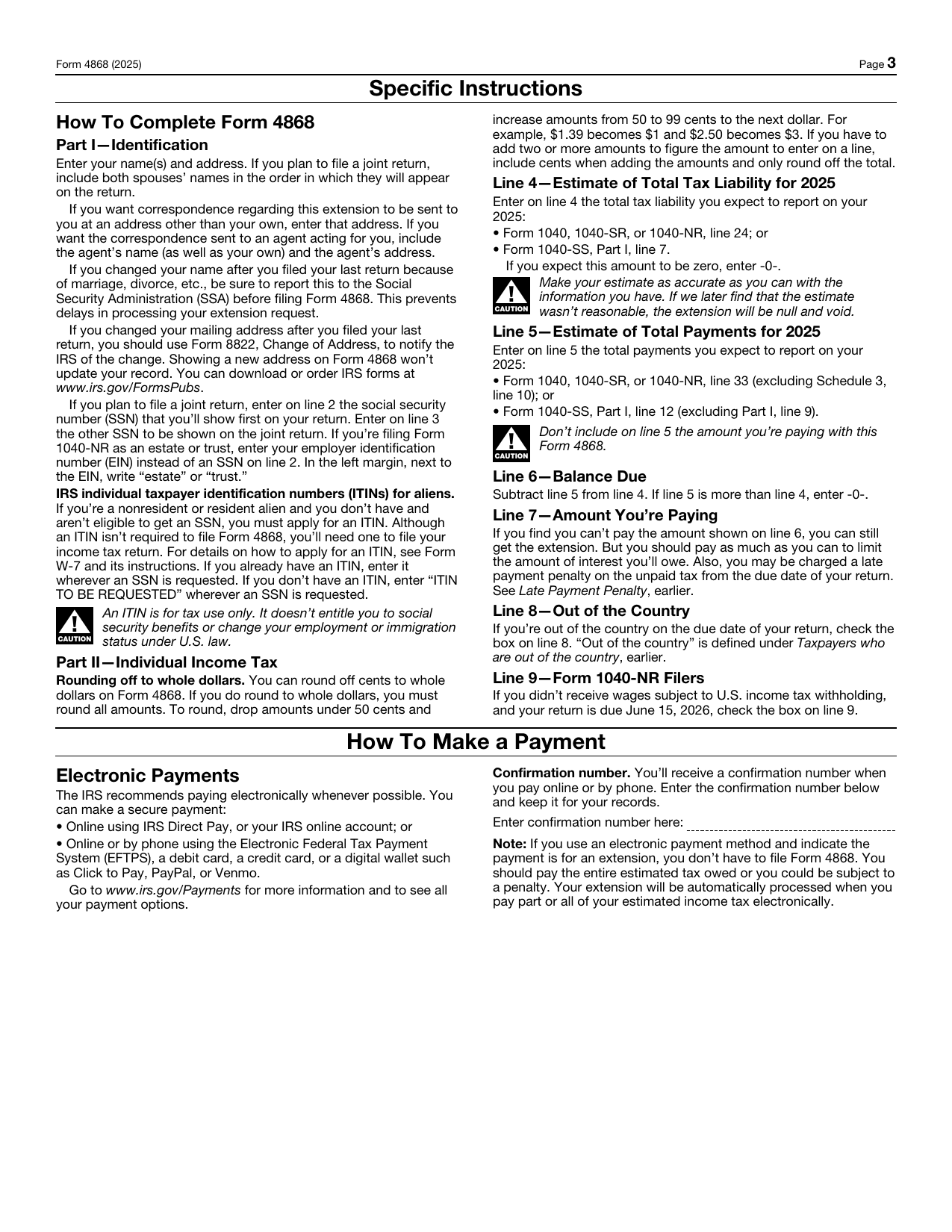
Here’s the real form from the IRS: the page with the voucher you’d mail, and the page where you note your payment confirmation. Every line has a plain-English note and Maya’s numbers from our Form 1040-ES walk-through.
Tap any line on the formHover over any line on the form to see what it means. Click a line to pin its note open so you can use the links. to see what it means. Our example is Maya, the freelance designer from our Form 1040-ES page. She expects $14,993 of total tax for 2026 and paid $12,000 in estimated tax, so she asks for more time to file and pays the last $2,993 by April 15, 2027. The form is the 2025 version, the latest the IRS has published, filled in with her 2026 numbers.

Swipe sideways to see the whole form.
Every line, in plain English
Before you start Three ways to get the extension
You don't have to mail this form to get an extension. You can pay some or all of your tax online and mark the payment as being for an extension, e-file Form 4868 through tax software or a tax pro, or fill in the voucher below and mail it. You get the same extension any of the three ways. Only fiscal-year filers have to use paper.
ExampleMaya pays $2,993 through IRS Direct Pay and picks "Extension" as the reason for the payment. That payment is her extension, so she never fills in the voucher.
Our tipIf you owe anything, paying online and choosing Extension is the usual route. It takes one step instead of two, and you get a confirmation number right away.
Tax year Calendar year or another tax year
The dates are only for people whose tax year doesn't run January to December. If yours is the calendar year, as it is for almost every freelancer and sole proprietor, leave them blank. Fiscal-year filers have to file a paper Form 4868.
ExampleMaya's tax year is the calendar year, so she leaves the dates blank.
Our tipThe year printed on the form matters. For your 2026 return, use the 2026 Form 4868, or just pay online and pick tax year 2026.
Line 1 Your name
Your name as it will appear on your tax return. If you plan to file a joint return, enter both names in the order they'll appear on it. If you changed your name since your last return, tell the Social Security Administration before you file this form, or the extension can be delayed.
ExampleMaya files single, so she enters only her own name.
Line 1 Your address
Where the IRS should write about this extension. You can give an address other than your own, or your tax pro's, with their name next to yours. Putting a new address here doesn't change it in IRS records.
ExampleMaya enters her home address, city, state and ZIP code.
Our tipMoved since your last return? File Form 8822 too, so IRS letters reach you.
Line 2 Your Social Security number
Your own Social Security number. On a joint return, enter the number that will be shown first on the return. If you have an ITIN instead, enter that. If you don't have one yet, the instructions say to write "ITIN TO BE REQUESTED".
ExampleMaya enters her Social Security number, not a business EIN.
Line 3 Spouse's Social Security number
Only for a joint return: the other Social Security number that will be shown on it.
ExampleMaya is single, so she leaves it blank.
Line 4 Your total tax for the year
Your best estimate of the total tax you'll report on your return, the "total tax" line of Form 1040 (line 24 on the 2025 return). For a freelancer that includes self-employment tax as well as income tax. If you expect it to be zero, enter 0. The estimate has to be reasonable: if the IRS later finds it wasn't, the extension doesn't count.
ExampleMaya's 2026 total tax is $14,993: $4,704 of income tax plus $10,289 of self-employment tax.
Our tipYour Form 1040-ES worksheet (line 11c) is a good starting point. Update it with your real numbers for the year.
Line 5 What you've already paid
The total payments you expect to report on your return: tax withheld from a paycheck, your estimated tax payments, any refund from last year you applied to this year, and refundable credits. It's the "total payments" line of Form 1040 (line 33 on the 2025 return). Don't include the amount you're paying with this extension.
ExampleMaya made four estimated payments of $3,000, so she enters $12,000.
Our tipYour IRS Online Account lists every payment you made for the year, so you don't have to dig for confirmations.
Line 6 Balance due
Line 4 minus line 5. This is roughly what you'll owe when you file, and it's due by April 15 even with the extension. If line 5 is more than line 4, enter 0.
ExampleMaya: $14,993 − $12,000 = $2,993.
Line 7 Amount you're paying
What you're paying now. You still get the extension if you can't pay all of line 6, but pay as much as you can: interest runs on anything unpaid after April 15, and there's usually a late-payment penalty of 0.5% a month. If at least 90% of your total tax is paid by April 15 and you pay the rest with your return, the IRS treats you as having a good reason, so the penalty doesn't apply for the extension period. Interest still does.
ExampleMaya pays the whole $2,993, so she won't owe interest or a penalty when she files in October.
Our tipShort on cash? For Maya, getting to 90% ($13,494) would take a payment of at least $1,494.
Line 8 Out of the country
Only for U.S. citizens and residents who live and work outside the U.S. and Puerto Rico, or are on military duty outside them, on the April due date. They get two extra months, to June 15, to file and pay without asking, though interest still runs from April 15. Check this box if you need four more months after that.
ExampleMaya lives and works in the U.S., so she leaves it unchecked.
Line 9 Form 1040-NR filers
Only for nonresident aliens filing Form 1040-NR who didn't get wages with U.S. income tax withheld. Their return is due June 15 instead of April 15.
ExampleMaya files Form 1040, so she leaves it unchecked.
Payment Confirmation number
When you pay online or by phone, you get a confirmation number. Write it here and keep it with your records. If you paid electronically and marked the payment as being for an extension, you don't need to file Form 4868 at all: the extension is processed automatically.
ExampleMaya saves the confirmation number from her $2,993 Direct Pay payment in her 2026 tax folder.
Our tipWhen you file, the extension payment goes on Schedule 3, line 10 (on the 2025 return), so you get credit for it. Don't lump it in with your estimated payments.
Form 4868 · Maya’s 2026 extension
Four numbers, and the one that’s due in April
- 4Total 2026 tax$4,704 income tax plus $10,289 self-employment tax$14,993
- 5Already paidFour estimated payments of $3,000$12,000
- 6Balance dueLine 4 minus line 5$2,993
- 7Paid with the extensionBy April 15, 2027. The return can wait until October 15.$2,993
Single filer with $72,825 of net profit, the same numbers as our Form 1040-ES example. Source: IRS, 2025 Form 4868 and instructions.
How to file a tax extension when you’re self-employed
The IRS gives you three ways to get the same extension. Whichever you pick, do it by April 15, 2027 for a 2026 return.
- Pay online and choose “Extension.” Pay some or all of what you owe through IRS Direct Pay, your IRS Online Account or a card, and mark the payment as being for an extension. The IRS processes the extension automatically, and you don’t file Form 4868.
- E-file Form 4868. Most tax software can send it in a few minutes, and anyone can use IRS Free File for an extension, whatever their income. Have last year’s return handy, since you’ll be asked for details from it.
- Mail the paper form. Fill in the voucher and send it to the address for your state on page 4 of the form, with a check if you’re paying that way.
Here’s how most people choose: if they owe anything, they use option 1. It’s one step instead of two, and the confirmation number is your proof. In Direct Pay, pick “Extension” as the reason for payment and the form number fills in as 4868. Here’s how Direct Pay and the IRS Online Account work. If you don’t owe anything, e-file the form instead.
More time to file, not more time to pay
This is the part people miss. Your tax is still due April 15, 2027. Anything unpaid after that date costs interest, and usually a late-payment penalty of 0.5% a month too.
There’s one break. If at least 90% of your total tax is paid by April 15, through withholding, estimated payments and your extension payment, and you pay the rest with your return, the IRS doesn’t charge the late-payment penalty for the extension period. Interest still runs.
Here’s what that means for Maya, who owes $2,993 after her estimated payments and files on October 15, 2027.
| What Maya pays by April 15 | Late-payment penalty | Interest | Extra cost |
|---|---|---|---|
| All $2,993 | $0 | $0 | $0 |
| $1,494, enough to reach 90% ($13,494) | $0 | About $52 on $1,499 | About $52 |
| Nothing | About $90 (0.5% × 6 months) | About $105 | About $195 |
Interest here uses 7% a year, the IRS rate for late 2026. The rate resets every quarter, so the 2027 numbers may differ a little. Skipping the extension would cost far more if she paid nothing: filing in October without one adds a late-filing penalty of about $670 on top. The late-filing penalty is a share of the unpaid tax, so it’s $0 if she paid it all by April 15. How the IRS penalties compare.
Can’t pay it all? File the extension anyway and pay what you can. Here’s how to set up a payment plan for the rest.
What an extension doesn’t change
An extension moves one date: when your return is due. Everything else stays on its normal schedule.
- Your 2027 estimated payments. The first one is still due April 15, 2027, the same day as your extension payment. Here are all the quarterly tax dates.
- HSAHealth savings account: money goes in tax-free, grows tax-free, and comes out tax-free for medical costs. and IRA contributions for 2026. These are still due by April 15, 2027.
- A SEP IRA is the exception. With an extension, you can open and fund one for 2026 until October 15, 2027. Here’s how much you can put in.
- An S-corpA tax status a business can elect. You pay yourself a salary through payroll, and profit above it skips Social Security and Medicare tax. return. Form 1120-S has its own extension, Form 7004The IRS form a business files to get an automatic six-month extension to file its return. It extends the time to file, not the time to pay., due March 15. Here’s how the S-corp deadlines work.
- Your state return. States have their own extension rules, so check your state’s tax website.
FAQ
Is Form 4868 free?
Yes. There’s no IRS fee, and anyone can e-file it through IRS Free File, whatever their income.
Do I need a reason to get an extension?
No. You don’t have to explain why. The IRS only contacts you if the request is denied, and if you e-file, you get an electronic acknowledgment to keep.
Can I file Form 4868 after April 15?
No. It has to be filed by your return’s due date, April 15, 2027 for a 2026 return. A late extension request doesn’t count, unless you were affected by a disaster that gave you more time. Check whether a disaster postponement covers your county.
Does an extension stop the estimated tax penalty?
No. If your 2026 quarterly payments came up short, that penalty is figured on each due date, extension or not. Maya paid last year’s $12,000 tax in four equal payments, so she owes none. How the estimated tax penalty works.
Can I file my return before October 15?
Yes. You can file any time before the extension runs out. Don’t attach Form 4868 to the return.
Where does my extension payment go on my return?
On Schedule 3, line 10, on the 2025 return, kept separate from your estimated payments. Your tax software asks for it when you file. Here’s what to do on filing day.
Sources
- IRS: 2025 Form 4868 and instructions (PDF)
- IRS: About Form 4868
- IRS: Get an extension to file your tax return
- IRS: Direct Pay help (paying for an extension)
- IRS: Failure to pay penalty
- IRS: Failure to file penalty
- IRS: Interest rates for the fourth quarter of 2026
General education, not tax advice. Line numbers are from the 2025 Form 4868; the dates and examples are for 2026 returns filed in 2027 and may change for later years.