The short answer
Your tax software has your Schedule CThe tax form where you report your business income and expenses. Its bottom line is your profit. and Schedule SEThe tax form that works out your self-employment tax from your Schedule C profit., and then a third form appears that you never asked for: Schedule 1. It has dozens of lines, but a one-person business usually fills in two or three of them.
Schedule 1 (Form 1040) collects income and deductions that don’t fit on the main 1040. Part I adds extra income, like your business profit on line 3, and its total goes to Form 1040, line 8. Part II lists adjustments to income, like half your self-employment taxSocial Security and Medicare tax for people who work for themselves: 15.3% on 92.35% of your profit, on top of income tax. on line 15, and its total goes to Form 1040, line 10. Every sole proprietor with a Schedule C files one.
The line numbers below come from the 2025 Schedule 1, the latest the IRS has published. Our example uses 2026 numbers. The 2026 form, which you’ll file in 2027, may move a line, so check it when it comes out.
Schedule 1, decoded: tap any line
Here’s the real form from the IRS, both pages. The lines a self-employed person uses each have their own note, and the rare ones are grouped so you can see at a glance that they don’t apply to you.
Tap any line on the formHover over any line on the form to see what it means. Click a line to pin its note open so you can use the links. to see what it means. Our example is Maya, the freelance designer from our Schedule C and Schedule SE pages: $72,825 of net profit in 2026, no W-2 job, and $5,145 for half of her self-employment tax.
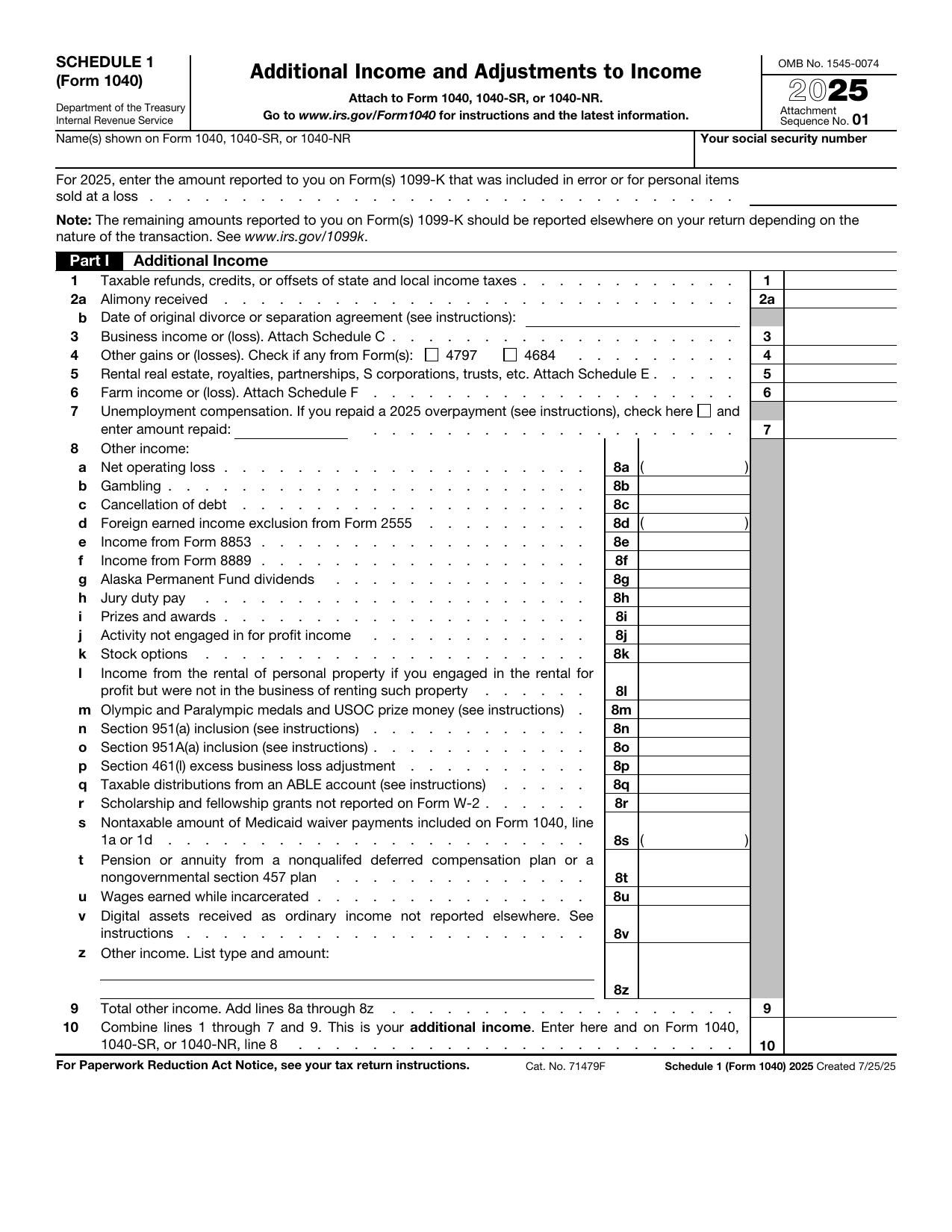
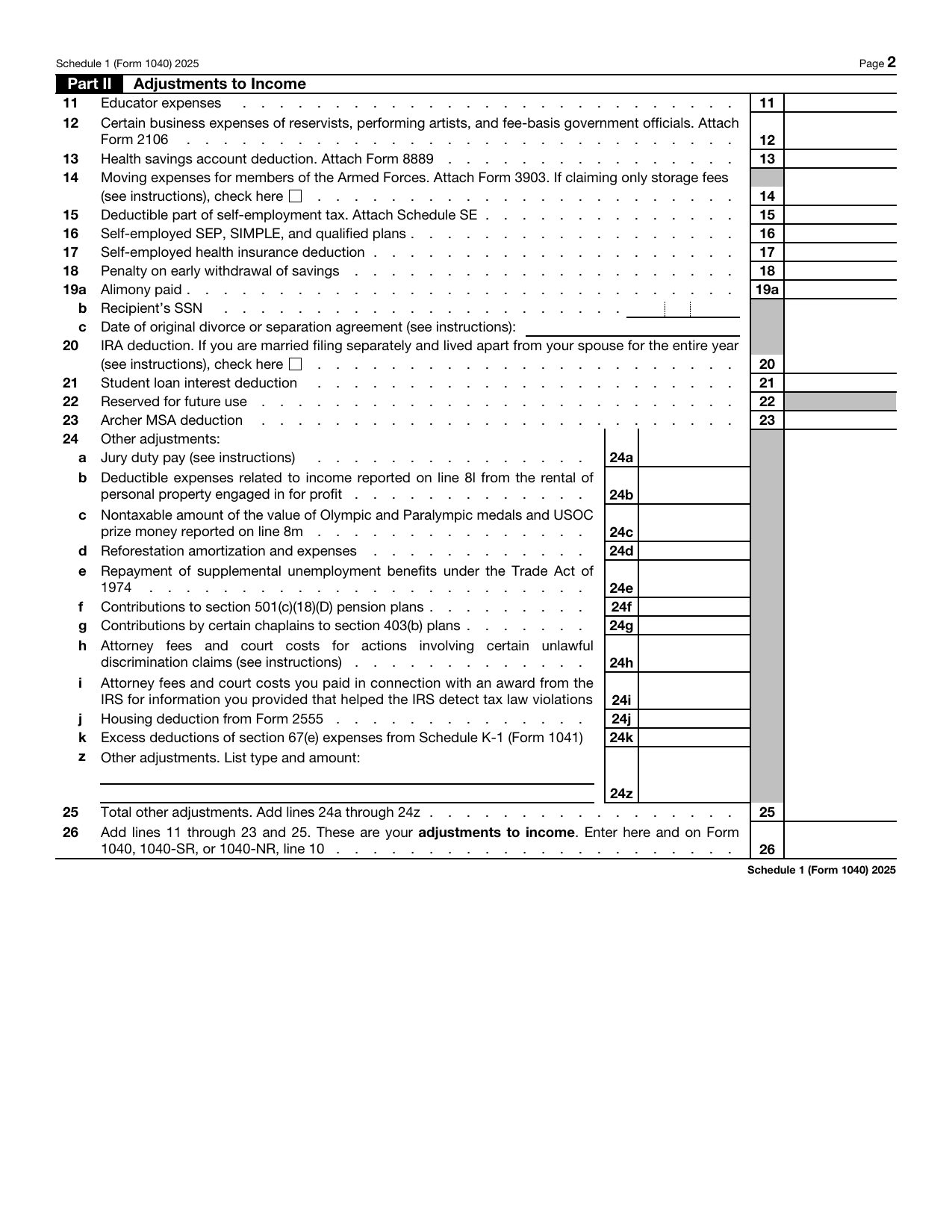
Swipe sideways to see the whole form.
Every line, in plain English
Name Your name
The name or names exactly as they appear on your Form 1040. On a joint return, that's both of you, in the same order.
ExampleMaya writes her own name.
SSN Your Social Security number
The first Social Security number shown on your Form 1040. It ties this schedule to the rest of your return.
ExampleMaya enters her own Social Security number, not a business EIN.
1099-K line A 1099-K that was wrong, or for personal things sold at a loss
If a payment app or marketplace sent you a 1099-K that included money it shouldn't have, like a friend paying you back, or a personal item you sold for less than you paid, you enter that amount here so the IRS sees why it isn't taxed. Business payments on a 1099-K don't go here: they go on Schedule C. For 2025, apps only had to send one above $20,000 and more than 200 payments.
ExampleSay you sold your old couch for $700 that cost you $1,000, and it showed up on a 1099-K. You enter $700 here. Maya's 1099-K is all design work, so she leaves this blank.
Our tipNever use this box to hide business income. Every business payment belongs on Schedule C, line 1, form or no form.
Line 1 State or local tax refunds
A state or local income tax refund is only taxable if you itemized deductions last year and deducted the tax it refunds. If you took the standard deduction last year, none of it goes here. The 1040 instructions have a worksheet for the taxable part.
ExampleMaya took the standard deduction last year, so her state refund isn't taxable and line 1 is blank.
Lines 2a and 2b Alimony received
Alimony you received counts as income only under a divorce or separation agreement made on or before December 31, 2018 (and not later changed to say otherwise). Line 2b asks for the month and year of that agreement. Alimony under newer agreements isn't taxable, and child support never is.
ExampleMaya doesn't receive alimony, so both lines are blank.
Line 3 Business income or loss
Your net profit or loss from Schedule C, line 31. This is how your business profit joins your other income for income tax. Run more than one business? Each gets its own Schedule C, and you add their results together here. A loss goes in as a negative number and lowers your other income.
ExampleMaya copies $72,825 from line 31 of her Schedule C.
Our tipSelf-employment tax on the same profit is figured separately, on Schedule SE.
Line 4 Selling business property
Gains or losses from selling things your business used, like a car or equipment, from Form 4797. Losses from a casualty or theft of business property come from Form 4684. You check the box for the form you used.
ExampleMaya didn't sell any business equipment, so this is blank.
Our tipSelling a computer you wrote off in full usually means some of the sale price is taxable again. Form 4797 works that out.
Line 5 Rentals, royalties, partnerships, S-corps
Income or loss from Schedule E: rental property, royalties, and your share from a partnership, an S-corp, an estate or a trust. If your LLC is taxed as an S-corp, your share of its profit lands here, not on line 3.
ExampleMaya is a sole proprietor with no rentals, so line 5 is blank.
Line 6 Farm income or loss
Your profit or loss from Schedule F, the farmer's version of Schedule C.
ExampleMaya doesn't farm, so this is blank.
Line 7 Unemployment compensation
Unemployment benefits from Form 1099-G, box 1. If you paid back an overpayment in the same year, you subtract it, check the box and write the amount you repaid.
ExampleMaya had no unemployment benefits in 2026, so this is blank.
Our tipUnemployment is taxable, but often nothing is withheld from it. If you collected some before your business got going, plan for the tax.
Line 8a A net operating loss from an earlier year
If a business loss in an earlier year was bigger than all your other income, the leftover can carry forward and lower this year's income. You enter it in the parentheses as a negative number.
ExampleMaya has never had a loss that big, so this is blank.
Lines 8b and 8c Gambling winnings and canceled debt
Line 8b is gambling winnings, including lotteries and raffles. Line 8c is debt a lender forgave, often shown on Form 1099-C, though some or all of it can be nontaxable.
ExampleMaya had neither, so both lines are blank.
Lines 8d to 8g Foreign income exclusion, medical savings accounts and Alaska dividends
Line 8d subtracts foreign earned income you exclude on Form 2555. Lines 8e and 8f are taxable amounts from Archer or Medicare Advantage medical savings accounts (Form 8853) and from an HSA (Form 8889), such as money taken out for non-medical costs. Line 8g is the Alaska Permanent Fund dividend.
ExampleMaya lives and works in the U.S. and used her HSA only for medical bills, so these lines are blank.
Lines 8h and 8i Jury duty pay, prizes and awards
Line 8h is jury duty pay. If you had to hand it over to an employer who kept paying your salary, you take it back out on line 24a. Line 8i is prizes and awards, such as a contest prize.
ExampleMaya didn't serve on a jury or win anything, so both are blank.
Our tipA self-employed person keeps any jury pay, since there's no employer to hand it over to.
Line 8j Hobby income
Income from an activity you don't run to make a profit, like selling a few paintings a year. It's taxed, but under current rules you can't deduct the costs of a hobby against it. A real business goes on Schedule C instead, where expenses count.
ExampleMaya's design work is a business, so it goes on Schedule C, not here.
Our tipRunning it like a business, with separate records, a profit plan and steady effort, is what the IRS looks at to tell the two apart.
Lines 8k to 8m Stock options, renting out personal property, Olympic medals
Line 8k is income from exercising stock options that isn't already in your wages. Line 8l is for renting out personal things, like a camera or a trailer, for profit when that isn't your business; its expenses come back off on line 24b. Line 8m is Olympic and Paralympic medals and prize money, which can be taken back out on line 24c.
ExampleMaya has none of these, so the lines are blank.
Lines 8n to 8r Foreign company income, excess business losses, ABLE accounts, scholarships
Lines 8n and 8o are for shareholders of certain foreign corporations. Line 8p adds back a business loss above the yearly limit, figured on Form 461. Line 8q is the taxable part of ABLE account withdrawals, and line 8r is scholarship money not on a W-2 that wasn't spent on tuition and course costs.
ExampleNone of these apply to Maya, so they're blank.
Our tipThe excess business loss rule only reaches very large losses, so it rarely touches a one-person business.
Lines 8s to 8u Medicaid waiver payments, deferred compensation, wages while incarcerated
Line 8s subtracts certain nontaxable Medicaid waiver payments for caring for someone who lives with you. Line 8t is a pension or annuity from a nonqualified deferred compensation plan or a nongovernmental 457 plan. Line 8u is pay for work done while in prison.
ExampleMaya has none of these, so the lines are blank.
Line 8v Crypto income not reported elsewhere
Ordinary income from digital assets that isn't on another line, like staking or mining rewards when they aren't part of a business. Sales of crypto go on Form 8949 and Schedule D instead. If you mine or stake as a business, it goes on Schedule C.
ExampleMaya doesn't own crypto, so this is blank. If a client paid her in crypto for design work, that would be business income on Schedule C, not here.
Line 8z Other income
Taxable income that doesn't fit anywhere else, with a short description, such as a reimbursement for something you deducted last year. The IRS is clear that self-employment income never goes on lines 8a to 8z, even with no expenses and even if it came on a 1099-NEC: it belongs on Schedule C.
ExampleMaya has nothing to list, so this is blank.
Our tipTax software sometimes asks "Was this 1099-NEC for work you do regularly?" A yes sends it to Schedule C, where it's counted for self-employment tax too.
Line 9 Total other income
Lines 8a through 8z added together, with the amounts in parentheses subtracted.
ExampleMaya: 0.
Line 10 Your additional income
Lines 1 through 7 plus line 9. This total goes to Form 1040, line 8, where it joins your wages, interest and other income.
ExampleMaya: $72,825, all of it from her business on line 3.
Line 11 Educator expenses
If you're a K-12 teacher, counselor, principal or aide who worked at least 900 hours in a school year, you can deduct up to $300 of classroom costs you paid yourself on the 2025 form.
ExampleMaya isn't a teacher, so this is blank.
Line 12 Reservists, performing artists, fee-basis officials
Work expenses for three groups only: National Guard and reserve members who traveled more than 100 miles from home, qualified performing artists, and fee-basis state or local government officials. You figure them on Form 2106.
ExampleMaya isn't in any of these groups, so this is blank. Her own business costs are already on Schedule C.
Line 13 Health savings account deduction
Money you put into an HSA yourself, figured on Form 8889. With no employer, that's every contribution for a self-employed person. You need a high-deductible health plan, and the 2026 limit is $4,400 for self-only coverage or $8,750 for family coverage.
ExampleMaya has no HSA, so this is blank. Had she put $4,400 into one for 2026, it would go here.
Our tipLike the lines below, it lowers your income tax but not your self-employment tax.
Line 14 Moving expenses for the military
Only active-duty members of the Armed Forces who moved because of a permanent change of station can deduct moving costs, on Form 3903. The box is for those claiming only storage fees.
ExampleMaya isn't in the military, so this is blank.
Line 15 Half of your self-employment tax
The deduction from Schedule SE, line 13: half of your self-employment tax. It lowers the income you pay income tax on, whether you take the standard deduction or itemize. It doesn't lower the self-employment tax itself.
ExampleMaya: $5,144.92 from Schedule SE, rounded to $5,145.
Our tipIn the 12% bracket that saves about $617; in the 22% bracket, about $1,132.
Line 16 SEP, SIMPLE and solo 401(k) contributions
What you put into a retirement plan for yourself as a self-employed person: a SEP IRA, a SIMPLE IRA or a qualified plan like a solo 401(k), both the employee and employer parts. Roth contributions aren't deductible, so they stay off this line. Contributions for employees go on Schedule C instead.
ExampleMaya's main example has no plan, so this is blank. Say she also put $10,000 into a solo 401(k) for 2026: line 16 would be $10,000.
Our tipThis lowers your income tax only. Retirement contributions for yourself never come off Schedule C, so they don't lower self-employment tax.
Line 17 Self-employed health insurance
Health, dental and vision premiums (and qualified long-term care) you paid for yourself, your spouse and your dependents, on a plan set up under your business. It can't be more than your business profit minus lines 15 and 16, and you can't count any month you could have joined a subsidized plan through your job or your spouse's. A short worksheet in the 1040 instructions or Form 7206 figures it.
ExampleSay Maya also paid $500 a month, $6,000 for 2026, for a plan she bought on her own with no premium tax credit. Line 17 would be $6,000, well under her limit.
Our tipIf you get a premium tax credit for a marketplace plan, the two are figured together using IRS Publication 974. Tax software handles it.
Line 18 Penalty for cashing in savings early
If you closed a CD early and the bank kept some interest as a penalty, you deduct that penalty here. Form 1099-INT or 1099-OID shows the amount.
ExampleMaya didn't break a CD, so this is blank.
Lines 19a to 19c Alimony paid
Alimony you paid is deductible only under a divorce or separation agreement made on or before December 31, 2018, and not later changed to say otherwise. You also give your former spouse's Social Security number and the month and year of the agreement.
ExampleMaya doesn't pay alimony, so these lines are blank.
Line 20 Traditional IRA deduction
Contributions to a traditional IRA. You need earned income, and for a self-employed person that's generally your net earnings from the business. If you're covered by a retirement plan, and a SEP, SIMPLE or solo 401(k) counts, the deduction can shrink or disappear at higher incomes. Roth IRA contributions are never deductible.
ExampleMaya has no IRA, so this is blank.
Our tipAlready have a solo 401(k) or SEP? Putting more there usually beats a traditional IRA for the deduction.
Line 21 Student loan interest
Interest you paid on a qualified student loan, up to $2,500. The deduction phases out at higher incomes, and your lender sends Form 1098-E if you paid $600 or more.
ExampleMaya paid off her student loans, so this is blank.
Lines 22 and 23 Reserved, and Archer MSA
Line 22 is shaded and reserved for future use, so it stays empty. Line 23 is the deduction for an Archer medical savings account, an older account that most people now have as an HSA instead, figured on Form 8853.
ExampleBoth are blank for Maya.
Lines 24a to 24c Taking back jury pay, rental costs and Olympic prizes
These undo three amounts from page 1. Line 24a is jury duty pay you handed over to your employer. Line 24b is the expenses of renting out personal property, against the income on line 8l. Line 24c is the nontaxable part of Olympic and Paralympic medals and prize money from line 8m.
ExampleMaya has none of these, so the lines are blank.
Lines 24d to 24k Rare adjustments
A list of narrow deductions: reforestation costs, repaying certain Trade Act unemployment benefits, two kinds of special pension contributions, attorney fees in discrimination claims and IRS whistleblower awards, the foreign housing deduction from Form 2555, and excess deductions passed through from an estate or trust.
ExampleNone apply to Maya, so these lines are blank.
Line 24z Other adjustments
A write-in line for an adjustment with no line of its own. The 2025 instructions say to leave it blank.
ExampleMaya leaves it blank.
Line 25 Total other adjustments
Lines 24a through 24z added together.
ExampleMaya: 0.
Line 26 Your adjustments to income
Lines 11 through 23 plus line 25. This total goes to Form 1040, line 10, where it comes off your total income to give your adjusted gross income (AGI). You get these whether you take the standard deduction or itemize.
ExampleMaya: $5,145, just line 15. With the solo 401(k) and health insurance from the "say she also" examples, it would be $21,145.
Our tipEvery dollar here lowers your income tax, but none of it lowers self-employment tax, which is figured from Schedule C profit alone.
Who files Schedule 1
You file Schedule 1 if you have any income or adjustment that the main Form 1040 has no line for. For readers of this site, that’s almost always because of the business.
- You file Schedule C. Your net profit or loss from Schedule C, line 31, has to reach your 1040 through Schedule 1, line 3. A loss counts too.
- You owe self-employment tax. Half of it is deductible, and that deduction lives on line 15. Deducting all of it instead is a math error the IRS can correct, and it shows up as a CP12 notice if you’re still due a refund.
- You have other extra income or deductions, such as unemployment benefits, an HSAHealth savings account: money goes in tax-free, grows tax-free, and comes out tax-free for medical costs. contribution, student loan interest or a traditional IRA.
You don’t need to hunt for the form. Tax software fills it in from your answers and attaches it for you.
The lines a self-employed person uses
Most of Schedule 1 is for situations you’ll never meet. These are the lines that matter for a one-person business, with Maya’s numbers for 2026. The last two columns are her real numbers and a “say she also” version with a solo 401(k) and health insurance.
| Line | What goes there | Maya | Say she also |
|---|---|---|---|
| 3 | Business profit from Schedule C, line 31 | $72,825 | $72,825 |
| 10 | Additional income, to Form 1040, line 8 | $72,825 | $72,825 |
| 13 | HSA contributions you made yourself | $0 | $0 |
| 15 | Half of self-employment tax, from Schedule SE, line 13 | $5,145 | $5,145 |
| 16 | SEP, SIMPLE or solo 401(k) contributions for yourself | $0 | $10,000 |
| 17 | Self-employed health insurance | $0 | $6,000 |
| 20 | Traditional IRA deduction | $0 | $0 |
| 26 | Adjustments to income, to Form 1040, line 10 | $5,145 | $21,145 |
If you keep an HSA, it goes on line 13. How an HSA works when you’re self-employed.
Maya’s Schedule 1, start to finish
Maya is a freelance designer with $72,825 of net profit in 2026 and no W-2The form an employer sends each January showing your wages and the tax withheld. As an S-corp owner, your own company sends you one. job. It’s the same Maya from our Schedule C and Schedule SE walk-throughs, so you can follow her numbers from form to form.
- Part I. She copies $72,825 from Schedule C, line 31, to line 3. She has no other extra income, so line 10 is also $72,825, and it goes to Form 1040, line 8.
- Part II. Her Schedule SE shows $10,289.84 of self-employment tax, and half of it, $5,144.92, is on line 13. She rounds it to $5,145 for line 15. That’s her only adjustment, so line 26 is $5,145, and it goes to Form 1040, line 10.
- The result. Form 1040 subtracts line 10 from her total income. Her adjusted gross incomeYour total income minus a few specific deductions, like half your self-employment tax. Many limits and credits are based on it. is $72,825 minus $5,145, or $67,680.
Now say she also put $10,000 into a solo 401(k) and paid $6,000 in health insurance premiums for 2026. Line 16 becomes $10,000, line 17 becomes $6,000, and line 26 grows to $21,145. Her adjusted gross income drops to $51,680, which lowers her income tax by 12 to 22 cents for each of those dollars, depending on her bracket.
If you pay for your own health insurance or put money aside for retirement, it’s worth checking that your tax software asks about both. They’re two of the biggest deductions a freelancer has, and they live here, not on Schedule C. How the health insurance deduction works, and which retirement plan to pick.
Why Part II deductions are worth having
The adjustments in Part II come off your income before the standard deductionThe amount you subtract from income before tax without listing deductions. On your federal return: $16,100 if single, $32,200 if married filing jointly (2026). States set their own.. You get them whether you take the standard deduction or itemize, which most deductions can’t say.
A lower adjusted gross income can also help elsewhere on your return, because many credits and deductions shrink as it rises. What they can’t do is lower your self-employment tax. That tax is figured from your Schedule C profit alone, so only business expenses reduce it. The full list of self-employed write-offs.
What doesn’t go on Schedule 1
A few things people expect to find here live somewhere else on the return.
- Business expenses. Software, mileage, a home office and the rest go on Schedule C, which is what makes line 3 smaller.
- The self-employment tax itself. Schedule SE, line 12, goes to Schedule 2, line 4. Only the deductible half comes to Schedule 1.
- Freelance income on lines 8a to 8z. The IRS instructions say self-employment income never goes on the “other income” lines, even with no expenses and even if it came on a 1099-NECThe form a client sends you (and the IRS) showing what they paid you. Required for payments of $2,000 or more in 2026.. It belongs on Schedule C.
- Your estimated taxTax you send the IRS yourself during the year, usually four times, because no employer is withholding it from a paycheck. payments. Those go on Form 1040, line 26. How to figure them on Form 1040-ES.
- The new deductions for tips, overtime, car loan interest and seniors. Starting with 2025 returns, these are on a separate form, Schedule 1-A.
FAQ
What is Schedule 1 used for?
It reports income and deductions that don’t have a line on Form 1040 itself. Part I covers extra income, such as business profit and unemployment. Part II covers adjustments to income, such as half of self-employment tax, retirement contributions and student loan interest.
Do I need Schedule 1 if I’m self-employed?
Yes. Your Schedule C profit or loss reaches your 1040 through Schedule 1, line 3, and the deduction for half of your self-employment tax goes on line 15.
Where does my Schedule C income go on Schedule 1?
Line 3, business income or loss. If you have more than one Schedule C, you add their results together there.
Where do I deduct my solo 401(k) or SEP IRA contributions?
On line 16, for contributions you make for yourself. Contributions for employees go on Schedule C instead. The 2026 solo 401(k) limits.
Is the self-employed health insurance deduction on Schedule 1?
Yes, on line 17. It can’t be more than your business profit minus lines 15 and 16, and you can’t count months you could have joined a subsidized plan through a job or your spouse’s job.
What’s the difference between Schedule 1 and Schedule 2?
Schedule 1 adds income and subtracts adjustments. Schedule 2 adds extra taxes, including your self-employment tax from Schedule SE.
Does Schedule 1 lower my self-employment tax?
No. Part II lowers your income tax only. Self-employment tax is figured on Schedule SE from your Schedule C profit, so only business expenses lower it.
Sources
- IRS: About Form 1040 and its schedules
- IRS: 2025 Schedule 1 (PDF)
- IRS: 2025 Instructions for Form 1040, including Schedule 1
- IRS: 2025 Instructions for Schedule SE
- IRS: Publication 560, Retirement Plans for Small Business
- IRS: About Form 7206, Self-Employed Health Insurance Deduction
General education, not legal or tax advice. Line numbers are from the 2025 Schedule 1; examples and limits are for 2026 and may change for later years.