The short answer
Early in the year, tax forms start showing up in your mailbox and inbox, and some of them have “1099” in the name. Here’s which one is which.
A 1099-NECThe form a client sends you (and the IRS) showing what they paid you. Required for payments of $2,000 or more in 2026. comes from a client who paid you $2,000 or more in 2026 by check or bank transfer. A 1099-KThe form payment apps and card processors send to report what you were paid through them. For 2026, apps and marketplaces send one over $20,000 and more than 200 payments; a traditional card merchant account reports card payments at any amount. comes from a payment app, marketplace or card processor. Apps and marketplaces like PayPal, Venmo, Stripe and Etsy send one when you were paid more than $20,000 across more than 200 payments in 2026. A traditional card merchant account reports card payments at any amount.
Neither form is a bill. Both are just reports to the IRS of money it already expects to see on your return. You owe tax on all your business income, whether or not a form arrives. If the forms and your return don’t match, the IRS mails a CP2000 notice asking about the difference. Forms for 2026 are due to you by February 1, 2027. Got paid a few different ways? Our free 1099 checker lists the forms to expect for your own mix of income, from bank interest to brokerage accounts.
For 2026 payments · due to you by Feb 1, 2027
Which 1099 you’ll get
You owe tax on all business income, with or without a form. Source: IRS.
Form 1099-NEC, decoded: tap any box
Here’s the real Copy B from the IRS, the copy you get as the person who was paid. Every box has a plain-English note with an example, so you know which number matters before you open your tax software.
Tap any line on the formHover over any line on the form to see what it means. Click a line to pin its note open so you can use the links. to see what it means. Our example is Maya, a freelance designer. One client paid her $12,000 by bank transfer in 2026 and sent her this form, with $12,000 in box 1a and no tax withheld.
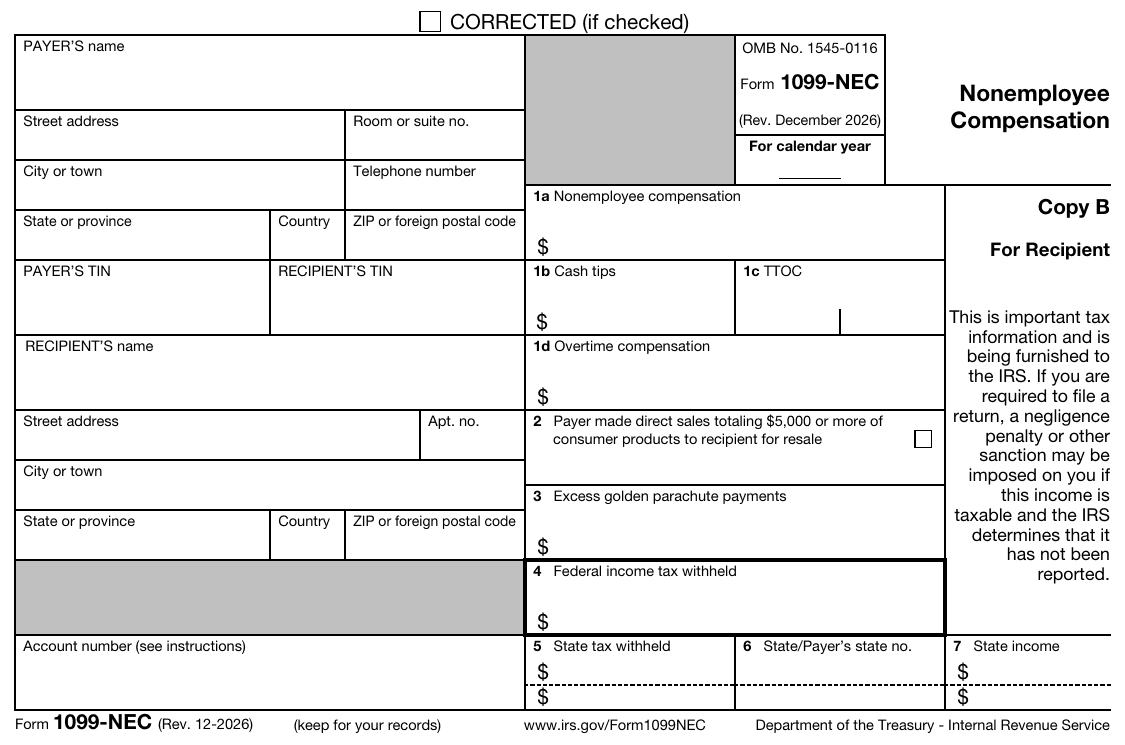
Swipe sideways to see the whole form.
Every line, in plain English
Corrected A corrected form
If this box is checked, the form replaces one the payer sent you earlier, usually because an amount or your details were wrong. Use the corrected one when you file.
ExampleSay Maya's client first reported $21,000 by mistake. Once she points it out, the client sends a new form with this box checked and $12,000 in box 1a.
Our tipIf you spot a mistake, ask the payer for a corrected form. Don't hold up your return waiting for it: file on time using your own records.
Payer Who paid you
The client's name, address and phone number. This is the business reporting your pay to the IRS, and the phone number is there so you can ask about the form.
ExampleMaya's says Northwind Studio LLC, the client that paid her $12,000.
Our tipDon't recognize the name? It may be a client's legal company name rather than the brand you know.
Calendar year The year you were paid
The year the payments were made. Check it, because a form for one year belongs on that year's return and no other.
ExampleMaya's says 2026, so it goes with the 2026 return she files in 2027.
Payer's TIN The client's tax ID
The payer's taxpayer identification number, usually an EIN. You don't need to do anything with it, though tax software may ask for it when you enter the form.
Recipient's TIN Your tax ID
Your Social Security number, or the EIN you gave the client on your W-9. For your protection, it may show only the last four digits, but the payer gave the IRS the full number.
ExampleMaya put her EIN on her W-9, so her form shows her EIN, not her Social Security number.
Our tipIf the number is wrong, ask the payer to fix it. The IRS uses it to match this form to your return.
Recipient's name Your name
Your name, or your business name, as you gave it on the W-9 you sent the client. It should line up with the tax ID next to it.
ExampleMaya's form says Maya Reyes.
Address Your mailing address
Where the payer sent your copy. An old address doesn't change what you owe, but tell the payer so next year's form reaches you.
Account number The payer's reference number
A number the payer may use to tell your accounts apart, for example if they send you more than one 1099-NEC. It's often blank, and you can ignore it.
Box 1a Nonemployee compensation
The number that matters. It's what this client paid you for your work during the year, before any of your costs. For most freelancers it's business income, so it goes on Schedule C line 1 and counts toward self-employment tax. Payments by card or a payment app aren't included: those show up on a 1099-K instead.
ExampleMaya's box 1a shows $12,000. It's part of the total she reports on Schedule C line 1, not an extra amount on top.
Our tipCheck it against your own records. Clients that paid you less than $2,000 in 2026 ($600 in 2025) don't have to send a form, but that money is still taxable.
Box 1b Cash tips
New on this revision. It shows the cash tips included in box 1a, counting tips paid in cash or charged by customers. They're already in box 1a, so don't add them again. You use this amount for the new deduction for qualified tips on Schedule 1-A.
ExampleMaya doesn't get tips for design work, so hers is blank.
Box 1c Tipped occupation code (TTOC)
A Treasury Tipped Occupation Code for the job your tips came from, up to two codes. It's used with box 1b for the tips deduction. If the only code is 000, those tips don't qualify for the deduction.
ExampleMaya's is blank.
Box 1d Overtime compensation
New on this revision. If you were paid overtime that federal wage law requires, this shows the qualified part: only the extra half in time-and-a-half. It's already included in box 1a. You use it for the overtime deduction on Schedule 1-A.
ExampleMost freelancers, Maya included, see this blank.
Box 2 Direct sales of $5,000 or more
A checkbox, not a dollar amount. It's checked if the payer sold you $5,000 or more of consumer products for you to resell somewhere other than a permanent store. Income from reselling them generally goes on Schedule C.
ExampleMaya sells design work, not products, so it's unchecked.
Box 3 Excess golden parachute payments
Rare. These are special payments tied to a change in a company's ownership or control, made to people like officers, shareholders or highly paid workers. The excess part carries an extra 20% excise tax. Almost every freelancer sees this blank.
ExampleMaya's is blank.
Box 4 Federal income tax withheld
Usually blank. A payer has to hold back tax, called backup withholding, if you didn't give them your taxpayer ID, for example by never returning their W-9. Any amount here is tax you've already paid, so you claim it on your return as tax withheld.
ExampleMaya sent her W-9 right away, so box 4 is blank. If she hadn't, the client could have held back 24% of her $12,000, which is $2,880.
Our tipWith nothing withheld, paying the tax is up to you. That's what quarterly estimated taxes are for.
Box 5 State tax withheld
State income tax the payer held back for you, if any. It's uncommon on a 1099-NEC. There's room for two states, one per row.
ExampleMaya's is blank.
Box 6 State and payer's state number
The state's abbreviation and the payer's ID number with that state. Boxes 5 to 7 are optional as far as the IRS is concerned, so many forms leave them blank.
Box 7 State income
The amount of the payment the payer reported to that state. Your state return may use it, but the federal return goes by box 1a.
Copy B Your copy
This copy is for you, the person who got paid. The payer files the same numbers with the IRS, and as the note on the form says, the IRS can add a penalty if taxable income on it goes unreported. You don't attach it to your return: keep it with your tax records.
ExampleFor 2026 payments, Maya's copy is due to her by February 1, 2027, because January 31 falls on a Sunday.
Form 1099-NEC
This is the one most freelancers get from clients. Here’s what to know about it.
- Who sends it: a business client that paid you for services. It goes to sole proprietors and LLCs; payments to corporations, including an LLC taxed as an S-corpA tax status a business can elect. You pay yourself a salary through payroll, and profit above it skips Social Security and Medicare tax., are mostly exempt.
- The 2026 threshold: $2,000 or more in a year. Before 2026 it was $600, so you’ll probably get fewer of these than you used to. Here’s what the $2,000 threshold covers, and what else changes for 2026.
- When: by January 31. For 2026 payments that becomes February 1, 2027, because January 31 is a Sunday.
- What to look at: Box 1a, “nonemployee compensation” (plain box 1 on forms for 2025 and earlier). Check it against your own records before you file.
- Where the client gets your details: the W-9The form you give clients with your name and tax ID, so they can send you a 1099. you send them. How W-9s and invoicing work.
One thing that surprises people: a client who paid you by card or through a payment app shouldn’t send a 1099-NEC for those payments. The app or card processor reports them on a 1099-K instead, so the same money isn’t reported twice.
Form 1099-K
If clients pay you through an app or you sell online, this is the form to watch for.
- Who sends it: payment apps and online marketplaces (PayPal, Venmo and Cash App business accounts, Stripe, Square, Etsy, eBay, Upwork and similar), and card processors. Our Upwork and Fiverr taxes guide walks through a platform freelancer’s 1099-K.
- The 2026 threshold: apps and marketplaces send one when you got more than $20,000 in more than 200 payments. The lower $600 rule you may have heard about was repealed in 2025. A traditional card merchant account reports every card payment, at any amount, while Stripe and Square use the same $20,000 and 200-payment line as apps. Any platform may send one below the threshold.
- What to look at: Box 1a is the gross amount, before fees, refunds and shipping. Your real income is lower, and you deduct the fees on your return, so don’t panic at the big number. Our Etsy seller taxes guide works through a shop’s 1099-K with real numbers.
- Personal money: friends paying you back for dinner aren’t income and shouldn’t be on a 1099-K. If they are, keep records that show it, and ask the platform to correct the form.
Form 1099-K, decoded: tap any box
Here’s the real Copy B of the 1099-K, the copy you get as the person who was paid. Every box has a plain-English note with an example, including the two that confuse people most: the gross amount in box 1a and the checkbox that says whether it’s card payments or app payments.
Tap any line on the formHover over any line on the form to see what it means. Click a line to pin its note open so you can use the links. to see what it means. Our example is Maya, the freelance designer from the 1099-NEC above. Some smaller clients pay her invoices by card, through the card processor she uses. In 2026 that came to $9,600 in 48 payments, $800 every month, so the processor sends her this form. Card processors report every card payment, whatever the total.

Swipe sideways to see the whole form.
Every line, in plain English
Corrected A corrected form
If this box is checked, the form replaces one the company sent you earlier, usually because an amount or your details were wrong. Use the corrected one when you file.
ExampleSay Maya's first form showed $12,000 because the processor counted a refund as a sale. Once she points it out, the processor sends a new form with this box checked and $9,600 in box 1a.
Our tipIf a number is wrong, contact the filer named on the form and ask for a correction. Don't hold up your return waiting for it: file on time using your own records.
Filer The company that sent the form
The name, address and phone number of the card processor, payment app or marketplace reporting your payments. The phone number has to reach someone who can answer questions about the amounts, so this is who you call if something looks wrong.
ExampleMaya's says Harbor Payments, the card processor behind her invoice payment links.
Our tipDon't recognize the name? It may be the legal name of an app you know by its brand. If you still can't place it, the instructions say to contact the company in the PSE box near the bottom.
Calendar year The year the payments were made
The year these payments came in. A form for one year belongs on that year's return and no other.
ExampleMaya's says 2026, so it goes with the 2026 return she files in 2027.
Filer type Who is filing: a PSE or an EPF
A payment settlement entity (PSE) is the card processor or the payment app or marketplace that settles the payments to you. Sometimes a PSE hires another company, an electronic payment facilitator (EPF), to send the money, and then that company files the form instead. If the EPF box is checked, the PSE's name and phone show up near the bottom left.
ExampleMaya's card processor files its own form, so the PSE box is checked.
Transactions Card payments or app payments
Payment card means customers paid you by credit, debit or gift card through a card processor. Card processors report these at any amount. Third party network means payments through an app or marketplace, which only has to send a form above $20,000 and more than 200 payments, though it may send one below that.
ExampleMaya's clients paid by card, so Payment card is checked. That's why she got a form for $9,600, well under $20,000.
Our tipA company that handles both kinds for you has to send a separate form for each, so you may get two 1099-Ks from the same company. Count each one once.
Filer's TIN The company's tax ID
The filer's taxpayer identification number. You don't need to do anything with it, though tax software may ask for it when you enter the form.
Payee's TIN Your tax ID
Your Social Security number, or the EIN on the account. For your protection, it may show only the last four digits, but the filer gave the IRS the full number.
ExampleMaya opened her processor account with her Social Security number, before she got her EIN, so hers shows ***-**-4821, the last four of that number.
Our tipIf your business files its own return, like an S-corp on Form 1120-S, and this form shows your personal name and number, ask the filer to correct it.
Payee's name Your name
The name on the account the payments went to: yours, or your business name. It should line up with the tax ID above it.
ExampleMaya's says Maya Reyes.
Address Your mailing address
The address on your account. An old address doesn't change what you owe, but update it in your account so next year's form reaches you.
PSE's name and phone Who to call if you don't know the filer
Filled in when the filer is an EPF working for a PSE. It gives the PSE's name and a phone number. If you don't recognize the company in the top left corner, the IRS says to contact this one.
ExampleMaya's processor filed the form itself, so this box is blank.
Account number Your account with the company
A number the filer uses to tell your accounts apart. It's required when you have more than one account and get more than one 1099-K from them. Otherwise you can usually ignore it.
Box 1a Gross amount of card and app payments
The number that matters. It's the total of every payment to you for the year, before fees, refunds, shipping, discounts or anything else comes out. So it's almost always higher than what landed in your bank account. If the payments were for your business, they're part of your gross receipts on Schedule C line 1, and you deduct the fees and refunds as expenses.
ExampleMaya's box 1a shows $9,600. The processor kept $288 in fees, so only $9,312 reached her bank. She counts the full $9,600 in her income and deducts the $288 on Schedule C.
Our tipStart from your own records, then check this form fits inside them. Payments that are also on a 1099-NEC, or personal money like friends paying you back, shouldn't be counted twice or taxed.
Box 1b Card not present transactions
The part of box 1a paid without the card in front of you: online, by phone, or with the number typed in. It's already included in box 1a, so don't add it again. It's left out when the form reports app or marketplace payments.
ExampleMaya's clients paid $7,200 through payment links on her invoices and $2,400 by tapping her card reader at meetings. Box 1b shows $7,200.
Box 1c Cash tips
New on this revision. It shows the tips included in box 1a, counting tips paid in cash or charged. They're already in box 1a, so don't add them again. You use this amount for the new deduction for qualified tips on Schedule 1-A.
ExampleMaya doesn't get tips for design work, so hers is blank.
Box 1d Tipped occupation code (TTOC)
A Treasury Tipped Occupation Code for the job your tips came from, up to two codes. It's used with box 1c for the tips deduction. If the only code is 000, those tips don't qualify for the deduction.
ExampleMaya's is blank.
Box 2 Merchant category code
A four-digit code the card industry uses to classify your kind of business. It's for the card network's records, and nothing on your return depends on it. Payment apps and marketplaces usually leave it blank.
ExampleMaya's shows the code her processor assigned to design businesses when she signed up.
Box 3 Number of payment transactions
How many payments make up box 1a, not counting refunds. For an app or marketplace, this is the count that has to pass 200 before it must send the form.
ExampleMaya had 48 card payments, about four a month at $200 each.
Box 4 Federal income tax withheld
Usually blank. A filer has to hold back tax, called backup withholding, if you didn't give it your correct taxpayer ID. Any amount here is tax you've already paid, so you claim it on your return as tax withheld.
ExampleMaya gave her processor her Social Security number when she opened the account, so box 4 is blank. If she hadn't, it could have held back 24% of her $9,600, which is $2,304.
Our tipWith nothing withheld, paying the tax is up to you. That's what quarterly estimated taxes are for.
Boxes 5a to 5l Month by month
The gross amount for each month, January to December. The twelve boxes add up to box 1a. They're handy for matching the form against your bank statements or bookkeeping, one month at a time.
ExampleMaya's show $800 in every month, and 12 × $800 = $9,600, the same as box 1a.
Our tipIf the total doesn't match your records, compare month by month to find where the gap is. It's often a refund or a payment that landed in a different month.
Boxes 6 to 8 State information
State income tax withheld, the filer's ID number with the state, and the state. There's room for two states, one per row. These boxes are optional as far as the IRS is concerned, so many forms leave them blank. Your federal return goes by box 1a.
ExampleMaya's are blank.
Copy B Your copy
This copy is for you, the payee. The filer sends the same numbers to the IRS, and as the note on the form says, the IRS can add a penalty if taxable income on it goes unreported. You don't attach it to your return: keep it with your tax records.
ExampleFor 2026 payments, Maya's copy is due to her by February 1, 2027, because January 31 falls on a Sunday.
What about 1099-MISC?
Since 2020, freelance work goes on the 1099-NEC, not the 1099-MISCThe 1099 for other kinds of payments, like rent, prizes and royalties. Since 2020, pay for freelance work goes on the 1099-NEC instead.. You’d get a 1099-MISC for other kinds of income, like rent, prizes and awards, or certain royalties. If a client puts your freelance pay on a 1099-MISC by mistake, don’t worry: it’s still self-employment income and goes on Schedule CThe tax form where you report your business income and expenses. Its bottom line is your profit..
How to report them
Here’s the order most people work in at tax time:
- Start from your own records, not the forms. Add up everything your business took in for the year from your bookkeeping or bank statements.
- Check that the forms fit inside that total. Every 1099 should match money you’ve already counted. If one is wrong, ask the sender for a corrected form.
- Report the total on Schedule C, then subtract your expenses, including payment app and card fees. You don’t attach the 1099s to your return.
- Don’t count anything twice. If a client paid you through PayPal and also sent a 1099-NEC for the same money, report it once and keep the records that show why.
Tax software walks you through all of this. Here’s the full filing-day checklist. Want to know what you’ll owe first? Try the 1099 tax calculator.
If you pay contractors yourself
Once you hire help, the same rules work in reverse. If your business pays another freelancer $2,000 or more in 2026 for services, by check or bank transfer, you send them a 1099-NEC and file a copy with the IRS by February 1, 2027. File late and the IRS can propose a penalty for each form on a Notice 972CG: $60 to $340 a form for forms due in 2026. Get a W-9 from them before you pay. If a name and number don’t match IRS records, the IRS tells you with a CP2100 notice. It’s the same form you send your own clients, and our line-by-line W-9 guide shows what each line should say. The good news: you can deduct what you paid them. More on business deductions.
FAQ
I didn’t get a 1099. Do I still owe tax?
Yes. All business income is taxable, form or no form. Below the thresholds, most clients and apps simply aren’t required to send one, so a missing form usually doesn’t mean anyone made a mistake.
Is the 1099-K threshold $600 or $20,000?
For apps and marketplaces, it’s $20,000 and more than 200 payments. A 2025 law brought back that older threshold and cancelled the planned drop to $600.
Why did I get a 1099-K for less than $20,000?
Apps and marketplaces are allowed to send a form below the threshold, a few states set a lower line, and a traditional card merchant account reports card payments at any amount. Check the “transactions reported” box on the form: the decoder above shows where it is.
Does a 1099 mean I’m a “1099 employee”?
It means a client treated you as an independent contractorSomeone a client pays as a separate business, not as an employee: no tax withheld, no benefits, and a 1099 instead of a W-2. rather than an employee. What being a 1099 worker means for your taxes.
What if a 1099 arrives late or never?
File on time anyway, using your own records. A late or missing form doesn’t change what you owe.
I sold some old personal stuff online. Is that taxed?
Only if you sold it for more than you paid. Selling a used couch at a loss isn’t taxable. But if the sale shows up on a 1099-K, you still note it on your return so the numbers match. The IRS explains how on its 1099-K page.
Sources
- IRS: About Form 1099-NEC
- IRS: Instructions for Forms 1099-MISC and 1099-NEC
- IRS: Understanding your Form 1099-K
- IRS: What to do with Form 1099-K
- IRS: Instructions for Form 1099-K
- IRS: About Form 1099-MISC
General education, not tax advice. Thresholds are for payments made in 2026; the $2,000 1099-NEC threshold may rise with inflation from 2027.