The short answer
It’s October, and the 1099s your business filed for its contractors back in January feel long finished. Then an IRS notice arrives addressed to the business, with a short list of those contractors’ names on it.
A CP2100 or CP2100A notice means some of the 1099s your business filed have a payee name and taxpayer identification number (TIN) that’s missing or doesn’t match IRS records. It isn’t a bill, and you don’t reply to the IRS. You compare the list with your records, send each matching payee a “B” notice within 15 business days, and start 24% backup withholdingFederal income tax a payer holds back, at 24%, from payments like contractor fees when the payee hasn't given a correct taxpayer ID number. The payee gets credit for it on their own return. for anyone who doesn’t fix it. Most of the work is a few letters and a W-9The form you give clients with your name and tax ID, so they can send you a 1099. or two.
How worried to be
It isn't a bill, and nothing goes back to the IRS. But it starts a short clock: B notices to your payees within 15 business days, and 24% backup withholding if they don't answer.
Reply needed?
No reply to the IRS. Publication 1281 gives you 15 business days from the notice date, or the day you got it if that's later, to send B notices, and 30 business days to start backup withholding.
CP2100, decoded: tap any part of the letter
The IRS doesn’t show a sample of the CP2100 or CP2100A, so we built this one in the IRS’s usual notice layout, with made-up details and the instructions from the IRS’s CP2100 page and Publication 1281. Our sample is a CP2100A, the version a small business gets. Every part has a plain-English note.
Tap any part of the letterHover over any part of the letter to see what it means. Click a part to pin its note open so you can use the links. to see what it means. Our made-up example: Sam Rivera's S corporation, Harbor Lane Design LLC, filed Forms 1099-NEC for its contractors for 2025, and two had a TIN problem.
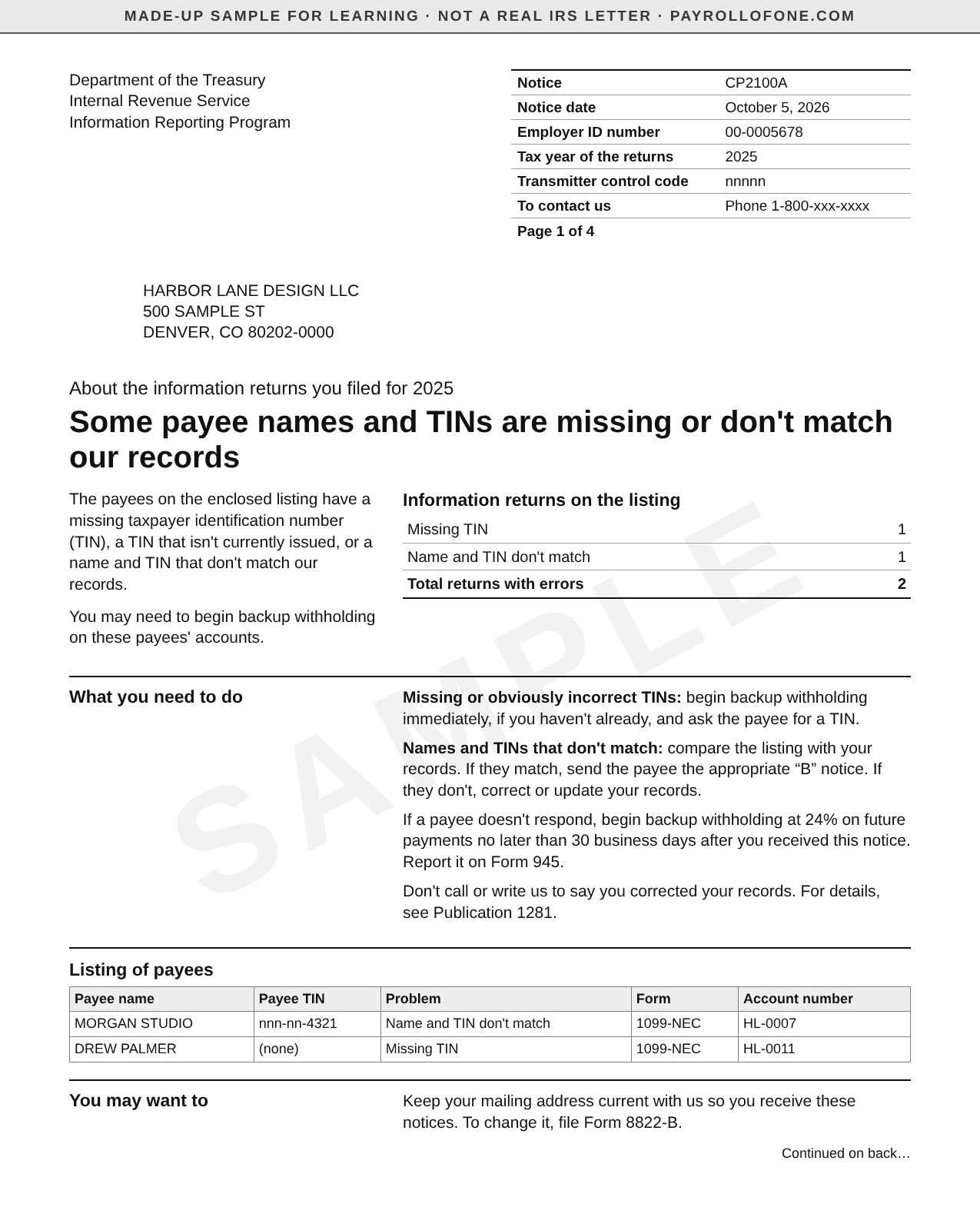
Swipe sideways to see the whole letter.
Every part, in plain English
Top left Who sent it
These notices come from the IRS's backup withholding "B" program. The IRS's CP2100 page lists 866-455-7438 (toll-free) for questions, 8:30 a.m. to 4:30 p.m. Eastern time, Monday through Friday.
ExampleHarbor Lane's notice is about the 1099s it filed, so it's addressed to the business, not to Sam.
Good to knowNot sure a notice is real? Call the number on the IRS's CP2100 page rather than one printed only in the letter.
Notice CP2100 or CP2100A
The IRS sends a CP2100 when a payer filed 50 or more information returns with errors, and a CP2100A when there are fewer than 50. It says the information and instructions are the same. The only difference is how many forms are listed.
ExampleHarbor Lane had two forms with errors, so it got a CP2100A.
Notice date The date that starts the clock
Publication 1281 gives you 15 business days from the notice date, or the date you received it if that's later, to send B notices. The IRS sends these notices twice a year, in October and the following April.
ExampleHarbor Lane received its October 5, 2026, notice on October 8, so its B notice is due by October 30, 2026. Business days skip weekends and federal holidays like Columbus Day.
Good to knowWrite down the day the notice arrived. The deadlines count from that day if it's later than the notice date.
EIN The payer's EIN
The business that filed the 1099s. Any backup withholding it collects is reported on Form 945 under the same name and EIN it used on the information returns.
ExampleHarbor Lane Design LLC's made-up EIN is 00-0005678.
Good to knowIf your business uses a paying agent, the IRS says not to put the agent's name on Form 945.
Tax year Which year's forms
The tax year of the information returns with problems. The listing shows the payees from that year's 1099s.
ExampleHarbor Lane's 2025 Forms 1099-NEC, filed early in 2026.
Good to knowPayers of most Forms 1099 can apply for the IRS's TIN Matching program to check names and TINs before filing.
TCC Transmitter control code
The code for whoever sent the forms to the IRS electronically. Publication 1281 says it may be yours, or it may belong to someone you hired to file, like an accountant or payroll provider.
ExampleHarbor Lane's payroll provider filed its 1099s, so the code is the provider's.
Good to knowDon't recognize the code? Ask whoever filed your information returns for you.
To contact us The phone number for questions
The number for questions about backup withholding and the notice. The IRS's CP2100 page also uses this line for copies of the notice.
ExampleSam calls only if something on the listing is confusing.
Good to knowThe IRS says not to call or write just to say you fixed your records.
Headline Names and TINs that don't match
The IRS checked the payee name and taxpayer identification number on each form you filed, and some are missing or don't match its records. This notice isn't a bill. A separate notice, the 972CG, is the one that proposes a penalty for incorrect forms.
ExampleTwo of Harbor Lane's contractor forms didn't match.
Why you got it How a mismatch happens
The IRS compares each name and TIN with Social Security and IRS files. One cause is a name change that never reached the Social Security Administration. Another is a sole proprietor's business name used with the owner's Social Security number: Publication 1281 says the individual name must come first.
ExampleCasey Morgan's W-9 put "Morgan Studio" on the first line next to Casey's Social Security number, so the 1099 didn't match.
Good to knowFreelancers can avoid causing this for their clients by filling in their W-9 the way the IRS expects.
Missing TINs Withhold now
A TIN is missing if it wasn't given, has more or fewer than nine digits, or has letters. For these payees, the IRS says to begin backup withholding immediately if you haven't already, even for a one-time payment, and keep asking for the TIN. No B notice goes out for a missing TIN.
ExampleDrew Palmer never returned a W-9. If Harbor Lane pays Drew $1,000 again, it withholds $240 until Drew gives a TIN.
Good to knowPublication 1281 also calls for yearly written requests for a missing TIN, to avoid a penalty on the information return.
Mismatches Compare, then send a B notice
If the listing matches your records, send the payee a "B" notice: the First B Notice with a Form W-9 the first time, or the Second B Notice if the same payee is listed again within three calendar years. If your records don't match the listing, you only correct your records.
ExampleHarbor Lane's records show the same name and number, so it mails Casey a First B Notice and a blank W-9 in an envelope marked "Important Tax Information Enclosed."
Good to knowAfter a Second B Notice, the payee has to send a copy of a Social Security card or an IRS Letter 147C, not just a W-9.
Backup withholding 24% if the payee doesn't answer
If the payee doesn't respond, you start withholding 24% of future payments no later than 30 business days after you received the notice, and stop within 30 calendar days after you get their TIN. You deposit it on your monthly or semiweekly schedule and report it on Form 945 and on the payee's 1099.
ExampleIf Casey never sends the W-9 back and Harbor Lane pays $2,500 in December 2026, it withholds $600.
Good to knowBackup withholding is reported even if the payment is below the usual 1099 threshold.
The listing Which payees have a problem
One row per form: the payee name and TIN as you filed them, the problem (missing TIN, a TIN not currently issued, or a name and TIN that don't match), the form and your account number for the payee. Publication 1281 says the notice doesn't tell you whether it's the first or second time a payee is listed, so you track that yourself.
ExampleMorgan Studio has a mismatch and Drew Palmer has no TIN.
Good to knowA listing may not reflect corrections you already made. If you know an account was fixed, Publication 1281 says not to send a B notice.
You may want to Keep your address current
The IRS mails these notices to your address of record. If your business moves, Form 8822-B updates it.
ExampleIf Harbor Lane leaves 500 Sample St, Sam files Form 8822-B.
Good to knowForm 8822-B is also how a business reports a new responsible party.
CP2100 vs. CP2100A
The two notices say the same thing. The IRS sends a CP2100 when a payer filed 50 or more information returnsForms a business files with the IRS to report money it paid someone, like 1099s and W-2s, with a copy to the person paid. with errors, and a CP2100A when there are fewer than 50. It says the information and instructions are identical, and the only difference is how many forms are listed.
A one-person S corporation with a handful of contractors gets the CP2100A, unless 50 or more of its forms have errors. Publication 1281 adds that payers with 250 or more errors get the listing as a data file on a CD or DVD instead of paper. The IRS sends these notices twice a year, in October and the following April.
What to do, in the IRS’s order
The IRS’s instructions sort every name on the list into one of two piles: missing TINs and mismatched ones. Here’s the order to work through them.
- Compare the listing with your records. If your records don’t match the listing, because you made a typo, the payee’s details changed or the IRS misprinted it, just correct your records. No B notice goes out, and the IRS says not to call or write to say you fixed it.
- Missing TINs: withhold now. A TIN counts as missing if it wasn’t given, isn’t nine digits or has letters in it. Begin backup withholding on that payee immediately, if you haven’t already, and ask for the TIN again, even for a one-time payment.
- Mismatched TINs that match your records: send a B notice. You have 15 business days from the notice date, or the day you received it if that’s later. The first time a payee is listed, that’s the First B Notice with a blank Form W-9.
- Start backup withholding if they don’t answer. For a payee who doesn’t send back a signed W-9, withholding starts no later than 30 business days after you received the notice.
- Keep track for three years. Publication 1281 says the notice doesn’t tell you whether it’s the first or second time a payee is listed, so you keep that record yourself.
Say Harbor Lane Design LLC, from our sample, receives its October 5, 2026, notice on October 8. Business days skip weekends and federal holidays like Columbus Day and Veterans Day, so mailing the B notice by October 30 keeps it within 15 business days. If Casey Morgan never returns the W-9, withholding applies to payments made after November 23. If your business uses a payroll provider to file 1099s, it may help with the notices too. Here’s how to pick payroll for an S-corp of one.
First and second B notices
The “B” stands for backup withholding. Publication 1281 includes the text of both notices, and the IRS asks for the outside envelope to be marked “Important Tax Information Enclosed” or “Important Tax Return Document Enclosed.” Here’s how they differ.
| First B Notice | Second B Notice | |
|---|---|---|
| When you send it | The first time a payee is listed | The second time the same payee is listed within three calendar years |
| What goes in the envelope | The B notice, a blank Form W-9 and, if you like, a reply envelope | The B notice and, if you like, a reply envelope. No W-9 |
| What the payee sends back | A signed Form W-9 with the right name and number | A copy of their Social Security card, or an IRS Letter 147C for an EIN |
| When backup withholding starts if they don’t | No later than 30 business days after you received the CP2100 | If nothing arrives by the 30th business day after the date of the Second B Notice |
A third listing for the same payee, with the same name and number, can generally be ignored once you’ve done both steps. Publication 1281 says a listing with a different name and number counts as a new first notice.
How backup withholding works
Backup withholding is federal income tax you hold back from a payment that normally has none taken out. The rate is 24%. You keep withholding until the payee gives you a TIN, and you stop no later than 30 calendar days after you receive it.
Say Casey never sends the W-9 back, and Harbor Lane pays Casey $2,500 in December 2026. It sends Casey $1,900 and holds back $600. Here’s what happens to that $600.
- Deposit it on your monthly or semiweekly deposit schedule, as the IRS’s CP2100 page says. Here’s how payroll tax deposits work.
- Report it on Form 945, the annual return for withheld income tax on non-payroll payments, using the same name and EINEmployer Identification Number: your business’s tax ID, like a Social Security number for the business. Free from the IRS. as the 1099s.
- Show it on the payee’s 1099, even if the payment is below the usual 1099 threshold.
- The payee gets credit for it on their own tax return, the IRS says, like withholding from a paycheck.
If you’re the contractor who got a B notice
Plenty of freelancers meet this notice from the other side: a client sends a letter saying the name and number on your W-9 didn’t match IRS records. It’s fixable, and quickly.
- Check your W-9’s first line. Publication 1281 says a sole proprietor must give their individual name, with either their Social Security number or the business’s EIN. A business name belongs on the second line. Here’s how to fill out a W-9, line by line.
- Check your name with Social Security. A name change that never reached the Social Security Administration is one cause Publication 1281 points to.
- Answer by the date on the notice. A First B Notice needs a signed W-9. A Second B Notice needs a copy of your Social Security card, or a Letter 147C if the number is an EIN. Here’s how to get Letter 147C.
- Know what’s at stake. The B notice text in Publication 1281 warns of backup withholding, now 24%, and a possible $50 IRS penalty for not giving a correct name and TIN.
What happens if you ignore it
Nothing goes back to the IRS, so it’s easy to let a CP2100 slide. But the steps protect the business. Publication 1281 says sending a B notice satisfies the yearly request for a correct TIN that helps you avoid a penalty for filing an information return with an incorrect TIN. The penalty itself is proposed in a different notice. Here’s Notice 972CG, decoded.
Skipping backup withholding has a cost too. The IRS’s instructions for requesters of Form W-9 say that if you don’t collect backup withholding as required, you may become liable for the amount you didn’t collect.
The cheapest fix is upstream. Get a signed W-9 from every contractor before the first payment, and payers of most Forms 1099 can apply for the IRS’s TIN Matching program to check names and numbers before filing. Here’s how the 1099-NEC works for the contractors you pay.
When to get help
A short CP2100A is something many owners handle themselves in an afternoon. If the listing is long, payees dispute it, or backup withholding and Form 945 are new to you, a payroll provider or tax professional can take it on. The IRS also answers questions at 866-455-7438, 8:30 a.m. to 4:30 p.m. Eastern time, Monday through Friday. Here’s when a tax pro is worth it, and what one costs.
FAQ
What is a CP2100 notice?
A notice to a payer, such as a business that files 1099s, listing information returns whose payee name and TIN are missing, not currently issued or don’t match IRS records. It says the payer may need to begin backup withholding.
Do I need to respond to the IRS?
No. The IRS says not to call or write to say you corrected your records. The actions go to your payees: B notices, W-9s and, if needed, backup withholding.
How long do I have to send a B notice?
Publication 1281 gives 15 business days from the date of the CP2100 or CP2100A, or the date you received it, whichever is later.
What is the backup withholding rate?
24% of each reportable payment, reported on Form 945.
Do I file a corrected 1099?
Not just for the TIN. Publication 1281 says not to file a corrected information return unless you’re also changing the dollar amount. Use the corrected name and TIN on future filings.
Can I ask the payee for their TIN by phone?
No. Publication 1281 says the information may not be solicited by telephone. It comes back on a signed W-9, or with a Social Security card copy or Letter 147C after a Second B Notice.
Can I get a copy of my CP2100?
Yes. The IRS says to call 866-455-7438 and follow the prompts.
Sources
- IRS: Understanding your CP2100 or CP2100A notice
- IRS: Backup withholding “B” program
- IRS: Backup withholding
- IRS: Publication 1281, Backup Withholding on Missing and Incorrect Name/TINs (PDF)
- IRS: About Form 945
- IRS: Taxpayer Identification Number (TIN) Matching
The letter above is a made-up sample for learning, laid out like an IRS notice. It isn’t a real notice and nothing on this page reads or answers yours. The 24% backup withholding rate applies in 2026. General education, not tax advice.