The short answer
You sent your contractors their 1099s, a few weeks late, and forgot about it. More than a year later, an envelope from the IRS arrives with Notice 972CG in the corner and the words “Notice of Proposed Civil Penalty.”
Notice 972CG is a proposed penalty for information returnsForms a business files with the IRS to report money it paid someone, like 1099s and W-2s, with a copy to the person paid., like Forms 1099-NECThe form a client sends you (and the IRS) showing what they paid you. Required for payments of $2,000 or more in 2026., that you filed with the IRS late, on paper when you had to e-file, or with a missing or wrong taxpayer ID number. It isn’t a bill yet. You have 45 days from the notice date to pay, explain why the penalty shouldn’t apply, or both. With no answer, the IRS charges the full amount. For forms due in 2025, the penalty runs from $60 to $330 per form.
How worried to be
It's a proposal, not a bill yet, and you have 45 days to agree or explain. Ignore it and the IRS charges the full penalty and sends a bill.
When your reply is due
The IRS's usual window is 45 days from the notice date. Enter the date to see yours.
The IRS's information return penalties page says to respond within 45 days of the notice date (60 days for a foreign filer) before it assesses the penalty. Publication 1586 says the same, counted in calendar days.
Notice 972CG, decoded: tap any part of the letter
The IRS doesn’t show a sample of Notice 972CG, so we built this one in the IRS’s usual notice layout, with made-up details and the parts IRS Publication 1586 says the notice contains: the reason, a record of each filing counted, a penalty summary and a response page. Your notice may look different, but it will have the same pieces.
Tap any part of the letterHover over any part of the letter to see what it means. Click a part to pin its note open so you can use the links. to see what it means. Our made-up example: Sam Rivera's S corporation, Harbor Lane Design LLC, filed the 2024 Forms 1099-NEC for its three contractors six weeks late.
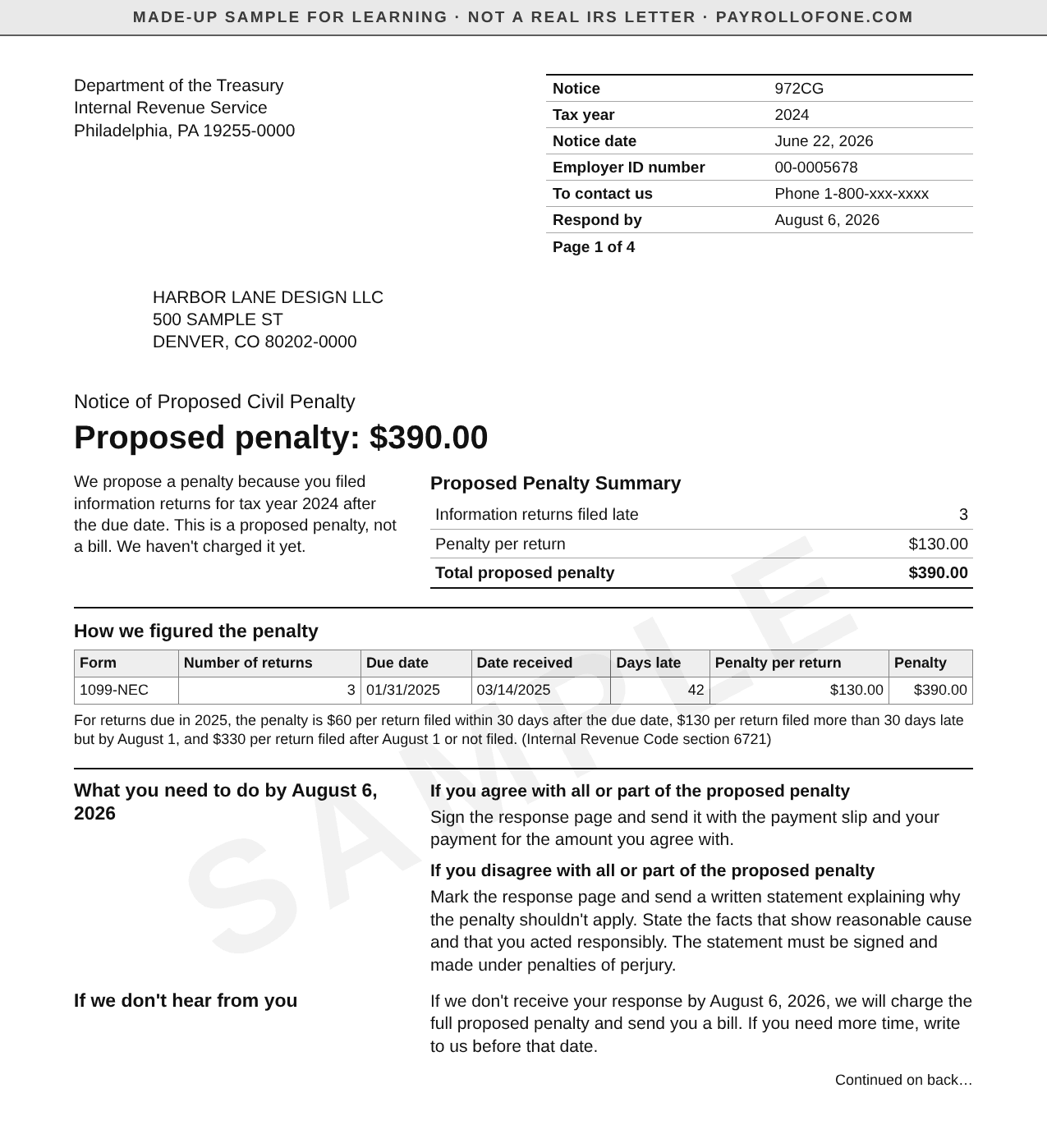
Swipe sideways to see the whole letter.
Every part, in plain English
Notice The notice code
Notice 972CG is the IRS's Notice of Proposed Civil Penalty for information returns, such as Forms 1099-NEC, that were filed late, filed on paper when electronic filing was required, or filed with a missing or incorrect taxpayer ID number. One notice can combine more than one of these.
ExampleType 972CG into our lookup and you land on this page.
Good to knowThe IRS explains these penalties on its information return penalties page, and Publication 1586 explains how to answer the notice.
Tax year The year of the payments
The year the payments were made. The forms for it were due early the next year, and the IRS's manual says these notices normally go out the year after the forms are processed.
ExampleHarbor Lane's notice is about 2024 contractor payments, reported on Forms 1099-NEC due January 31, 2025.
Good to knowThat's why a 972CG can arrive more than a year after the late filing. Keep your filing confirmations at least that long.
Notice date The date the 45 days count from
The IRS says to respond within 45 days of this date, or 60 days for a foreign filer, before it assesses the penalty. Publication 1586 says those are calendar days.
ExampleHarbor Lane's notice is dated June 22, 2026, so its answer is due August 6, 2026.
Good to knowNeed more time? Publication 1586 says to ask in writing before the 45 days are up. The IRS's manual says it generally grants 30 more days, or up to 90 days from the notice date if you ask for a specific date.
EIN The payer's EIN
The penalty is proposed against the payer: the business whose EIN was on the forms as the one making the payments.
ExampleHarbor Lane Design LLC's made-up EIN is 00-0005678.
Good to knowCan't find your EIN paperwork? The IRS can confirm the number with a Letter 147C.
To contact us The number for questions
Call this number with questions about the proposed penalty. The IRS's information return penalties page says you can dispute a penalty by calling or by writing a signed letter to the address on the notice.
ExampleIf Harbor Lane thought the received date was wrong, this is where it would start, with its filing confirmation in hand.
Good to knowLost the notice? The IRS's manual says it doesn't keep copies, but you can ask for a re-created one at 1-866-455-7438.
Respond by The 45-day date
The last day for your answer, 45 days after the notice date. It's not a payment due date: the penalty hasn't been charged yet.
ExampleAugust 6, 2026, for Harbor Lane.
Good to knowOur sample prints the date for you. If yours doesn't, count 45 calendar days from the notice date, or use the box above the letter.
Proposed penalty What the IRS plans to charge
The penalty the IRS proposes, before it's assessed. That's the point of the notice: you get a chance to explain before it becomes a bill.
ExampleHarbor Lane's proposed penalty is $390.00.
Good to knowPublication 1586 says interest starts only with the bill that follows an assessment, a CP215 or CP15 notice, unless you pay within the time that bill gives.
Why Why the IRS proposes a penalty
The reason, in a sentence. This version is about forms filed after the due date. A notice about missing or incorrect taxpayer ID numbers also includes a list of the forms involved and a copy of Publication 1586.
ExampleHarbor Lane filed its three 2024 Forms 1099-NEC on March 14, 2025.
Good to knowA late form and a wrong number on the same form count once, not twice. The IRS's manual says it charges the filing penalty only once per form.
Total Total proposed penalty
The number of forms times the rate for each. The law caps the yearly total, with lower caps for a small business, but the caps matter only for a payer filing thousands of forms.
Example3 forms × $130 = $390.
Good to knowThe IRS counts a small business as one with average yearly gross receipts of $5 million or less over the past three years.
The record How the penalty was figured
A line for each filing the IRS counted: the form, how many, the due date, the date the IRS received them, and the rate that applies. Publication 1586 says the notice includes a record like this for each submission.
ExampleDue January 31, 2025, received March 14, 2025: 42 days late, past the 30-day mark, so the $130 rate applies.
Good to knowFiled within 30 days, by March 2, 2025, the rate would have been $60 a form, or $180 in all.
The rates Three rates, by how late
The penalty depends on when the correct form was filed. For forms due in 2025, it's $60 within 30 days of the due date, $130 after that but by August 1, and $330 after August 1 or never. For forms due in 2026, the top rate is $340.
ExampleHarbor Lane's forms landed in the middle tier.
Good to knowLate is still much cheaper than never. A form that's never filed costs the top rate, and intentional disregard costs more, with no yearly cap.
If you agree Pay what you agree with
Publication 1586 says to send the part of the response page that fits your answer, signed, with payment if you fully or partly agree. You can agree with some of the penalty and explain the rest.
ExampleIf Harbor Lane has no reasonable cause, it signs and sends the $390.00.
Good to knowThe IRS's manual says you can also sign a consent and let the IRS send you a bill instead of paying now.
If you disagree A signed statement of reasonable cause
To ask for the penalty to be waived, Publication 1586 says to send a written statement that names the reason (for example, events beyond your control), sets out the facts, and shows you acted responsibly. The person required to file the forms signs it under penalties of perjury.
ExampleHarbor Lane would have to show what kept the forms from going in on time and that it filed as soon as it could.
Good to knowFor a missing or wrong taxpayer ID number, acting responsibly generally means you asked for the number at the start, usually with Form W-9, and asked again each year if it was still missing or wrong.
If you wait What happens with no answer
No answer within the 45 days means the IRS assesses the full proposed penalty and sends a bill with your appeal rights. The bill is a CP215 or CP15 notice, and interest runs from its date unless you pay within the time it gives.
ExampleIf Harbor Lane ignores the notice, the $390.00 becomes a bill.
Good to knowIf the IRS turns down a reasonable cause statement, Publication 1586 says it sends Letter 854C explaining why, with your appeal rights.
What Notice 972CG means
Every business that pays a contractor $600 or more for services in a year (for 2024, the year in our sample) files a Form 1099-NEC with the IRS and gives a copy to the contractor. The IRS keeps a record of when each payer’s forms arrived and whether the ID numbers on them match its files. A 972CG is what that record produces when something was off. Here are the three problems it can cover.
- Filed late: the forms reached the IRS after the due date.
- Not filed electronically when required: starting with forms due in 2024, a business with 10 or more information returns in a year, W-2s included, has to e-file them.
- Missing or incorrect taxpayer ID numbers: a payee’s name and number don’t match IRS records. The notice then lists the forms involved and includes Publication 1586.
The timing can be confusing. The IRS’s manual says these notices normally go out the year after the forms are processed, so a 972CG in 2026 is usually about forms for tax year 2024. In our sample, Harbor Lane Design LLC filed its three 2024 Forms 1099-NEC on March 14, 2025, six weeks after the January 31 deadline. Here’s who gets a 1099-NEC and when it’s due.
One thing the notice doesn’t cover: the copies you give your contractors. Publication 1586 says Notice 972CG proposes the penalty for returns filed with the IRS. Late or wrong copies to payees are a separate penalty under a different section of the law.
How much the 972CG penalty is
The penalty is set per form, and it depends on how late the correct form arrived. Here are the rates for the two most recent years.
| Forms due in | Within 30 days of the due date | Day 31 through August 1 | After August 1, or never filed | Intentional disregard |
|---|---|---|---|---|
| 2025 (tax year 2024) | $60 | $130 | $330 | $660 |
| 2026 (tax year 2025) | $60 | $130 | $340 | $680 |
Harbor Lane’s forms were 42 days late, past the 30-day mark but well before August 1. That puts them in the middle column: 3 × $130 = $390. Filed by March 2, 2025, the same three forms would have cost $180.
The law caps the total for a year, with lower caps for a small business (average gross receiptsAll the money your business took in during the year, before subtracting any expenses. of $5 million or less over the past three years). For a business filing a handful of forms, the caps never come into play. Intentional disregard has no cap at all.
How to answer a 972CG within 45 days
Publication 1586 lays out the response. Here it is in order.
- Compare the notice’s record with yours. Check the form type, the count and the date received against your filing confirmations.
- Decide where you stand. The response page lets you fully agree, partly agree or disagree.
- If you agree with any of it, sign and pay that part. Send the payment with the signed response page and payment slip.
- If you disagree, send a written statement. It names the reason you’re asking for a waiver, sets out the facts, shows you acted responsibly, and is signed under penalties of perjury by the person required to file the forms.
- Ask for more time in writing if you need it, before the 45 days are up. The IRS’s manual says it generally grants 30 more days.
After that, the IRS writes back. A Letter 6304C means your explanation was accepted and the penalty won’t be charged. A Letter 854C means it was denied in full or in part, with your appeal rights, and a bill (a CP215 or CP15) follows. With no answer at all, the full penalty is charged and billed, and interest runs from the date of the bill unless you pay within the time it gives.
Here’s what most people in your spot do the day a 972CG arrives: find the filing confirmations for that year, put the 45-day date on the calendar, and decide within the first week whether there’s a real reason to write. If there isn’t, paying the $390 settles the proposal.
Reasonable cause, and what counts
The IRS can waive the penalty for reasonable cause, but the test has two parts, and you need both. First, you acted responsibly before and after the problem: you tried to prevent it, fixed it, and filed as soon as you could. Second, there were significant mitigating factors or events beyond your control.
The IRS’s examples of the second part include being a first-time filer of that form, a good compliance history, actions of the IRS, actions of an agent or another person, trouble getting your business records, and economic hardship that prevented e-filing. First Time Abate isn’t an option here: the IRS’s list of penalties it covers doesn’t include information return penalties.
For missing or wrong taxpayer ID numbers, acting responsibly has a specific meaning. Publication 1586 says it generally includes asking the payee for their name and number at the start of the relationship and, if the number turns out to be missing or wrong, asking again in later years. That first request is usually a Form W-9, collected before you pay anyone.
How to avoid the next 972CG
For a small business, avoiding the next one mostly comes down to a date. Forms 1099-NEC for 2026 payments are due February 1, 2027, because January 31 is a Sunday, and the threshold for 2026 payments is $2,000. Unlike most information returns, the 1099-NEC has no automatic extension.
- Get a W-9The form you give clients with your name and tax ID, so they can send you a 1099. before the first payment, so the name and number are right from the start.
- E-file through the IRS’s free IRISThe Information Returns Intake System: the IRS's free online portal for filing 1099s electronically. system, and keep a record of the date you filed.
- Put the deadline on the calendar in December, next to your payroll year-end forms.
If your business pays you a salary too, the W-2The form an employer sends each January showing your wages and the tax withheld. As an S-corp owner, your own company sends you one. has the same deadline. Here’s every payroll deadline for an S-corp of one. If you’d rather hand the forms to a professional, here’s when a tax pro is worth it.
FAQ
Is Notice 972CG a bill?
No. It’s a proposed penalty. The IRS hasn’t charged it yet, and you have 45 days from the notice date (60 days for a foreign filer) to agree, explain, or both before it does.
How long do I have to respond to Notice 972CG?
45 calendar days from the notice date, or 60 for a foreign filer. If you need more time, Publication 1586 says to ask in writing before that period ends.
Why did I get a 972CG so long after I filed?
The IRS’s manual says these notices are mailed once a year, normally the year after the forms are processed. Forms for tax year 2024, filed in 2025, get their notices in 2026.
What happens if I ignore Notice 972CG?
The IRS assesses the full proposed penalty and sends a bill, a CP215 or CP15, with your appeal rights. Interest then runs from the date of that bill unless you pay within the time it gives.
Can I get a 972CG penalty waived?
Yes, if you show reasonable cause: you acted responsibly before and after, and there were mitigating factors or events beyond your control. Send a signed statement, under penalties of perjury, by the 45-day date.
Does Notice 972CG cover the copies I gave my contractors?
No. It covers the forms filed with the IRS. Late or incorrect copies to payees fall under a separate penalty. Our IRS letter decoder explains other codes too.
Sources
- IRS: Information return penalties
- IRS: Publication 1586, Reasonable Cause Regulations and Requirements for Missing and Incorrect Name/TINs (PDF)
- IRS: General Instructions for Certain Information Returns
- IRS: Penalty relief for reasonable cause
- IRS: Administrative penalty relief
- IRS: Internal Revenue Manual 20.1.7, Information return penalties
- IRS: Internal Revenue Manual 4.19.25, Information return penalty procedures
The notice above is a made-up sample for learning, laid out like an IRS notice. It isn’t a real notice, the EINEmployer Identification Number: your business’s tax ID, like a Social Security number for the business. Free from the IRS. is fake, and nothing on this page reads or answers yours. Penalty rates are for information returns due in 2025 and 2026, per the IRS. General education, not tax advice.