The short answer
You filed early and you’ve been watching for your refund. Then a letter arrives instead, with CP12 in the corner and a headline that says “Adjusted refund,” and the number isn’t the one on your return.
A CP12 notice means the IRS corrected a miscalculation on your return and your refund changed: it went down, it went up, or you’re getting a refund you didn’t expect. If you agree, you don’t need to do anything, and the IRS says the refund should arrive in 4 to 6 weeks. If the IRS cut your refund and you think it’s wrong, you have 60 days from the notice date to have the change reversed.
How worried to be
You're still getting money back, and if you agree there's nothing to do. If the IRS cut your refund and you think it's wrong, you have 60 days to have the change reversed.
Reply needed?
No reply needed if you agree: the IRS says the refund should arrive in 4 to 6 weeks. If you disagree, contact the IRS by the date on the notice. By law (IRC section 6213(b)), you have 60 days from the notice date to ask for a math-error change to be reversed.
CP12, decoded: tap any part of the letter
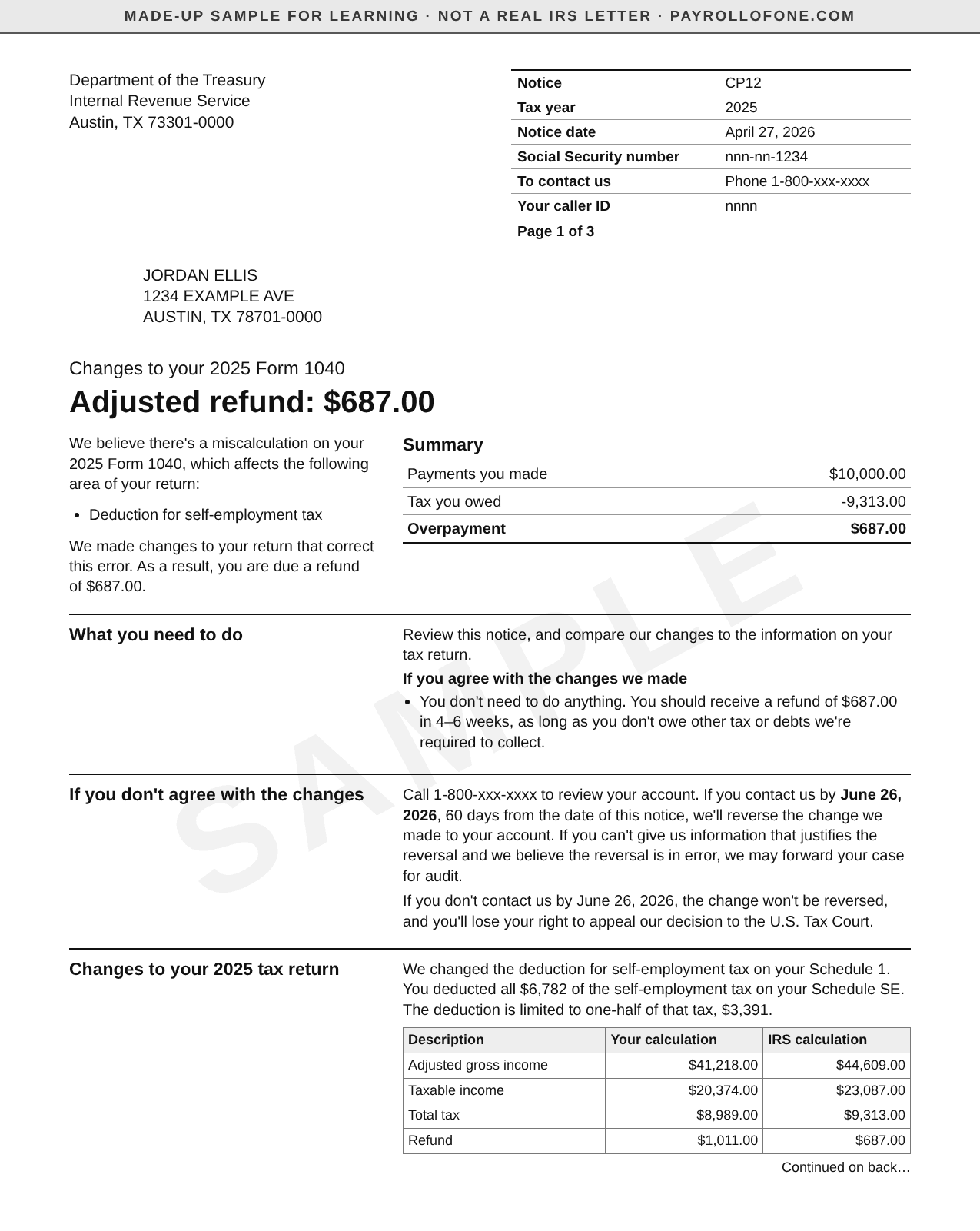
The IRS no longer shows sample letters on its notice pages, so we rebuilt this one from its older official sample, with made-up details. Every part has a plain-English note. Yours will have different numbers but the same parts in about the same places.
Tap any part of the letterHover over any part of the letter to see what it means. Click a part to pin its note open so you can use the links. to see what it means. Our made-up example: Jordan Ellis, a freelance photographer, deducted all of the self-employment tax on a 2025 return instead of half.
Swipe sideways to see the whole letter.
Every part, in plain English
Top left Which IRS office sent it
The IRS campus that processed your return and found the error. If you write to the IRS about this notice, use the address the notice gives.
ExampleJordan's notice came from Austin, Texas.
Good to knowThe IRS says the fastest way to sort out most return errors is by phone, using the number on the notice.
Notice The notice code
The IRS sends a CP12 when it corrects one or more mistakes on your return and the refund comes out different from the one you expected, or you get a refund when you thought you owed or broke even.
ExampleType CP12 into our lookup or the IRS's notice search and you land on the right instructions.
Good to knowIf the correction left you owing money instead, the IRS sends a CP11.
Tax year Which return was changed
The year of the return the IRS corrected. The IRS checks returns for math errors while it processes them, so it's usually the return you filed most recently.
ExampleJordan's notice is about the 2025 return, filed in March 2026.
Good to knowPull out your copy of that return, with every schedule, before you read further.
Notice date The date that starts the clock
If you disagree with the change, your 60 days to ask for a reversal count from this date, not from the day the letter reached you. The IRS says a refund owed after a notice usually arrives within 6 weeks of this date.
ExampleJordan's notice is dated April 27, 2026, so the last day to dispute is June 26, 2026.
Good to knowPut the 60-day date on your calendar even if you're not sure yet. It's easier to let it pass than to wish you'd known it.
To contact us The number to call if you disagree
Call this number to ask about the change or to dispute it. The IRS says many return errors are fastest to resolve by phone, and you can often fax a missing document while you're on the call.
ExampleIf Jordan thought the full deduction was right, this call is where the dispute would start.
Good to knowNot sure a letter is real? Call the IRS at a number listed on irs.gov, or check for the notice in your IRS Online Account.
Headline Adjusted refund
The refund the IRS will send after its correction. It can be smaller or bigger than the one on your return, and sometimes it's a refund you didn't expect at all.
ExampleJordan's return claimed $1,011. The adjusted refund is $687.00, which is $324 less.
Good to knowThe check or deposit can still come in lower if the refund is used to pay other debts. You get a separate notice explaining it if that happens.
What changed The part of your return the IRS fixed
A short list of the areas the correction touched. The full reason is in the "Changes to your tax return" section further down. A math error can be an arithmetic slip, a number copied wrong between forms, or a deduction or credit over its legal limit.
ExampleJordan's error was in the deduction for self-employment tax on Schedule 1.
Good to knowThis kind of fix is done by computer when the return is processed. It isn't an audit.
Summary Payments minus the corrected tax
Everything you paid for the year, minus the tax after the IRS's correction. Payments include estimated tax payments, withholding and anything paid with the return.
ExampleJordan made four estimated payments of $2,500, so $10,000. The corrected tax is $9,313.
Good to knowCheck the payments line too. If it's lower than what you paid, that's a separate problem worth a call.
Overpayment What you'll get back
The difference between what you paid and the corrected tax. This is the refund the IRS plans to send, unless part of it goes to other debts it's required to collect.
Example$10,000 minus $9,313 leaves Jordan a $687 overpayment.
Good to knowYou can track it with the IRS's Where's My Refund tool.
What to do If you agree, nothing
The IRS's CP12 page says no response is needed if you agree. The refund should arrive in 4 to 6 weeks. The IRS also suggests correcting the copy of the return you kept, without sending it in.
ExampleJordan checks the Schedule SE instructions, sees the deduction is half the tax, and agrees. Nothing to send.
Good to knowYou don't need an amended return to accept a CP12. If you find a different mistake on the return, that one needs a Form 1040-X.
If you disagree Your 60-day right to a reversal
If the IRS cut your refund and you think it's wrong, federal law (IRC section 6213(b)) gives you 60 days from the notice date to ask it to reverse the change. The IRS says it reverses most changes that reduced a refund, and you don't have to explain, though it helps. If it still disagrees, it may send the case to audit.
ExampleIf Jordan believed the full $6,782 deduction was right, a call by June 26, 2026 would start the reversal.
Good to knowMiss the date and you lose the formal right to the reversal and to Tax Court. The IRS says it will still look at information you send later and may reverse the change if it agrees.
The reason Exactly what the IRS changed
The plain-language reason for the correction, usually naming the line or schedule. This is the part to check against your own copy of the return.
ExampleSelf-employment tax is $6,782, and the deduction for it is limited to half: $3,391. Jordan deducted all $6,782.
Good to knowThe deduction for half of self-employment tax is one of the easiest freelancer deductions to get wrong by hand.
Your numbers Your calculation and the IRS's
The key totals from your return next to the IRS's corrected ones. One fix can ripple through: a smaller deduction raises adjusted gross income, which raises taxable income and the tax.
ExampleJordan's adjusted gross income rises by $3,391, the tax by $324, and the refund drops from $1,011 to $687.
Good to knowIf you use tax software, fix the number in your file too, so next year's return doesn't start from the same mistake.
What a CP12 means
The IRS checks returns for math errors while it processes them. When it corrects one or more mistakes and you still come out with money back, it sends a CP12. The IRS lists two situations.
- Your refund is different from the one you expected. It can be smaller or bigger.
- You have a refund when you thought you owed money or broke even. The correction turned out in your favor.
A math error here means something the IRS can fix from the return itself: an arithmetic slip, a number copied wrong between forms, a missing piece of information, or a deduction or credit over a limit set by law. It isn’t an audit, and no one has looked at your receipts.
For freelancers, a classic CP12 is the deduction for self-employment taxSocial Security and Medicare tax for people who work for themselves: 15.3% on 92.35% of your profit, on top of income tax.. You can deduct half of it, not all of it. Say your Schedule SEThe tax form that works out your self-employment tax from your Schedule C profit. shows $6,782 of self-employment tax, like Jordan’s in our sample. The deduction is $3,391. Deducting the full $6,782 lowers your income by too much, and the correction costs Jordan $324 of the refund. Here’s how self-employment tax and its deduction work.
What to do, in the IRS’s order
The IRS’s steps for a CP12 are short. Most people only need the first three.
- Read what was changed. The “Changes to your tax return” section names the line or schedule. Find it on your copy of the return.
- If you agree, do nothing. No response is needed. The refund should arrive in 4 to 6 weeks, as long as you don’t owe other tax or debts the IRS is required to collect.
- Correct the copy of your return you kept. The IRS suggests it, so next year starts from the right numbers. Don’t send the corrected copy in.
- If you disagree, contact the IRS by the date on the notice. Call the number in the notice. Many errors are fastest to sort out by phone.
Here’s what most people in your spot do with a CP12: check the one line it names, and if the IRS is right, fix that number in your tax software or records so the same slip doesn’t come back next year.
If your refund went down: the 60-day window
A smaller refund can sting, especially if you’d planned around it. If you believe your return was right, the law gives you a clear way to push back.
- You have 60 days from the notice date. Internal Revenue Code section 6213(b) lets you ask for a math-error change to be reversed within 60 days, and the IRS must reverse it.
- The IRS reverses most changes that cut a refund. Its CP12 page says you don’t need to explain or send documents, though doing so may help.
- A call counts. The IRS’s own procedures say the request can be written or oral, and you can often fax documents during the call.
- An audit can follow. If the IRS doesn’t get information supporting your return, it may send the case to audit. The IRS says audit staff contact you within 6 weeks, and you then have formal appeal rights.
If you don’t contact the IRS by the date on the notice, you lose the formal right to the reversal and to take the case to the U.S. Tax Court. The IRS says it will still consider information you send later and may reverse the change if it agrees. After that, a claim for refund is generally due within 3 years of filing the return or 2 years of paying the tax, whichever is later.
Why the deposit can be smaller than the notice says
The CP12 says you’ll get the refund “as long as you don’t owe other tax or debts we’re required to collect.” That line matters. A refund can be used to pay these first.
- Federal tax you owe for another year
- Past-due child support
- Federal agency debts that aren’t tax
- State income tax you owe
- Certain state unemployment compensation debts
If that happens, you get a separate notice. For a debt to another agency, it comes from the Treasury’s Bureau of the Fiscal Service and shows the original refund, the amount taken and the agency that got it.
CP12, CP11 and CP24: how they differ
The IRS sends a few similar notices after it changes a return. Here’s how to tell them apart.
| Notice | What the IRS changed | Result | If you agree |
|---|---|---|---|
| CP12 | A miscalculation on the return | A refund, different from the one you expected | Nothing to do |
| CP11 | A miscalculation on the return | You owe | Pay by the due date |
| CP24 | Estimated tax payments, to match its records | You may have a credit | Nothing to do |
| CP23 | Estimated tax payments, to match its records | You owe | Pay by the due date |
If your notice is about payments rather than math, here’s the CP24, decoded. If the correction left you owing, here’s what a CP11 means.
When to get help
Most CP12s need nothing more than a look at one line. Help is worth it when the change is large, involves a credit you don’t fully understand, or you’ve asked for a reversal and the case moves to audit.
The Taxpayer Advocate Service and Low Income Taxpayer Clinics are free options the IRS lists. Here’s when a tax pro is worth it, and what one costs. If you file your own return, here’s how filing works when you’re self-employed.
FAQ
Is a CP12 good or bad news?
Mostly good: you’re still getting a refund. It can be smaller than you expected, but it can also be bigger, or a refund you didn’t know you had coming.
Do I need to respond to a CP12?
Not if you agree. The IRS says no response is needed. Only contact the IRS if you disagree, by the date on the notice.
When will I get my refund after a CP12?
The IRS says in 4 to 6 weeks, as long as you don’t owe other tax or debts it’s required to collect. You can follow it with the IRS’s Where’s My Refund tool.
How long do I have to dispute a CP12?
60 days from the notice date for a math-error change, under Internal Revenue Code section 6213(b). The notice prints the date to contact the IRS by.
Should I file an amended return?
Not to accept the change: the IRS has already made it. If you find a different mistake on the return, you’d fix that one with a Form 1040-X.
Is a CP12 an audit?
No. It’s an automatic correction made while your return was processed. An audit only comes into it if you dispute the change and the IRS still thinks it was right.
How do I know a CP12 is really from the IRS?
The IRS starts contact by mail, not by email, text or social media. Check the notice in your IRS Online Account, or call the IRS at a number listed on irs.gov. Our IRS letter decoder explains other codes too.
Sources
- IRS: Understanding your CP12 notice
- IRS: Internal Revenue Manual 21.5.4, General Math Error Procedures
- IRS: Reduced refund
- IRS: Tax Topic 651, Notices, what to do
- IRS: Time you can claim a credit or refund
- IRS: Self-employment tax (Social Security and Medicare taxes)
The letter above is a made-up sample for learning, laid out like the IRS’s own CP12. It isn’t a real notice and nothing on this page reads or answers yours. The tax figures use 2025 rules (a $15,750 standard deductionThe amount you subtract from income before tax without listing deductions. On your federal return: $16,100 if single, $32,200 if married filing jointly (2026). States set their own. for a single filer). General education, not tax advice.