Tap any line on the formHover over any line on the form to see what it means. Click a line to pin its note open so you can use the links. to see what it means. Our example is Maya, a freelance designer. One client paid her $12,000 by bank transfer in 2026 and sent her this form, with $12,000 in box 1a and no tax withheld.
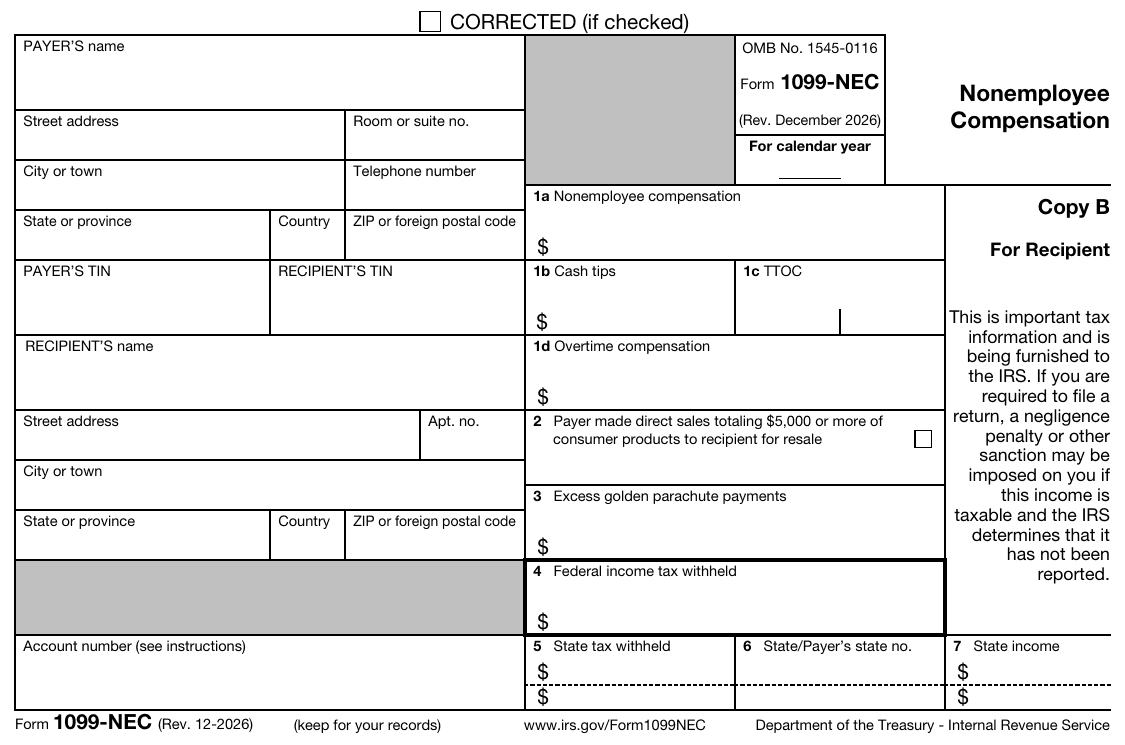
Swipe sideways to see the whole form.
Every line, in plain English
Corrected A corrected form
If this box is checked, the form replaces one the payer sent you earlier, usually because an amount or your details were wrong. Use the corrected one when you file.
ExampleSay Maya's client first reported $21,000 by mistake. Once she points it out, the client sends a new form with this box checked and $12,000 in box 1a.
Our tipIf you spot a mistake, ask the payer for a corrected form. Don't hold up your return waiting for it: file on time using your own records.
Payer Who paid you
The client's name, address and phone number. This is the business reporting your pay to the IRS, and the phone number is there so you can ask about the form.
ExampleMaya's says Northwind Studio LLC, the client that paid her $12,000.
Our tipDon't recognize the name? It may be a client's legal company name rather than the brand you know.
Calendar year The year you were paid
The year the payments were made. Check it, because a form for one year belongs on that year's return and no other.
ExampleMaya's says 2026, so it goes with the 2026 return she files in 2027.
Payer's TIN The client's tax ID
The payer's taxpayer identification number, usually an EIN. You don't need to do anything with it, though tax software may ask for it when you enter the form.
Recipient's TIN Your tax ID
Your Social Security number, or the EIN you gave the client on your W-9. For your protection, it may show only the last four digits, but the payer gave the IRS the full number.
ExampleMaya put her EIN on her W-9, so her form shows her EIN, not her Social Security number.
Our tipIf the number is wrong, ask the payer to fix it. The IRS uses it to match this form to your return.
Recipient's name Your name
Your name, or your business name, as you gave it on the W-9 you sent the client. It should line up with the tax ID next to it.
ExampleMaya's form says Maya Reyes.
Address Your mailing address
Where the payer sent your copy. An old address doesn't change what you owe, but tell the payer so next year's form reaches you.
Account number The payer's reference number
A number the payer may use to tell your accounts apart, for example if they send you more than one 1099-NEC. It's often blank, and you can ignore it.
Box 1a Nonemployee compensation
The number that matters. It's what this client paid you for your work during the year, before any of your costs. For most freelancers it's business income, so it goes on Schedule C line 1 and counts toward self-employment tax. Payments by card or a payment app aren't included: those show up on a 1099-K instead.
ExampleMaya's box 1a shows $12,000. It's part of the total she reports on Schedule C line 1, not an extra amount on top.
Our tipCheck it against your own records. Clients that paid you less than $2,000 in 2026 ($600 in 2025) don't have to send a form, but that money is still taxable.
Box 1b Cash tips
New on this revision. It shows the cash tips included in box 1a, counting tips paid in cash or charged by customers. They're already in box 1a, so don't add them again. You use this amount for the new deduction for qualified tips on Schedule 1-A.
ExampleMaya doesn't get tips for design work, so hers is blank.
Box 1c Tipped occupation code (TTOC)
A Treasury Tipped Occupation Code for the job your tips came from, up to two codes. It's used with box 1b for the tips deduction. If the only code is 000, those tips don't qualify for the deduction.
ExampleMaya's is blank.
Box 1d Overtime compensation
New on this revision. If you were paid overtime that federal wage law requires, this shows the qualified part: only the extra half in time-and-a-half. It's already included in box 1a. You use it for the overtime deduction on Schedule 1-A.
ExampleMost freelancers, Maya included, see this blank.
Box 2 Direct sales of $5,000 or more
A checkbox, not a dollar amount. It's checked if the payer sold you $5,000 or more of consumer products for you to resell somewhere other than a permanent store. Income from reselling them generally goes on Schedule C.
ExampleMaya sells design work, not products, so it's unchecked.
Box 3 Excess golden parachute payments
Rare. These are special payments tied to a change in a company's ownership or control, made to people like officers, shareholders or highly paid workers. The excess part carries an extra 20% excise tax. Almost every freelancer sees this blank.
ExampleMaya's is blank.
Box 4 Federal income tax withheld
Usually blank. A payer has to hold back tax, called backup withholding, if you didn't give them your taxpayer ID, for example by never returning their W-9. Any amount here is tax you've already paid, so you claim it on your return as tax withheld.
ExampleMaya sent her W-9 right away, so box 4 is blank. If she hadn't, the client could have held back 24% of her $12,000, which is $2,880.
Our tipWith nothing withheld, paying the tax is up to you. That's what quarterly estimated taxes are for.
Box 5 State tax withheld
State income tax the payer held back for you, if any. It's uncommon on a 1099-NEC. There's room for two states, one per row.
ExampleMaya's is blank.
Box 6 State and payer's state number
The state's abbreviation and the payer's ID number with that state. Boxes 5 to 7 are optional as far as the IRS is concerned, so many forms leave them blank.
Box 7 State income
The amount of the payment the payer reported to that state. Your state return may use it, but the federal return goes by box 1a.
Copy B Your copy
This copy is for you, the person who got paid. The payer files the same numbers with the IRS, and as the note on the form says, the IRS can add a penalty if taxable income on it goes unreported. You don't attach it to your return: keep it with your tax records.
ExampleFor 2026 payments, Maya's copy is due to her by February 1, 2027, because January 31 falls on a Sunday.
