The short answer
You bought a new laptop or camera for work, and now your tax software wants a form you’ve never seen: Form 4562. The official Form 4562 instructions run 24 pages, but a one-person business usually needs only a handful of lines.
Form 4562 is where you deduct business equipment you placed in serviceThe day equipment is ready and available to use in your business. It decides which year you can deduct it, not the day you pay for it. this year: with the Section 179A tax rule that lets you choose to deduct the full cost of equipment in the year you start using it, up to your business income. The 2026 limit is $2,560,000. election in Part I, bonus depreciationA first-year write-off of the full cost of most equipment: 100% for property bought after January 19, 2025. It applies unless you opt out. on line 14, or regular depreciation in Part III. It also holds your car’s business-use details and any amortization. The total on line 22 goes to Schedule CThe tax form where you report your business income and expenses. Its bottom line is your profit., line 13. For 2026, Section 179 and 100% bonus depreciation can each write off the full cost of a laptop or camera in the first year, and items of $2,500 or less can skip the form entirely.
The line numbers below come from the 2025 Form 4562, the latest final form the IRS has published, and our example uses 2026 limits. The IRS has posted an early draft of the 2026 form that splits line 14 into four lines (14a to 14d) and adds a new line 19k. The lines a freelancer uses otherwise keep their numbers, but check the final form when it comes out.
Form 4562, decoded: tap any line
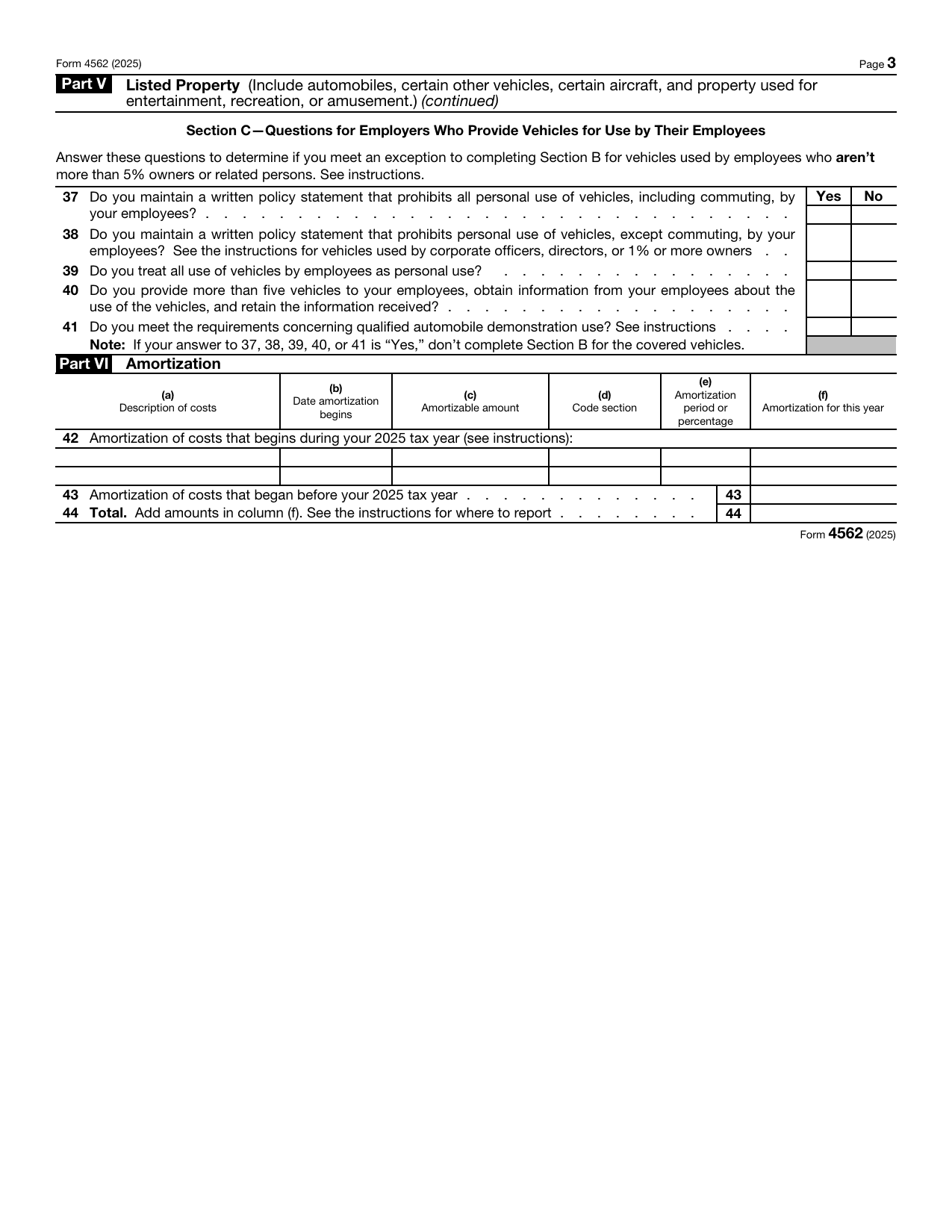
Here’s the real form from the IRS, all three pages. Every line has a plain-English note, and our example, Maya, fills in the ones she needs for a $2,400 laptop and a $1,800 camera, so you can see where $4,200 of gear ends up on her return.
Tap any line on the formHover over any line on the form to see what it means. Click a line to pin its note open so you can use the links. to see what it means. Our example is Maya, the freelance designer from our Schedule C page, with one change: in 2026 she also buys a $2,400 laptop and a $1,800 camera, both used only for work, and expenses them with Section 179. We use 2026 limits on the 2025 form.


Swipe sideways to see the whole form.
Every line, in plain English
Name Your name
Your name exactly as it appears on your Form 1040. Form 4562 is attached to your personal return, next to the Schedule C it belongs to.
ExampleMaya writes her own name.
Business Which business this form is for
A short name for the business or activity. If you have more than one business that needs Form 4562, each one gets its own form.
ExampleMaya writes: Graphic design.
Our tipUse the same description as line A of your Schedule C, so the two forms clearly go together.
ID number Identifying number
The number on your return. For a sole proprietor or single-member LLC filing Schedule C, that's usually your Social Security number, the same one on your Form 1040.
ExampleMaya enters her Social Security number.
Line 1 The Section 179 maximum
The most you can expense under Section 179 in a year. The form says "see instructions" instead of printing it. For 2025 it's $2,500,000, and for 2026 it's $2,560,000. Part I only matters if you choose to expense something; it's never automatic.
ExampleFor Maya's 2026 return, line 1 is $2,560,000.
Our tipIf you have any listed property, like a car you're expensing, the form asks you to fill in Part V on page 2 first.
Line 2 What you bought that qualifies
The total cost of all Section 179 property you placed in service this year: equipment, computers, cameras, off-the-shelf software and similar business property. Count all of it, even items you don't plan to expense, plus any listed property from Part V.
ExampleMaya: $2,400 + $1,800 = $4,200.
Our tipPlaced in service means ready and available to use. A camera ordered in December that arrives in January counts next year.
Line 3 The spending threshold
The amount of qualifying purchases where the limit starts to shrink: $4,000,000 for 2025 and $4,090,000 for 2026. It's there for big companies.
ExampleFor Maya's 2026 return, line 3 is $4,090,000.
Line 4 Reduction in the limit
Line 2 minus line 3. If you bought more than the threshold, your limit drops dollar for dollar. For a one-person business it's zero.
ExampleMaya: $4,200 is far below $4,090,000, so 0.
Line 5 Your dollar limit for the year
Line 1 minus line 4. If you're married filing separately, you and your spouse split this limit, 50% each unless you both choose a different split.
ExampleMaya: $2,560,000 − 0 = $2,560,000.
Line 6 The items you're expensing
One row per item you elect to expense. Column (a) is a short description, column (b) is the cost (only the business-use share), and column (c) is how much of it you choose to expense now. Whatever you don't expense gets depreciated in Part II or III instead. Cars and other listed property go in Part V, not here.
ExampleMaya writes "Laptop", $2,400, $2,400 on the first row and "Camera", $1,800, $1,800 on the second.
Our tipTo use Section 179, the item has to be used more than 50% for business. If business use later drops to 50% or less, part of the deduction comes back as income.
Line 7 Listed property you're expensing
The Section 179 amount for listed property, like a car used more than 50% for business, copied from line 29 on page 2.
ExampleMaya isn't expensing her car, so 0.
Line 8 Total you chose to expense
Column (c) of line 6 plus line 7.
ExampleMaya: $2,400 + $1,800 + 0 = $4,200.
Line 9 Tentative deduction
The smaller of line 5 or line 8.
ExampleMaya: the smaller of $2,560,000 and $4,200 is $4,200.
Line 10 Last year's leftover
Section 179 you chose in an earlier year but couldn't deduct because of the business income limit. Copy it from line 13 of last year's Form 4562.
ExampleThis is Maya's first time using Section 179, so 0.
Line 11 The business income limit
Section 179 can't create a loss. Enter the smaller of line 5 or your taxable income from businesses you actively run, figured before this deduction and before the deduction for half your self-employment tax. Wages from a W-2 job count too, and on a joint return so does your spouse's.
ExampleMaya's Schedule C profit before the gear is $72,825 and she has no W-2 job, so line 11 is $72,825.
Our tipBonus depreciation on line 14 doesn't have this limit, which is why it can create a loss and Section 179 can't.
Line 12 Your Section 179 deduction
Lines 9 and 10 added together, but no more than line 11. This is the part of Part I that counts. It goes into the total on line 22.
ExampleMaya: $4,200, well under $72,825.
Line 13 Carryover to next year
Lines 9 and 10 minus line 12: what didn't fit under the income limit. It isn't lost. Write it down for line 10 of next year's form.
ExampleMaya: $4,200 − $4,200 = 0.
Line 14 Bonus depreciation
The special depreciation allowance, often called bonus depreciation. For qualifying property acquired and placed in service after January 19, 2025, it's 100% of the cost, and it applies automatically unless you elect out for a whole class of property. It's figured after any Section 179, so if you expensed the full cost in Part I, there's nothing left for it.
ExampleMaya used Section 179 for the full $4,200, so line 14 is 0. If she had skipped Part I, the same $4,200 would land here instead.
Our tipElecting out means attaching a statement to your return. It covers every item in that class placed in service that year, not just one.
Line 15 Units-of-production property
Depreciation for property you chose to depreciate by how much it produces instead of by years. It's for things like some industrial machines. Freelancers leave it blank.
ExampleMaya: blank.
Line 16 Other depreciation
Older or unusual cases: property first used before 1987, certain films and recordings, and a few other kinds that don't follow today's rules. Most one-person businesses leave it blank.
ExampleMaya: blank.
Line 17 Depreciation on things from earlier years
This year's depreciation on equipment you started depreciating in an earlier year, like a desk from two years ago you didn't expense. If that's your only depreciation, you usually don't need Form 4562 at all: it goes straight onto Schedule C, line 13.
ExampleMaya has nothing she's still depreciating, so 0.
Our tipKeep a simple list of what you bought, when and for how much. You'll need it every year the item is being depreciated.
Line 18 General asset accounts
A checkbox to group assets placed in service this year into pools that are depreciated as one asset. It's an irrevocable election that mostly helps businesses with many similar items. Leave it unchecked.
ExampleMaya leaves it blank.
Line 19 columns How the depreciation table works
For each kind of property you placed in service this year and didn't fully expense: (c) the business-use cost, minus any Section 179 and bonus you took, (d) how many years it's spread over, (e) the convention, usually HY for half-year, (f) the method, usually 200 DB for equipment, and (g) this year's deduction.
ExampleMaya expensed everything, so her line 19 rows are empty.
Our tipThe half-year convention treats everything as bought mid-year. But if more than 40% of the year's purchases came in October to December, the mid-quarter convention applies instead.
Line 19a 3-year property
A short list of property with a 3-year life, such as certain horses and rent-to-own property. A typical freelancer has nothing here.
ExampleMaya: blank.
Line 19b 5-year property
Computers, copiers and other office machines, and cars and light trucks (though cars go in Part V, not here). This is where a laptop goes if you depreciate it over the years instead of expensing it.
ExampleIf Maya had skipped Section 179 and elected out of bonus depreciation, her laptop would go here: $2,400, 5 yrs., HY, 200 DB, and a first-year deduction of $480 (20%).
Our tipSpreading it out only makes sense if you expect higher income later. Most solo owners take the full write-off now.
Line 19c 7-year property
Office furniture and fixtures, like a desk, chair or shelving, plus any property that has no other class.
ExampleIf Maya had bought a $900 desk and chosen to depreciate it, it would go here. Under $2,500, though, she'd more likely deduct it with the $2,500 rule.
Lines 19d to 19h Long-lived property
10-, 15-, 20-, 25- and 50-year property: things like boats, land improvements such as fences and sidewalks, farm buildings, utility property and railroad grading. One-person service businesses rarely have any.
ExampleMaya: blank.
Lines 19i and 19j Buildings
Rental homes (27.5 years) and other buildings (39 years). A home office in a house you own is depreciated as 39-year property, but that depreciation is figured on Form 8829 first. Column (b) asks for the month and year.
ExampleMaya rents her apartment, so she has no building to depreciate.
Lines 20a to 20e The Alternative Depreciation System
A slower, straight-line method over longer periods. It's required for some property, like equipment used mostly outside the US, and you can choose it for a whole class. Most freelancers never use it.
ExampleMaya: blank.
Line 21 Listed property total
The depreciation on cars and other listed property, copied from line 28 below.
ExampleMaya uses the standard mileage rate for her car, so there's no depreciation: 0.
Line 22 Your total deduction
Line 12, lines 14 to 17, column (g) of lines 19 and 20, and line 21, added up. This is the number that leaves the form. For a sole proprietor it goes on Schedule C, line 13, where it lowers both your income tax and your self-employment tax.
ExampleMaya: $4,200, which goes on Schedule C, line 13. Her profit drops from $72,825 to $68,625.
Our tipThat cuts her self-employment tax by about $593, plus income tax at her bracket.
Lines 23a and 23b Costs capitalized under section 263A
Only for businesses that build or produce property and have to add some of their costs, like interest, to its basis under the uniform capitalization rules. A freelancer buying ready-made equipment leaves these blank.
ExampleMaya: blank.
Lines 24a and 24b Do you have proof of business use?
The IRS asks whether you have evidence for the business use you're claiming on your vehicles and other listed property, and whether it's written. A mileage log or app records count as written evidence.
ExampleMaya tracks her trips in an app, so she checks Yes on both.
Our tipIf you file Form 4562 for any reason, your car details move here from Part IV of Schedule C, even with the standard mileage rate.
Line 24c Aircraft
New for 2025: check whether you own, lease or charter an aircraft you're claiming depreciation on.
ExampleMaya leaves all three boxes blank.
Part V columns The listed property table
One row per vehicle or other listed property, cars first. Column (a) is the make and model, (b) the date it went into business use, (c) your business-use percentage, (d) cost, (e) the business share of the cost, (f) to (h) how it's depreciated, and (i) any Section 179. With the standard mileage rate, you fill in only columns (a) to (c).
ExampleMaya lists her car's make and model, March 1, 2024, and 33.33% (3,000 business miles out of 9,000).
Our tipComputers bought after 2017 aren't listed property anymore, and neither is a camera used only for business. Maya's laptop and camera stay in Part I.
Line 25 Bonus depreciation on listed property
Bonus depreciation for a car or other listed property placed in service this year and used more than 50% for business. For a car, it counts toward the yearly depreciation caps: in 2025, $20,200 in the first year with bonus, or $12,200 without.
ExampleMaya: 0. Her car uses the mileage rate and her business use is under 50%.
Line 26 Used more than 50% for business
Vehicles and other listed property used more than 50% for business. These can use Section 179, bonus depreciation and the faster methods. Column (i) holds any Section 179, which for an SUV over 6,000 pounds is capped at $32,000 in 2026.
ExampleIf Maya drove a car 80% for work and depreciated it, it would go on one of these rows.
Our tipOnce you take depreciation on a car, you generally can't switch it to the standard mileage rate later.
Line 27 Used 50% or less for business
Vehicles and other listed property used 50% or less for business. No Section 179 and no bonus here: depreciation is straight line over the slower ADS period, which is 5 years for cars.
ExampleMaya's car is 33.33% business, so it goes on a line 27 row. She uses the standard mileage rate, so she fills in only columns (a) to (c).
Line 28 Listed property depreciation
Column (h) of lines 25 to 27, added up. It goes up to line 21.
ExampleMaya: 0.
Line 29 Listed property Section 179
Column (i) of line 26, added up. It goes back to line 7 in Part I.
ExampleMaya: 0.
Line 30 Business miles
For each vehicle, the miles you drove for business during the year. Commuting doesn't count. If your home is your main place of business, driving from home to a client is business, not commuting.
ExampleMaya: 3,000 business miles.
Our tipThese are the same miles you multiply by the standard mileage rate on Schedule C, line 9.
Lines 31 and 32 Commuting and personal miles
Line 31 is commuting miles: driving between home and a regular work location. Line 32 is all your other personal driving.
ExampleMaya: 0 commuting and 6,000 personal miles.
Line 33 Total miles
Lines 30 to 32 added together. Your business-use percentage in Part V is line 30 divided by this.
ExampleMaya: 3,000 + 0 + 6,000 = 9,000 miles, so 33.33% business.
Line 34 Available for personal use?
Whether you could use the vehicle for personal driving outside work hours. For a sole proprietor's own car, Yes is normal.
ExampleMaya uses the same car for errands, so she checks Yes.
Line 35 Used mainly by an owner?
Whether the vehicle was used mainly by someone who owns more than 5% of the business, or a relative. As a sole proprietor, you own 100%.
ExampleMaya is the owner and the only driver, so she checks Yes.
Line 36 Another vehicle for personal use?
Whether you (or your spouse) have another vehicle available for personal driving. Either answer is fine; just answer honestly.
ExampleMaya has only the one car, so she checks No.
Lines 37 to 41 Employers who give vehicles to employees
Only for businesses that provide vehicles to employees who aren't owners or relatives. A Yes to any of these, like having a written policy banning personal use, means you can skip Section B for those vehicles. A one-person business with no employees skips all five.
ExampleMaya has no employees, so she leaves lines 37 to 41 blank.
Line 42 Amortization that starts this year
Amortization spreads certain costs evenly over a set period. The one a new freelancer is most likely to meet is startup costs: in the year your business begins, you can deduct up to $5,000 right away (less if your startup costs were over $50,000) and spread the rest over 180 months. You list the cost, the date it starts, the amount, the code section (195 for startup costs), the period and this year's share.
ExampleMaya started her business before 2026, so she has nothing here. Say you open in July 2026 with $8,000 of startup costs: you deduct $5,000 on Schedule C and amortize $3,000 here, so this year's amount is $3,000 ÷ 180 × 6 = $100.
Our tipThe $5,000 isn't entered on Form 4562; it goes on Schedule C as an other expense.
Line 43 Amortization from earlier years
This year's share of amortization that began in an earlier year. If this is the only reason you'd file Form 4562, don't file it: report the amount straight on Schedule C as an other expense.
ExampleIn the startup example, next year's amount would be $3,000 ÷ 180 × 12 = $200. Maya: 0.
Line 44 Total amortization
Column (f) of line 42 plus line 43. It doesn't go into line 22. For a sole proprietor it goes on Schedule C as an other expense, in Part V, which carries to line 27b.
ExampleMaya: 0.
Do you need to file Form 4562?
Not every purchase brings it along. For a sole proprietor filing Schedule C, you attach Form 4562 when you’re claiming any of these:
- Depreciation on property placed in service this year, like a laptop you’re depreciating instead of expensing, or the 100% bonus depreciation that applies automatically.
- A Section 179 deduction, including a carryover from an earlier year.
- Depreciation on a car or other listed property, no matter when you started using it.
- Amortization that starts this year, such as startup costsMoney spent getting a business ready before it opens, like research, training or a logo. Up to $5,000 is deductible in the first year; the rest is spread over 15 years. you’re spreading out.
You can skip it when you only have depreciation on things from earlier years, or when you deduct small items with the $2,500 rule. In those cases the amounts go straight onto Schedule C. One knock-on effect: once you do file Form 4562, your car details move from Part IV of Schedule C to Part V of this form, even if you use the standard mileage rateThe IRS’s set amount per business mile, which covers gas, repairs, insurance and wear: 72.5 cents for 2026 drives through June and 76 cents from July 1..
Maya’s laptop and camera: three ways to deduct them
Maya is the freelance designer from our Schedule C walk-through, with $72,825 of profit for 2026. This year she also buys a $2,400 laptop and a $1,800 camera, both used only for work. She can deduct the full $4,200 in 2026 three different ways. Here’s how they compare.
| The $2,500 rule | Section 179 | Bonus depreciation | |
|---|---|---|---|
| Where it goes | Schedule C, Part V (other expenses) | Form 4562, Part I, then Schedule C line 13 | Form 4562, line 14, then Schedule C line 13 |
| Form 4562 needed? | No | Yes | Yes |
| How you choose it | A short election statement with your return | List each item on line 6 | Automatic unless you elect out |
| Limit | $2,500 per item or invoice | Your business income; $2,560,000 for 2026 | No dollar or income limit (cars have yearly caps) |
| Maya’s 2026 deduction | $4,200 | $4,200 | $4,200 |
When every item costs $2,500 or less, the $2,500 rule (the de minimis safe harborAn IRS election that lets you deduct equipment and supplies costing $2,500 or less per item or invoice right away, instead of depreciating them.) is the simplest route. There’s no depreciation form at all, as long as you also expense the items in your books. For anything bigger, Section 179 or bonus depreciation does the same job on Form 4562. How the three rules compare, and when to buy.
Maya’s Form 4562, line by line
Say Maya goes the Section 179 route. Here’s every line she fills in, using the 2026 limits on the 2025 form.
| Line | What it does | Maya |
|---|---|---|
| 1 | Section 179 maximum for 2026 | $2,560,000 |
| 2 | Cost of qualifying property placed in service | $4,200 |
| 3 | Threshold before the limit shrinks (2026) | $4,090,000 |
| 4 | Reduction in the limit | $0 |
| 5 | Dollar limit for the year | $2,560,000 |
| 6 | Laptop $2,400 and camera $1,800, both elected in full | $4,200 |
| 8 and 9 | Total elected, then the smaller of line 5 or 8 | $4,200 |
| 11 | Business income limit: her Schedule C profit before this deduction | $72,825 |
| 12 | Section 179 deduction | $4,200 |
| 13 | Carryover to 2027 | $0 |
| 22 | Total, copied to Schedule C, line 13 | $4,200 |
| 24a, 24b, 30 to 36 | Her car: written evidence, 3,000 business miles of 9,000 | Yes, 33.33% |
Her Schedule C profit drops from $72,825 to $68,625. That cuts her self-employment taxSocial Security and Medicare tax for people who work for themselves: 15.3% on 92.35% of your profit, on top of income tax. by about $593 on Schedule SE, plus income tax at her bracket. Her mileage deduction itself stays on Schedule C, line 9: Part V only records the miles.
Section 179 or bonus depreciation?
For 2026 purchases, both can write off the whole cost in year one. Bonus depreciation is 100% for qualifying property acquired and placed in service after January 19, 2025, a change made permanent by the 2025 tax law. The differences show up at the edges.
- Section 179 is item by item and can’t create a loss. It’s capped at your business income (plus any W-2The form an employer sends each January showing your wages and the tax withheld. As an S-corp owner, your own company sends you one. wages), and whatever doesn’t fit carries to next year on line 13. It needs more than 50% business use.
- Bonus depreciation is automatic and can create a loss. If you don’t want it, you elect out for a whole class of property, like all 5-year property, with a statement attached to your return.
- Section 179 comes first. Bonus applies to whatever cost is left, then regular depreciation in Part III takes the rest.
Here’s what most people in your spot do: let the tax software apply the default, and only change it on purpose, for example if they expect much higher income next year and want some of the deduction later. If business use of an item later drops to 50% or less, part of a Section 179 or listed-property deduction comes back as income, so keep records of how you use it.
Cars and Part V
Part V is for listed property: mainly cars and other vehicles. Computers bought after 2017 aren’t listed property anymore, and a camera used only for business isn’t either, so most freelancers meet Part V only through their car.
- Standard mileage rate: if you’re filing Form 4562 anyway, you answer 24a and 24b, fill in columns (a) to (c) for the car, and complete the miles and use questions on lines 30 to 36.
- Depreciating the car: you fill in the whole row. Over 50% business use goes on line 26 and can use Section 179 and bonus, within the yearly caps for passenger cars. At 50% or less, it goes on line 27 with straight-line depreciation over 5 years.
- Heavy SUVs: vehicles over 6,000 pounds escape the passenger car caps, but Section 179 on an SUV is limited to $32,000 for 2026.
Whichever method you use, the miles come from your log. The best mileage tracker apps keep it for you.
FAQ
What is Form 4562 used for?
It’s where you claim depreciation and amortization, make the Section 179 election to expense business property, and report business use of cars and other listed property. The total on line 22 goes to Schedule C, line 13, for a sole proprietor.
Do I need Form 4562 for a laptop?
Not if it costs $2,500 or less and you use the de minimis safe harborA payment amount that protects you from IRS underpayment penalties, such as paying 100% of last year’s tax (110% if your AGI was over $150,000).: you deduct it as an other expense on Schedule C. A more expensive laptop goes on Form 4562, where Section 179 or bonus depreciation can usually still deduct all of it in the first year.
What is the Section 179 limit for 2026?
$2,560,000, reduced dollar for dollar once you place more than $4,090,000 of qualifying property in service. For 2025 the limits were $2,500,000 and $4,000,000. The deduction also can’t exceed your business income for the year.
Is bonus depreciation 100% in 2026?
Yes, for qualifying property acquired and placed in service after January 19, 2025. It applies automatically unless you elect out for a class of property.
Do I file Form 4562 every year?
Only in years you have a reason to: new property placed in service, a Section 179 deduction or carryover, depreciation on a car, or new amortization. Depreciation on older equipment alone goes straight on Schedule C.
Where does line 22 of Form 4562 go?
For a sole proprietor or single-member LLC, on Schedule C, line 13, depreciation and section 179 expense deduction. Amortization from line 44 goes separately, as an other expense in Part V of Schedule C.
Can I deduct equipment I also use personally?
Yes, the business share. Section 179 needs more than 50% business use, and you only expense the business part of the cost. More on what counts as a write-off.
Sources
- IRS: About Form 4562
- IRS: 2025 Instructions for Form 4562
- IRS: 2025 Form 4562 (PDF)
- IRS Publication 946: How to Depreciate Property (2026 Section 179 limits)
- IRS Rev. Proc. 2025-32: 2026 inflation adjustments
- IRS Notice 2026-11: Guidance on 100% bonus depreciation
- IRS: Instructions for Schedule C (de minimis safe harbor, vehicle information)
- IRS: Tangible property regulations
General education, not legal or tax advice. Line numbers are from the 2025 Form 4562; the limits and examples are for 2026 and may change for later years.