Tap any line on the formHover over any line on the form to see what it means. Click a line to pin its note open so you can use the links. to see what it means. Our example is Maya, the freelance designer from our Schedule C page: $72,825 of net profit in 2026 and no W-2 job, the same numbers as the walk-through further down.

Swipe sideways to see the whole form.
Every line, in plain English
Name Whose self-employment income this is
The name of the person who earned the self-employment income, as it appears on your Form 1040. On a joint return, that's the spouse with the business, not automatically the first name on the 1040.
ExampleMaya writes her own name.
Our tipIf you and your spouse both have self-employment income, each of you files your own Schedule SE.
SSN That person's Social Security number
The Social Security number of the same person named on the left. This is how your self-employment tax gets credited to your own Social Security record, so it has to match.
ExampleMaya enters her own Social Security number, not her business EIN.
Line A Ministers with an approved exemption
Only for ministers, members of a religious order and Christian Science practitioners who filed Form 4361 and were approved to be exempt from self-employment tax on their ministry pay, but who also had $400 or more of other self-employment earnings. Everyone else skips it.
ExampleMaya isn't a minister, so she leaves the box empty.
Line 1a Farm profit or loss
Your net farm profit or loss from Schedule F, line 34, plus farm partnership earnings from Schedule K-1. If you don't farm, leave it blank.
ExampleMaya isn't a farmer, so this is blank.
Line 1b Conservation Reserve Program payments
Only for people already getting Social Security retirement or disability benefits who also received Conservation Reserve Program payments. Those payments aren't taxed for self-employment tax, so you enter them here as a negative number, in parentheses.
ExampleMaya has no farm payments, so this is blank.
Line 2 Your business profit
The net profit or loss from Schedule C, line 31, plus any self-employment earnings from a partnership (Schedule K-1, box 14, code A). If you run more than one business, add their results together here: a loss in one lowers the profit from another.
ExampleMaya copies $72,825 from line 31 of her Schedule C.
Our tipEvery dollar of expenses you claim on Schedule C makes this line smaller, which lowers both your income tax and this tax.
Line 3 Your combined self-employment profit
Lines 1a, 1b and 2 added together. For most freelancers it's the same as line 2.
ExampleMaya: $72,825.
Line 4a The 92.35% step
If line 3 is more than zero, you multiply it by 92.35%. This trims your profit the way an employee's pay is figured before the employer's share of payroll tax, so you aren't taxed on the tax. The result is your net earnings from self-employment.
ExampleMaya: $72,825 × 92.35% = $67,253.89.
Our tipThis is why self-employment tax works out to about 14.1% of your profit, not the full 15.3%.
Line 4b Optional methods, if you use them
If you choose one of the optional methods in Part II on page 2, you enter the total of lines 15 and 17 here. Most people leave it blank.
ExampleMaya doesn't use an optional method, so this is blank.
Line 4c The $400 test
Lines 4a and 4b added together. If the total is under $400, you stop: you don't owe self-employment tax (unless you had church employee income). That works out to about $433 of profit. At $400 or more, you keep going.
ExampleMaya: $67,253.89, far above $400, so she continues.
Our tipYou still report a small business profit on Schedule C for income tax, even when this line says you owe no self-employment tax.
Lines 5a and 5b Church employee income
Only for people paid wages by a church that elected out of paying employer Social Security and Medicare tax. You enter that W-2 pay on 5a and multiply it by 92.35% on 5b. If the result is under $100, you enter zero. Pay as a minister doesn't count here.
ExampleMaya has no church wages, so both lines are blank.
Line 6 Earnings the tax is figured on
Lines 4c and 5b added together. This is the number the 12.4% and 2.9% rates apply to.
ExampleMaya: $67,253.89.
Line 7 The Social Security wage base
The most earnings that can be charged Social Security tax in the year, counting your wages and self-employment earnings together. It's printed on the form: $176,100 on the 2025 form. For 2026 it's $184,500.
ExampleFor Maya's 2026 return, line 7 is $184,500.
Our tipThe 2.9% Medicare part has no cap, so earnings above this line still pay Medicare.
Lines 8a to 8c Wages from a job
If you also had a W-2 job, your Social Security wages (boxes 3 and 7 of your W-2) go on 8a. Lines 8b and 8c are for unreported tips and for wages from Form 8919, which is for workers who were treated as contractors when they should have been employees. If your wages alone reach the line 7 amount, you skip ahead to line 11.
ExampleMaya has no W-2 job, so these lines are 0.
Our tipYour job uses up the wage base first. Your side business only pays the 12.4% on whatever room is left.
Line 8d Total wages
Lines 8a, 8b and 8c added together.
ExampleMaya: 0.
Line 9 Room left under the cap
Line 7 minus line 8d: how much of the wage base your wages haven't already used. If it's zero or less, enter 0 here and on line 10.
ExampleMaya: $184,500 − 0 = $184,500. If she also had a $150,000 W-2 job, line 9 would be $34,500.
Line 10 Social Security tax: 12.4%
You multiply the smaller of line 6 or line 9 by 12.4%. That's the Social Security part of the tax, both the employee and the employer share.
ExampleMaya: $67,253.89 is smaller than $184,500, so $67,253.89 × 12.4% = $8,339.48.
Our tipWith that $150,000 job, she would pay 12.4% on just $34,500, so $4,278.
Line 11 Medicare tax: 2.9%
Line 6 multiplied by 2.9%. Medicare has no cap, so this applies to all your net earnings.
ExampleMaya: $67,253.89 × 2.9% = $1,950.36.
Our tipAbove $200,000 single or $250,000 married filing jointly, an extra 0.9% Additional Medicare Tax applies. It's figured on Form 8959, not here.
Line 12 Your self-employment tax
Lines 10 and 11 added together. This is the tax you owe on top of income tax. It goes to Schedule 2 (Form 1040), line 4, and from there into the total tax on your Form 1040.
ExampleMaya: $8,339.48 + $1,950.36 = $10,289.84.
Our tipYour quarterly estimated payments need to cover this as well as your income tax.
Line 13 Deduct half of it
Half of line 12. It goes to Schedule 1 (Form 1040), line 15, where it lowers the income you pay income tax on. You get it even if you take the standard deduction. It doesn't lower the self-employment tax itself.
ExampleMaya: $10,289.84 × 50% = $5,144.92 off her income for income tax.
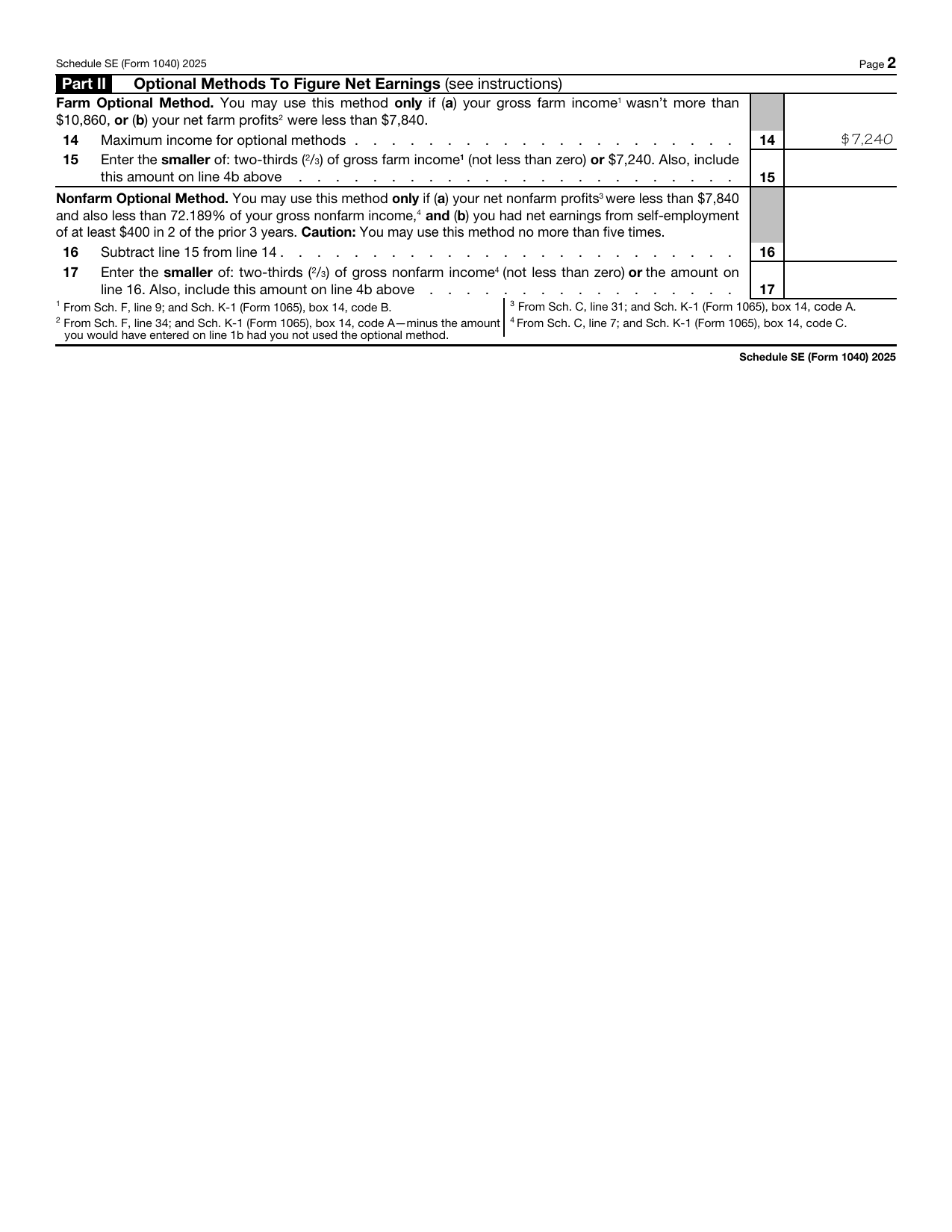
Lines 14 and 15 Farm optional method
A choice for farmers with small or negative farm income. If your gross farm income was $10,860 or less, or your net farm profits were under $7,840, you can report two-thirds of your gross farm income as your earnings, up to $7,240 on the 2025 form. Line 14 shows that limit, and line 15 carries the result to line 4b.
ExampleMaya doesn't farm, so she skips this section.
Our tipIt can mean more self-employment tax, but also Social Security credit for the year.
Lines 16 and 17 Nonfarm optional method
A choice for a low-profit year. You qualify if your nonfarm profit was under $7,840 and under 72.189% of your gross income, and you had $400 or more of net earnings in 2 of the 3 years before. You report two-thirds of your gross income instead, up to line 16. You can use it for only 5 years in total.
ExampleSay you brought in $9,000 and made $3,000 of profit. Two-thirds of $9,000 is $6,000, so you report $6,000 of earnings instead of about $2,771. Maya's profit is far too high to use it.
Our tipWhy pay more tax on purpose? It can earn Social Security credits and raise credits like the earned income credit. Run your numbers both ways first.
Footnotes Where the numbers above come from
The small notes tell you which lines feed Part II. For a sole proprietor, net nonfarm profit is Schedule C, line 31, and gross nonfarm income is Schedule C, line 7. Farmers use Schedule F, lines 9 and 34.
ExampleIn the example above, the $9,000 is Schedule C line 7 and the $3,000 is line 31.
