The short answer
A letter from the IRS arrives, and the headline says you didn’t file a tax return for a year you’d half forgotten about. Maybe you’re sure you filed it. Maybe that was the year the freelance work started and taxes slipped. Either way, this one is fixable.
A CP59 notice means the IRS has no record of your personal tax return for the year printed on it. The IRS asks you to file that return immediately, or tell it why you don’t need to. If you filed within the last eight weeks, you don’t need to do anything. It isn’t a bill, but waiting can cost you penalties and even a refund.
How worried to be
It isn't a bill, and if you filed recently you can ignore it. But a missing return can cost you penalties and a refund, so it needs an answer this week.
Reply needed?
No set number of days. The IRS's CP59 page says to file your return immediately, or explain why you don't need to file. If you filed within the last eight weeks, you don't need to do anything.
CP59, decoded: tap any part of the letter
We rebuilt this sample from the IRS’s older official CP59, with made-up details. Every part has a plain-English note. Yours will have different dates but the same parts in about the same places.
Tap any part of the letterHover over any part of the letter to see what it means. Click a part to pin its note open so you can use the links. to see what it means. Our made-up example: Jordan Ellis, a freelance photographer, has no 2024 return on file with the IRS.
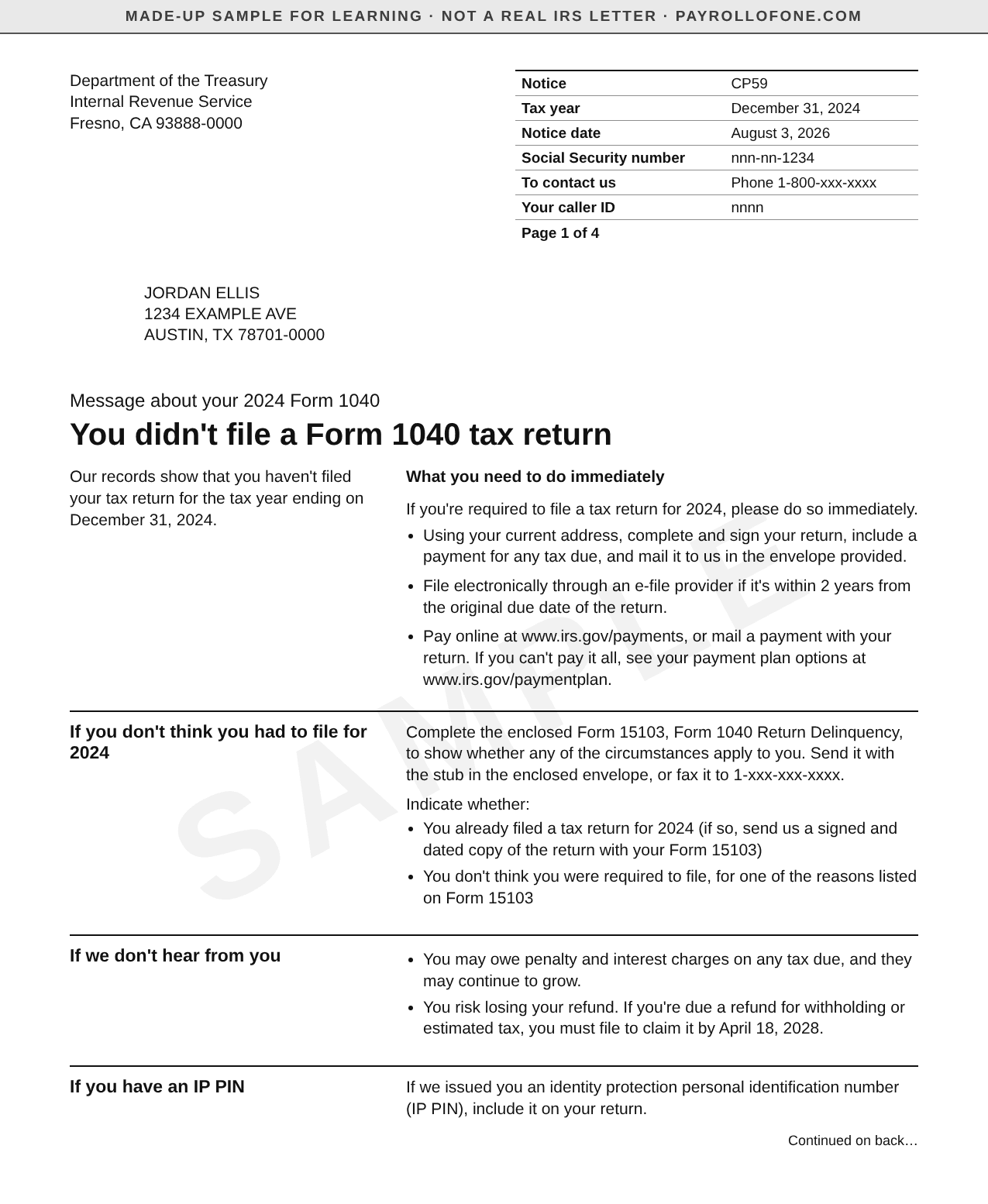
Swipe sideways to see the whole letter.
Every part, in plain English
Top left Which IRS office sent it
The IRS campus handling your account. If you mail a late return or Form 15103 in response, send it to the address on the notice, not the address you'd normally use.
ExampleJordan's notice came from Fresno, so a reply goes there, in the envelope that came with it.
Good to knowThe IRS says to send a past due return to the location shown on the notice you received.
Notice The notice code
CP59 is the IRS's notice for a missing personal return: its records show no Form 1040 for the year printed below. It's a request to file, not a bill.
ExampleType CP59 into our lookup or the IRS's notice search and you land on the right instructions.
Tax year Which return is missing
The year of the return the IRS can't find. It's often a year or more back, so check that year in particular, not just your most recent return.
ExampleJordan's notice is about the 2024 return, which was due April 15, 2025.
Good to knowCheck that the name, Social Security number and tax year on the notice match the return you filed. A mismatch is one reason the IRS can't find a return.
Notice date When the IRS sent it
CP59 doesn't give a set number of days to answer: the IRS asks you to act immediately. The date still matters, because if you filed in the eight weeks before it, the return may simply not have been processed yet.
ExampleJordan's notice is dated August 3, 2026.
Good to knowThe IRS says you don't have to do anything if you filed your return within the last eight weeks.
Your number Social Security number
The number the IRS looked up. Our sample hides it. If it's wrong, or isn't the number you filed under, that may be why the IRS can't match your return.
Good to knowNot sure a letter is real? The IRS says to search for the notice code on irs.gov, and to call 800-829-1040 if it doesn't appear there or looks suspicious.
To contact us The phone number for your account
Call it if you think the IRS made a mistake or you have a question about the notice. Have your copy of the return, if you filed one, in front of you.
ExampleIf Jordan mailed the 2024 return last spring, a call is a quick way to ask whether it arrived.
Headline You didn't file a Form 1040 tax return
The headline states what the IRS's records show, not a final finding. You may have filed and the IRS hasn't matched it, or you may not have had to file at all.
ExampleThe IRS has no 2024 Form 1040 from Jordan.
Why you got it No return on file
The IRS sends a CP59 when its records show no personal return for a year. For freelancers this matters more than it seems: you must file if your net earnings from self-employment were $400 or more, even when you had no other income.
ExampleJordan earned freelance income in 2024, so a return was required.
Good to knowIf you're self-employed and don't file, the IRS says your self-employment income isn't reported to Social Security, so it doesn't count toward your future benefits.
What to do File immediately
If you were required to file, the IRS asks you to complete and sign the return using your current address, include a payment for any tax due, and mail it in the envelope provided.
ExampleJordan files the 2024 return now and pays what it shows.
Good to knowA late return still goes on the forms for the year it's about: a 2024 return uses the 2024 Form 1040.
E-file option Filing a late return online
The IRS accepts returns from the last two years electronically, but you'll need an e-file provider that handles prior years. Not every tax preparation service does.
ExampleJordan's 2024 return was due April 15, 2025, so it can still be e-filed through a provider that offers prior-year filing.
Good to knowOlder returns than that have to be filed on paper.
Paying If the return shows tax due
Pay online or send a payment with the return. If you can't pay the full amount, the IRS says to file anyway and request a payment plan. Penalties and interest keep growing until you file and pay in full.
ExampleIf Jordan's 2024 return shows a balance due, Jordan pays what's possible now and sets up a plan for the rest.
Good to knowNot filing usually costs more than not paying. The failure-to-file penalty is 5% of the unpaid tax for each month or part of a month the return is late, up to 25%.
Form 15103 If you think the IRS made a mistake
Form 15103, Form 1040 Return Delinquency, is how you tell the IRS you already filed or didn't need to. The IRS says you can mail or fax it, or upload it through your IRS Online Account.
ExampleIf Jordan had no filing requirement for 2024, Form 15103 is where that gets explained.
Good to knowIf you live in a U.S. territory and filed with your territory's tax office, the IRS says to contact that office about how to respond.
Already filed Send a signed copy
If you filed more than eight weeks ago, the IRS asks for a signed and dated copy of the return. It also suggests checking that your e-filed return wasn't rejected, which would mean it never counted as filed.
ExampleIf Jordan e-filed in April 2025, the first step is to check whether the software shows the return as accepted.
Good to knowKeep proof of filing, like an e-file acceptance or a mailing receipt, with each year's return.
If you ignore it Penalties, interest and a lost refund
Penalties and interest can keep adding up on any tax due. If you're owed a refund, you lose it unless you file within three years of the return's due date. The IRS can also file a substitute return for you, which may leave out deductions you're entitled to.
ExampleJordan has until April 18, 2028 to claim any 2024 refund. Three years from the due date is April 15, a Saturday, so the deadline moves to the next business day.
Good to knowThe IRS holds income tax refunds while its records show a past due return.
Why you got a CP59
The IRS sends a CP59 when its records show no Form 1040 from you for a year. That can happen for several reasons, and only some of them mean you actually missed a return.
- You didn’t file. The most common case. For freelancers, it’s often the first year of self-employment, when there’s no employer sending a W-2The form an employer sends each January showing your wages and the tax withheld. As an S-corp owner, your own company sends you one. to remind you.
- You filed recently. A return sent in the last eight weeks may not be processed yet. The IRS says you don’t need to do anything in that case.
- Your e-filed return was rejected. A rejected return doesn’t count as filed. The IRS suggests checking for this.
- The details don’t match. The name, Social Security number or tax year on the return differ from what’s on the notice.
- You didn’t have to file. Your income was below the filing threshold, or another exception applied.
That last one is rarer for the self-employed than people think. You must file a return if your net earnings from self-employmentYour business profit times 92.35%. Self-employment tax is figured on this amount, and if it’s under $400 for the year, you owe none. were $400 or more. Say Jordan, from our sample, netted $9,000 from photography in 2024 and had no other income. That’s too little for income tax after the standard deductionThe amount you subtract from income before tax without listing deductions. On your federal return: $16,100 if single, $32,200 if married filing jointly (2026). States set their own., but well over $400, so the return was required and would show about $1,270 of self-employment taxSocial Security and Medicare tax for people who work for themselves: 15.3% on 92.35% of your profit, on top of income tax.. Here’s how filing works when you’re self-employed.
What to do, in the IRS’s order
The IRS’s instructions boil down to a few steps. Which ones apply depends on whether you filed.
- Check the date you filed, if you did. Within the last eight weeks? You’re done. Keep the notice with that year’s records.
- Check the details. Make sure the name, Social Security number and tax year on the notice match your return, and that an e-filed return wasn’t rejected.
- If you filed more than eight weeks ago, mail the IRS a signed and dated copy of the return, with Form 15103.
- If you didn’t file and had to, file the return now, for the year on the notice, and send it to the address on the notice. The IRS accepts the last two years’ returns electronically through an e-file provider that offers prior-year filing.
- If you didn’t have to file, complete Form 15103, Form 1040 Return Delinquency, and explain why. The IRS says you can mail or fax it, or upload it through your IRS Online Account.
- Pay what the return shows, or request a payment plan if you can’t pay it all.
Here’s what most people in your spot do the day a CP59 arrives: look for proof of filing for that year, like an e-file acceptance or a mailing receipt, before anything else. It settles which branch you’re on in a few minutes.
If you filed, or didn’t have to
Here’s what the IRS asks for in each situation.
| Your situation | What the IRS asks you to do |
|---|---|
| Filed in the last eight weeks | Nothing. Keep the notice. |
| Filed more than eight weeks ago | Check the name, number and year match, then mail a signed and dated copy of the return with Form 15103 |
| E-filed, but the return was rejected | It wasn’t filed. File it now, electronically if it’s within two years, or on paper |
| Not required to file | Complete Form 15103 and explain why, by mail, fax or your IRS Online Account |
| Required, didn’t file | File the return immediately, with any IP PIN the IRS gave you |
What happens if you ignore a CP59
A CP59 doesn’t go away on its own. If you owe tax, the failure-to-file penalty is 5% of the unpaid tax for each month or part of a month the return is late, up to 25%, plus interest and a separate late-payment penalty. There’s also a minimum penalty for returns more than 60 days late.
If you’re owed money instead, you lose the refund unless you file within three years of the return’s due date. For Jordan’s 2024 return, that’s April 18, 2028: April 15 falls on a Saturday that year, so the deadline moves to the next business day. The IRS also holds refunds while its records show a past due return.
Wait long enough and the IRS may file a substitute return for you, which might not include deductions you’re entitled to. It then sends a Notice of Deficiency, CP3219N, which gives you 90 days to file your own return or petition the Tax Court. After that, the tax is assessed and the billing letters start. Here’s what the first bill, the CP14, looks like.
One cost freelancers often miss: if you’re self-employed and don’t file, your self-employment income isn’t reported to the Social Security Administration, so it doesn’t count toward your retirement or disability benefits.
If you can’t pay what the return shows
File anyway. The penalty for not filing is far bigger than the penalty for not paying, and the IRS says to file all returns that are due whether or not you can pay in full. Then pay what you can and ask for a payment plan for the rest. Here’s what to do if you can’t pay the IRS.
Looking ahead, an extension is the tool that keeps a return from being late in the first place. Form 4868 gives you until October 15 to file, though the tax is still due in April. Here’s how a tax extension works.
When to get help
One missing return with simple freelance income is something plenty of people file themselves. A tax professional earns their fee when several years are missing, the records are thin, or the IRS has already filed a substitute return. If you need your income records, the IRS’s Get Transcript service can give you a wage and income transcript, which lists the W-2s and 1099s reported to the IRS.
If you can’t afford help, the Taxpayer Advocate Service and Low Income Taxpayer Clinics are free options the IRS lists on the CP59 page. Here’s when a tax pro is worth it, and what one costs.
FAQ
What does a CP59 notice mean?
The IRS has no record that you filed a personal tax return for the year on the notice. It asks you to file it immediately or explain why you didn’t have to.
I already filed. Why did I get a CP59?
If you filed in the last eight weeks, the IRS may not have processed it yet, and you don’t need to do anything. If it’s been longer, check that the name, Social Security number and year match and that an e-filed return wasn’t rejected, then mail a signed and dated copy.
How long do I have to respond to a CP59?
The IRS doesn’t give a set number of days. It says to file immediately, and penalties and interest on any tax due keep growing until you file and pay.
What is Form 15103?
Form 15103, Form 1040 Return Delinquency, is how you tell the IRS you already filed or didn’t need to. The IRS says to mail or fax it, or upload it through your IRS Online Account, if you believe it made a mistake.
Can I e-file a late return?
The IRS accepts the last two years’ returns electronically, but you’ll need an e-file provider that handles prior years. Not every service does. Older returns go on paper. Here’s how tax software for the self-employed compares.
Do I have to file if I made very little freelancing?
Yes, if your net earnings from self-employment were $400 or more, even if you had no other income and owe no income tax.
How do I know the letter is really from the IRS?
The IRS says to search for the notice code on irs.gov, and to call 800-829-1040 if the letter doesn’t appear there or looks suspicious. The IRS starts most contact by regular mail, and payment always goes to the United States Treasury.
Sources
- IRS: Understanding your CP59 notice
- IRS: Filing past due tax returns
- IRS: Failure to file penalty
- IRS: Self-employed individuals tax center
- IRS: Form 15103, Form 1040 Return Delinquency (PDF)
- IRS: Get an extension to file your tax return
- IRS: Understanding your IRS notice or letter
The letter above is a made-up sample for learning, laid out like the IRS’s own CP59. It isn’t a real notice and nothing on this page reads or answers yours. Self-employment tax in the example uses the 2024 rate of 15.3% on 92.35% of net earnings. General education, not tax advice.