The short answer
You filed early this year and the refund still hasn’t come. Then a letter shows up asking you to call the IRS and prove you’re you. It feels a little like a scam, and it’s smart to check, but the letter itself is a normal IRS safeguard.
Letter 4883C means the IRS received a tax return under your Social Security number or ITIN and wants to confirm it came from you before it keeps processing it. You verify by calling the Taxpayer Protection ProgramThe IRS program that holds a tax return it suspects an identity thief filed until the real taxpayer verifies it, using letters like 5071C and 4883C. Hotline on the letter, with the letter, the return and a prior year’s return in front of you. If you didn’t file that return, the same call is how you tell the IRS someone may be using your identity.
How worried to be
It's a safety check, not a bill. But your return and any refund wait until you call, and if you didn't file, someone may be using your Social Security number.
Reply needed?
Yes, by phone. The IRS's 4883C page says to call the Taxpayer Protection Program Hotline immediately and gives no set number of days. Your return stays on hold until you verify.
4883C, decoded: tap any part of the letter
The IRS doesn’t post a sample of Letter 4883C, so we built this one in the IRS’s usual letter layout, with made-up details and the instructions from the IRS’s own page. Every part has a plain-English note. Your letter’s wording may differ, but it asks for the same call and the same documents.
Tap any part of the letterHover over any part of the letter to see what it means. Click a part to pin its note open so you can use the links. to see what it means. Our made-up example: Jordan Ellis, a freelance photographer, filed a 2025 return in February 2026, and the IRS wants to confirm by phone that it was really Jordan.
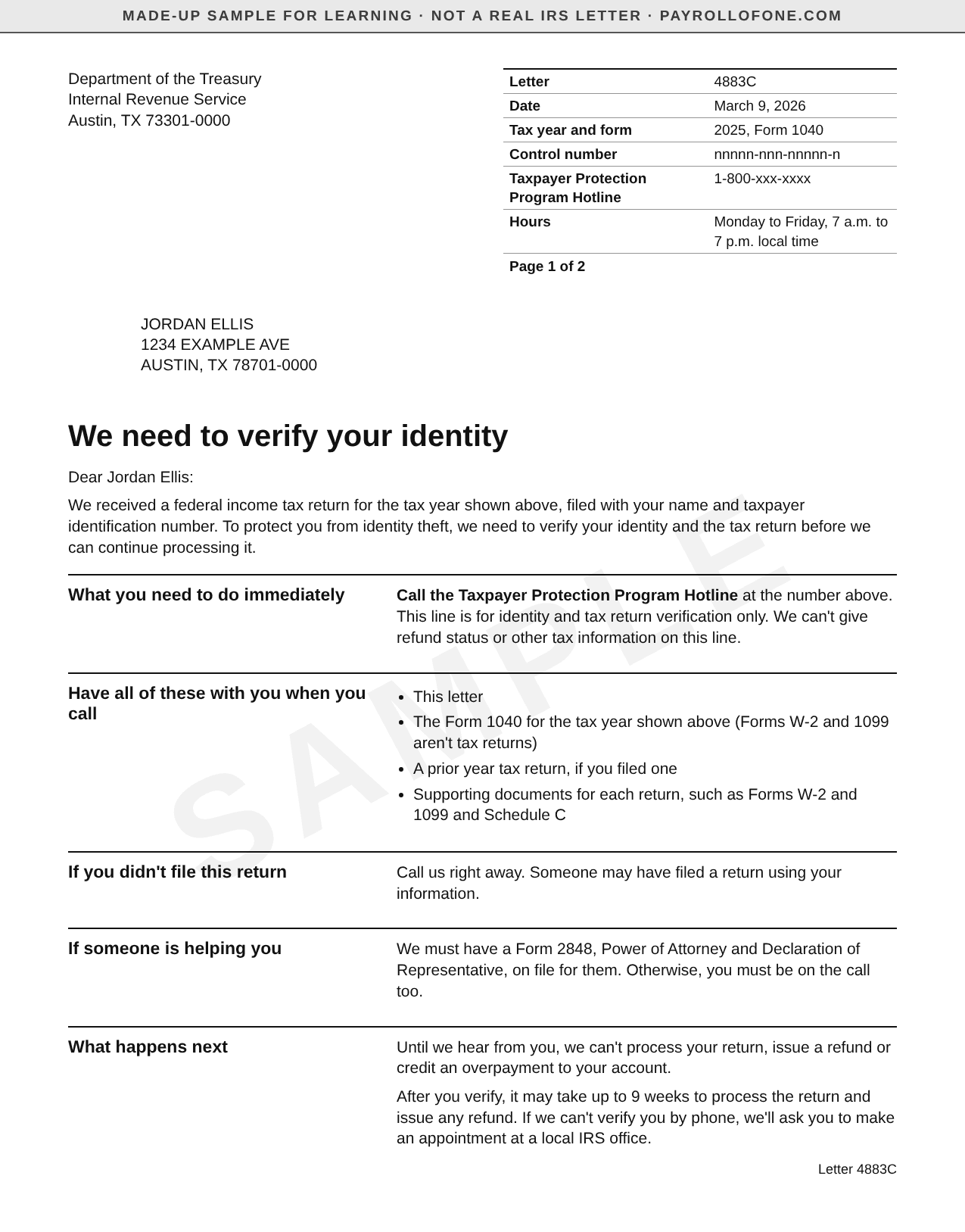
Swipe sideways to see the whole letter.
Every part, in plain English
Top left Which IRS office sent it
The IRS campus holding your return. Your letter may show a different IRS location, and that's normal.
ExampleJordan's letter came from the IRS in Austin, Texas.
Good to knowScammers copy IRS letters. The IRS says to search for the letter number on irs.gov, and to call 800-829-1040 if it doesn't appear or looks suspicious.
Letter The letter number
The IRS calls Letter 4883C "Potential Identity Theft during Original Processing." It's one of several Taxpayer Protection Program letters. The Taxpayer Advocate Service says the 5071C offers online and phone options, while the 4883C offers a phone option.
ExampleType 4883C into our lookup and you land here.
Good to knowGot a 5071C instead? That one can be answered online.
Date When the IRS sent it
The IRS's 4883C page doesn't give a set number of days. It says to call immediately, and your return waits until you do.
ExampleJordan's letter is dated March 9, 2026.
Good to knowLost the letter? The Taxpayer Advocate Service says to check your IRS Online Account or call the Taxpayer Protection Program line at 800-830-5084.
Tax year Which return is on hold
The tax year and form of the return the IRS is holding. IRS procedures show the letter can also be about an amended return, a Form 1040-X.
ExampleJordan's 2025 Form 1040, filed in February 2026.
Good to knowNo copy? Check your tax software or ask your preparer.
Control number The number for the return
IRS procedures fill in the return's document locator number, a control number that points to the exact return being held. You'll notice the letter doesn't show your Social Security number: the same procedures say these identity letters are issued without one.
ExampleOur sample hides the number.
Phone The Taxpayer Protection Program Hotline
The number to call to verify. The IRS says this line is for identity and tax return verification only, so it can't give refund status or other tax information. The Taxpayer Advocate Service and IRS procedures list it as 800-830-5084.
ExampleJordan calls this number with the documents ready.
Good to knowCheck that the number on your letter matches the one the IRS and the Taxpayer Advocate Service publish before you call.
Hours When to call
IRS procedures give the hotline's hours as 7 a.m. to 7 p.m., Monday through Friday, in local time, though some letters give Pacific time instead. Go by the hours printed on yours.
ExampleJordan calls on a weekday morning.
Headline We need to verify your identity
A protective step, not an accusation and not an audit. The IRS holds a return it thinks someone else might have filed in your name until you confirm it.
ExampleThe IRS wants Jordan to confirm the 2025 return before it sends any refund.
Why you got it A return was filed under your number
The IRS received a Form 1040-series return filed under your Social Security number or ITIN, and it needs you to verify your identity and the return so it can keep processing it.
ExampleJordan filed the return, so this is just a matter of confirming it.
Good to knowIf you did file, this is a check before processing, not a sign that something is wrong with your return.
What to do Call, don't go online
This letter is answered by phone. The IRS's online Identity and Tax Return Verification Service is only for the CP5071 series and Letter 5447C, so a 4883C isn't one it handles.
ExampleJordan calls the hotline rather than looking for a website.
Good to knowThe IRS says not to file Form 14039, the Identity Theft Affidavit, if you got a 4883C. Follow the letter instead.
Have ready What to have when you call
The letter, the return for the tax year shown, a prior year return if you filed one, and the documents behind each return, like W-2s, 1099s and Schedule C. The IRS points out that a W-2 or 1099 on its own isn't a tax return.
ExampleJordan pulls the 2025 and 2024 returns, the 1099s and both Schedule Cs.
Good to knowThe questions can be about details on the returns, so the actual returns help more than a summary.
Didn't file? If the return isn't yours
The IRS says to let it know immediately if you didn't file a return for the year shown, because you may be a victim of identity theft. You tell it on the same phone line.
ExampleIf Jordan hadn't filed for 2025 yet, the call is how to report it.
Good to knowThe IRS suggests an identity protection PIN, a six-digit number that stops anyone else from filing a return under your Social Security number.
Getting help If someone calls with you
A representative can call for you, but the IRS needs a Form 2848 on file for them, and it encourages you to be available on the call too. Without a Form 2848, you and your helper call together. A fiduciary acting for another person, an estate or a trust sends Form 56.
ExampleJordan makes the call alone, so no form is needed.
Next What happens after you call
Until you verify, the IRS won't process the return, issue a refund or credit an overpayment. After you verify, it says a refund can take up to nine weeks, and it may write again if it finds other problems. If you can't verify by phone, it asks you to bring the same documents to a local IRS office by appointment.
ExampleIf Jordan verifies on March 16, a refund could take until about mid-May.
Letter 4883C vs. 5071C
Both letters come from the IRS’s Taxpayer Protection Program, and both hold a return until you confirm it’s yours. The difference is how you answer. Here’s how they compare, using only what the IRS and the Taxpayer Advocate Service say.
| Letter 4883C | Letter 5071C | |
|---|---|---|
| How you verify | By phone, on the Taxpayer Protection Program Hotline | Online at irs.gov/verifyreturn, or by phone |
| Can you use the online verification service? | No. The IRS says that service is only for the CP5071 series and Letter 5447C | Yes |
| What to have ready | The letter, the return for the year shown, a prior year return if you filed one, and supporting documents like W-2s, 1099s and Schedule C | |
| If you can’t verify that way | You may be asked to verify in person at a local IRS office, by appointment | |
| After you verify | Up to nine weeks to process the return and send any refund | |
The Taxpayer Advocate Service lists two more letters in the same family: Letter 5447C, for returns with a foreign address, which offers phone and mail options, and Letter 5747C, which asks you to verify in person. Here’s Letter 5071C, decoded.
Is Letter 4883C real or a scam?
Letter 4883C is a real IRS letter, and because it asks you to call, it’s worth a minute of checking first. Here’s how the IRS and the Taxpayer Advocate Service say to check.
- Look up the letter number on irs.gov. The IRS has a page for Letter 4883C. Its general notice page says to call 800-829-1040 if a letter doesn’t appear in the search or looks suspicious.
- Check the phone number. The Taxpayer Advocate Service lists the Taxpayer Protection Program line as 800-830-5084, and IRS procedures say that’s the number in the letter.
- Don’t expect to see your Social Security number. IRS procedures say these identity letters are issued without a taxpayer ID number.
- Know what the IRS won’t do. It starts most contact by mail, and it doesn’t demand payment by gift card, prepaid debit card or wire transfer. A 4883C doesn’t ask for money at all.
If anything feels off, the number to call is the one published on irs.gov or the Taxpayer Advocate Service’s site, not a number from an email or text.
How to verify, in the IRS’s order
The call goes faster when everything is on the table before you dial. The questions are about the return itself.
- Gather all of the documents. The letter, the Form 1040 for the tax year shown, a prior year return (not the same year) if you filed one, and the supporting documents for each, like W-2s, 1099s and Schedule CThe tax form where you report your business income and expenses. Its bottom line is your profit.. The IRS reminds you that a W-2The form an employer sends each January showing your wages and the tax withheld. As an S-corp owner, your own company sends you one. or 1099 isn’t a tax return.
- Call the hotline on the letter. IRS procedures list the hours as 7 a.m. to 7 p.m., Monday through Friday, in local time, though some letters give Pacific time instead. The line is for identity and return verification only, so it can’t give you refund status.
- Answer the questions, including whether you filed the return.
- If the phone doesn’t work out, the IRS asks you to make an appointment and bring the same documents to a local IRS office.
- Wait for processing. The IRS says a refund can take up to nine weeks after you verify, and that it will contact you again if it finds other problems.
Say Jordan, from our sample, calls and verifies on March 16, 2026. Nine weeks later is May 18, so the refund could take until about then. Having your Schedule C at hand helps, since the questions can touch the numbers on it. Here’s how Schedule C works, line by line.
If you didn’t file that return
This is the situation the letter is designed to catch. If you didn’t file a return for the year shown, someone may have filed a fraudulent one with your name and number. The IRS says to let it know immediately, and the Taxpayer Advocate Service says to call the identity verification number on the letter.
Here’s what to know about the paperwork.
- Don’t file Form 14039. The IRS’s 4883C page says not to file the Identity Theft Affidavit if you got this letter. Follow the letter instead.
- File your own return as usual, if you haven’t yet.
- Consider an identity protection PIN. It’s a six-digit number, new each year, that stops anyone else from filing a return with your Social Security number. The IRS suggests it in its 4883C instructions.
Freelancers can also keep their Social Security number off client paperwork by using a free EINEmployer Identification Number: your business’s tax ID, like a Social Security number for the business. Free from the IRS. on W-9s. Here’s how an EIN works for a sole proprietor.
What happens if you don’t call
If you filed the return, it simply sits. The IRS says that until it hears from you, it can’t process the return, issue a refund or credit an overpayment to your account. For a freelancer who planned to apply an overpayment to next year’s estimated taxTax you send the IRS yourself during the year, usually four times, because no employer is withholding it from a paycheck., that can throw off the first quarterly payment. Here’s how quarterly estimated taxes work.
If you didn’t file it, silence leaves a possible fraud unreported. The IRS gives no set number of days for a 4883C, only “immediately,” so there’s no reason to wait either way.
When to get help
Most people verify in one call. If you’d like a tax professional on the line, the IRS needs a Form 2848, Power of Attorney, on file for them, and it encourages you to be on the call too. Without that form, you and your helper call together.
If you can’t verify, or your return is stuck long after you did, the Taxpayer Advocate Service and Low Income Taxpayer Clinics offer free help. Here’s when a tax pro is worth it, and what one costs.
FAQ
What is IRS Letter 4883C?
A letter saying the IRS received a Form 1040-series return under your Social Security number or ITIN and needs to verify your identity and the return before it keeps processing it. The IRS’s internal name for it is “Potential Identity Theft during Original Processing.”
Can I verify a 4883C online?
No. The IRS’s online Identity and Tax Return Verification Service is only for the CP5071 series and Letter 5447C. A 4883C is answered by phone, or in person if the phone doesn’t work.
How long do I have to respond to Letter 4883C?
The IRS’s page doesn’t give a number of days. It says to call immediately, and your return waits until you do.
What’s the phone number for Letter 4883C?
Use the Taxpayer Protection Program Hotline printed on your letter. The Taxpayer Advocate Service lists the line as 800-830-5084 if you can’t find the letter.
How long does my refund take after I verify?
The IRS says up to nine weeks, and longer if it finds other problems and writes to you again.
Should I file Form 14039?
No. The IRS’s 4883C page says not to file the Identity Theft Affidavit if you received this letter.
Can someone call for me?
Yes, with a Form 2848 on file for them. Otherwise you both have to be on the call, and you have to take part.
Sources
- IRS: Understanding your Letter 4883C
- IRS: Identity and Tax Return Verification Service
- IRS: Internal Revenue Manual 25.25.6, Taxpayer Protection Program
- Taxpayer Advocate Service: Identity verification and your tax return
- Taxpayer Advocate Service: Identity theft
- IRS: Get an identity protection PIN
- IRS: Understanding your IRS notice or letter
- IRS: How to know it’s really the IRS
The letter above is a made-up sample for learning, laid out like an IRS letter. It isn’t a real letter and nothing on this page reads or answers yours. General education, not tax advice.