The short answer
You pay yourself a salary through your S-corpA tax status a business can elect. You pay yourself a salary through payroll, and profit above it skips Social Security and Medicare tax., the quarterly Form 941The quarterly payroll tax return. A payroll service files it for you. went in on time, and you’d moved on. Then an envelope arrives addressed to the business. The top corner says CP161, and the big line says “Amount due.”
A CP161 notice is the IRS’s first bill to a business: a return, often a quarterly Form 941, still has unpaid tax, and the notice adds the penalties and interest so far. Pay by the dates printed on it, or contact the IRS within 10 days if it looks wrong. For payroll tax, the first date matters most: tax still unpaid 10 days after the notice date gets an extra 5% penalty. Acting in the first week is the cheapest way through it.
How worried to be
It's a real bill, and for payroll tax it has a short fuse: unpaid tax not paid within 10 days of the notice date gets an extra 5% penalty. Pay, or call if it's wrong, within those 10 days.
When your reply is due
The IRS's usual window is 10 days from the notice date. Enter the date to see yours.
The IRS's CP161 page says to contact it within 10 days of the notice date if you think there's a mistake. For unpaid payroll tax, the IRS's own sample CP161 also asked for the tax within 10 days, and the full balance by the date in the billing summary, 21 days after the notice date. The dates printed on your notice are the ones that count.
CP161, decoded: tap any part of the letter
The IRS no longer shows sample letters on its notice pages, so we rebuilt this one from its older official CP161 sample, which was also for a Form 941 balance, with made-up details. Every part has a plain-English note. Yours will have different numbers but the same parts in about the same places.
Tap any part of the letterHover over any part of the letter to see what it means. Click a part to pin its note open so you can use the links. to see what it means. Our made-up example: Sam Rivera's one-person S corporation, Harbor Lane Design LLC, filed its first-quarter 2026 Form 941 on time but never made the March payroll tax deposit.
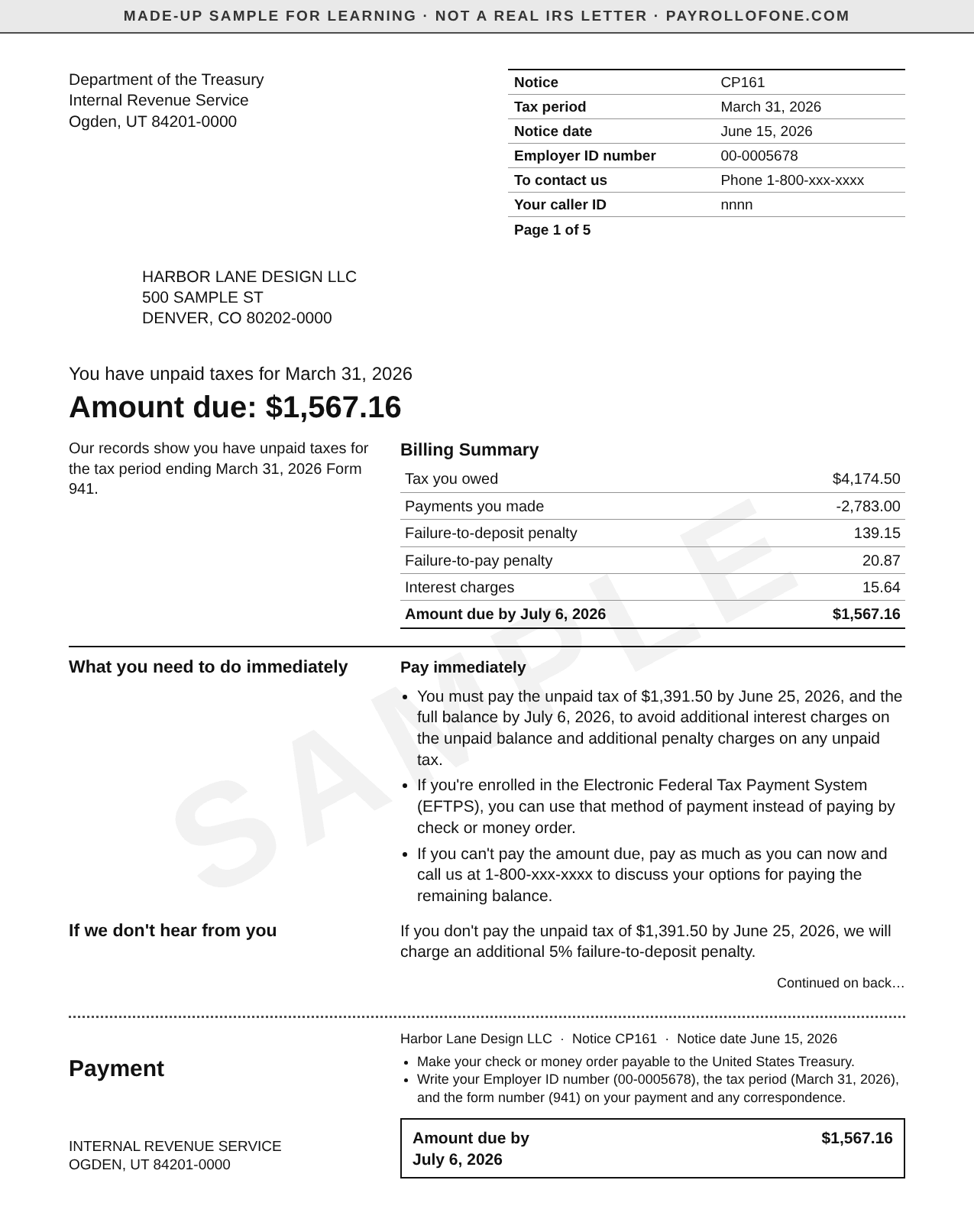
Swipe sideways to see the whole letter.
Every part, in plain English
Notice The notice code
CP161 is the IRS's first bill to a business for an unpaid balance on a return: payroll tax on Form 941, for example, or a corporation's income tax. The IRS's manual describes it as a balance-due notice with no math error, for any return except a partnership's Form 1065.
ExampleType CP161 into our lookup or the IRS's notice search and you land on the right instructions.
Good to knowNo math error means the IRS didn't change your return. It's billing what the return showed as unpaid, plus penalties and interest.
Tax period Which return the balance is from
The last day of the period the balance comes from. On a Form 941 balance, March 31 means the first quarter, January through March. The sentence under the headline names the form.
ExampleHarbor Lane's balance is from its first-quarter 2026 Form 941, filed on time on April 30, 2026.
Good to knowPull out that quarter's Form 941 and your deposit confirmations before you read further.
Notice date The date two deadlines count from
The IRS's CP161 page says to contact it within 10 days of this date if you think it made a mistake. The pay-by dates count from here too. In the IRS's own sample, unpaid payroll tax was due 10 days after the notice date and the full balance 21 days after.
ExampleHarbor Lane's notice is dated June 15, 2026: June 25 for the unpaid tax, July 6 for everything.
Good to knowEnter this date in the box above the letter to see the date 10 days later. The dates printed on your notice are the ones that count.
EIN Your business's EIN
The Employer Identification Number of the business that owes. The payroll returns, the deposits and any payment on this bill all go under this number, not the owner's Social Security number.
ExampleHarbor Lane Design LLC's made-up EIN is 00-0005678.
Good to knowCan't find your EIN paperwork? The IRS can confirm the number with a Letter 147C.
To contact us The number to call if the bill looks wrong
Call this number if a deposit is missing, the amount looks wrong, or you need to arrange payments. The IRS's CP161 page says to have your records ready when you call, such as cancelled checks or an amended return.
ExampleIf Harbor Lane had made the March deposit and it wasn't showing, this is where to start, with the deposit confirmation in hand.
Good to knowNot sure a letter is real? Call a number listed on irs.gov rather than one printed only in the letter.
Amount due Amount due
Everything the IRS says the business owes for this period right now: the unpaid tax plus the penalties and interest added so far. A CP161 is a bill, not a proposal, so there's nothing to sign if you agree. You pay it.
ExampleHarbor Lane's amount due is $1,567.16.
Good to knowIf the amount is right but more than the business can pay at once, the notice says to pay what you can now and call about the rest.
Tax and payments Tax on the return, minus what you deposited
The total tax the return showed, then the payments the IRS has on file. On Form 941, the tax is the income tax withheld from wages plus both halves of Social Security and Medicare, and the payments are the deposits made during the quarter.
ExampleHarbor Lane paid Sam $16,500 of salary in the quarter, for $4,174.50 of payroll tax. It deposited $1,391.50 for January and $1,391.50 for February, but nothing for March.
Good to knowThe IRS's CP161 page says to check the list of payments it applied. If a deposit you made is missing, call with the confirmation.
Penalty Failure-to-deposit penalty
Payroll tax has to be deposited during the quarter, on a monthly or semiweekly schedule, not paid with Form 941. A deposit made more than 15 days late, or not made at all, costs 10% of the amount. It's separate from the late-payment penalty below.
ExampleHarbor Lane's March deposit of $1,391.50 was due April 15 and never made: $1,391.50 × 10% = $139.15.
Good to knowFirst Time Abate, and for 2026 quarters the IRS's new automatic version of it, can cover this penalty for an employer with a clean three-year record. Our sample assumes Harbor Lane was charged for a late deposit in 2025, so it doesn't qualify.
Penalty Failure-to-pay penalty
The late-payment penalty: 0.5% of the unpaid tax for each month or part of a month it stays unpaid after the return's due date, up to 25% in total. The IRS's sample CP161 notes that it applies even when the return was filed on time.
ExampleThe first-quarter Form 941 was due April 30, and July 6 falls in the third penalty month: $1,391.50 × 1.5% = $20.87.
Good to knowFiling Form 941 on time still matters. A late return adds a failure-to-file penalty, generally 5% of the unpaid tax for each month it's late, for up to 5 months.
Interest Interest charges
Interest on the unpaid tax from the return's due date, compounded daily at the IRS's rate for each quarter: 6% a year from April to June 2026 and 7% from July. The IRS's CP161 page says no more interest is charged if you pay the full amount by the payment due date.
ExampleApril 30 to July 6 is 67 days of interest on $1,391.50: $15.64.
Good to knowBy law, the IRS can't remove interest just because you had a good reason to pay late. Interest tied to a penalty drops only if that penalty is removed.
Amount due by The pay-by date for everything
The date to pay the whole balance, penalties and interest included. In the IRS's own sample CP161, this date was 21 days after the notice date. After it, interest and the late-payment penalty keep adding up on whatever is unpaid.
ExamplePaying $1,567.16 by July 6, 2026 closes out Harbor Lane's first quarter.
Good to knowCan't pay it all? Pay what you can and ask about a payment plan. The IRS's CP161 page lists Form 9465 for an installment agreement.
What to do Pay immediately, in two steps
A CP161 for payroll tax has two dates: the unpaid tax by the first, 10 days from the notice, then the rest by the second. The IRS's CP161 page adds the checks to make first: read the notice, compare it with your return, check the payments applied, and contact the IRS within 10 days if something's wrong.
ExampleHarbor Lane pays the $1,391.50 of tax by June 25 through EFTPS, then the rest by July 6. Paying the tax early also trims the interest a little.
Good to knowEFTPS is the Treasury's free payment system, the same one employers use for deposits. A payroll service that makes the deposits for you keeps a missed month from happening at all.
If you wait The extra 5%
If the unpaid tax isn't paid within 10 days of the notice date, the failure-to-deposit penalty rises from 10% to 15%. That's the highest tier, for amounts still unpaid more than 10 days after the IRS's first notice asking for the tax.
ExampleMissing June 25 would add about $70 to Harbor Lane's bill: 5% of $1,391.50.
Good to knowUnpaid payroll tax can also become personal. The IRS can charge the trust fund recovery penalty, 100% of the unpaid withheld taxes, to the people responsible for paying them who willfully didn't.
Payment stub The tear-off stub
If you pay by mail, this part goes in the envelope with the check or money order, so the money lands on the right quarter. Make the check payable to the United States Treasury and write the EIN, the tax period and the form number on it.
ExampleHarbor Lane's check would carry 00-0005678, March 31, 2026 and 941.
Good to knowPaying through EFTPS? You don't need the stub. Keep the notice with your payroll records either way.
What a CP161 notice means
The IRS’s own explanation is one line: you got this notice because you have an unpaid balance due. Its manual adds the detail. A CP161 is the first notice of tax, penalty or interest due on a business return, and “no math error” means the IRS didn’t change the return. It’s billing what the return itself left unpaid.
For an S corporation of one, the return behind a CP161 is most likely Form 941, since the S-corp itself usually owes no income tax. If a late Form 1120-S is the problem and no tax is due, the penalty comes on a different notice, a CP162A, part of the CP162 series.
Here’s how a balance like that happens. Say your S-corp pays you $5,500 a month, a salary set with the reasonable salary rule in mind. On the monthly deposit schedule, each month’s payroll tax, about $1,390 here, has to be deposited by the 15th of the next month. Form 941 only reports the quarter. In our sample, Harbor Lane Design LLC deposited for January and February, missed March, and the Form 941 it filed on April 30 showed $1,391.50 still owed. Here’s how S-corp payroll taxes and deposits work.
What to do, in the IRS’s order
The IRS’s CP161 page lists six steps. Here they are, with what each one looks like for a small business.
- Read the notice carefully. It explains how the IRS figured the amount due.
- Compare the figures with your return. Check the tax period and the total tax against your copy of the form.
- Check the list of payments the IRS applied. A deposit that’s missing is the most important thing to catch.
- Contact the IRS within 10 days of the notice date if you think it made a mistake. Have your deposit confirmations or an amended return ready.
- Pay the amount due by the date on the notice. EFTPSThe Electronic Federal Tax Payment System, the Treasury's free website for business tax payments, including payroll tax deposits. Individuals can no longer open new accounts., the system you use for deposits, works for this too.
- Ask about payment arrangements if you can’t pay it all. The IRS lists Form 9465 for an installment agreementThe IRS name for a long-term payment plan: you pay what you owe in monthly amounts, with interest and a reduced penalty..
Here’s what most people in your spot do the day a CP161 arrives: match the payments list against your deposit confirmations, put the 10-day date on the calendar, and pay the unpaid tax before it. The rest can follow by the second date.
The 10-day date and the extra 5%
Payroll tax has its own penalty for deposits that are late or missing, and it climbs in steps. The last step is tied to this notice. Here’s how the failure-to-deposit penaltyThe IRS penalty on payroll tax deposits made late, in the wrong amount or the wrong way: 2% to 10% depending on how late, and 15% if still unpaid more than 10 days after the IRS's first notice. works.
| When the deposit is made | Penalty |
|---|---|
| 1 to 5 calendar days late | 2% of the unpaid deposit |
| 6 to 15 calendar days late | 5% |
| More than 15 days late, or paid within 10 days of the IRS’s first notice | 10% |
| Still unpaid more than 10 days after the IRS’s first notice | 15% |
The steps don’t add up: a deposit 20 days late costs 10%, not 2% plus 5% plus 10%. In our sample, Harbor Lane’s missed March deposit of $1,391.50 already costs 10%, or $139.15. If the tax isn’t paid by June 25, ten days after the notice date, the penalty rises to 15%, about $70 more.
Unpaid payroll tax is also a business debt that can follow you personally. The income tax and employee share of Social Security and Medicare you withhold are “trust fund” taxes. If they go unpaid, the IRS can charge the trust fund recovery penaltyA penalty of 100% of unpaid withheld payroll taxes that the IRS can charge personally to the people responsible for paying them who willfully didn't., 100% of the unpaid amount, to the people responsible for paying them who willfully didn’t. Publication 594 says the IRS can also file a tax lien or levy for unpaid employment taxes.
Getting the penalties on a CP161 removed
Interest stays, by law, unless a penalty is removed. The penalties themselves often can be. Here are the IRS’s three routes.
- Automatic Exemption from Penalty (AEP). New in 2026. For Form 941 quarters from 2026 on, an employer with 12 straight quarters of timely compliance doesn’t get charged failure-to-deposit, failure-to-pay or failure-to-file penalties at all. The IRS sends a letter saying so.
- First Time Abate. The older version, which you ask for by phone or in writing. It covers the same three penalties for an employer with a clean three-year record.
- Reasonable cause. For events like a fire or disaster, serious illness or death, records you couldn’t get, or a system problem that delayed an electronic payment. The IRS says relying on a tax professional, not knowing the rules, a simple mistake or a lack of funds generally isn’t enough on its own.
Our sample assumes Harbor Lane was charged for a late deposit in 2025, so neither of the first two routes applies. If you think you should have qualified for AEP, the IRS says to contact it. And if a payroll service missed the deposit, Publication 15 says the employer generally remains responsible for the tax, penalties and interest. Here’s how we’d pick a payroll service for an S-corp of one.
If you can’t pay it all, or need help
The notice itself says what to do: pay as much as you can now and call about the rest. Paying the tax portion first stops the extra 5%, and a payment plan covers what’s left. Here’s how IRS payment plans work.
Most owners handle a single CP161 themselves. Help earns its cost when several quarters are unpaid, the IRS mentions the trust fund recovery penalty, or the deposit records are a mess. The IRS’s page points to Form 2848, which lets an accountant or other representative deal with the IRS for you. Here’s when a tax pro is worth it.
FAQ
Is a CP161 notice serious?
It’s a real bill, but it’s the first one. For a payroll tax balance, paying the unpaid tax within 10 days of the notice date keeps the penalty from rising, and paying the rest by the second date ends the matter.
How long do I have to respond to a CP161?
The IRS’s page says to contact it within 10 days of the notice date if you think there’s a mistake, and to pay by the date on the notice. In the IRS’s own sample, that was 21 days after the notice date, with unpaid payroll tax due in 10.
What’s the difference between a CP161 and a CP14?
Both are first bills for an unpaid balance. A CP14 is about an individual’s own return, like Form 1040. A CP161 goes to a business about returns like Form 941 or a corporation’s income tax return. Here’s what a CP14 says.
Will I be charged more interest if I pay by the due date?
No. The IRS’s CP161 page says no more interest is charged if you pay the full amount by the payment due date. It keeps growing on anything unpaid after that.
Why is there a failure-to-deposit penalty when I filed Form 941 on time?
Because payroll tax is due during the quarter, in deposits, not with the return. Filing Form 941 on time avoids the late-filing penalty but not the penalty for a deposit that was late or never made.
Can a CP161 penalty be removed?
Often, yes. For 2026 quarters onward, the IRS says it won’t charge the deposit, payment or filing penalties at all for employers with 12 straight clean quarters. Otherwise, First Time Abate or reasonable cause can remove them. Interest goes only with a penalty that’s removed.
How do I know a CP161 is really from the IRS?
It arrives by mail, it’s addressed to the business with its EINEmployer Identification Number: your business’s tax ID, like a Social Security number for the business. Free from the IRS., and payment goes to the United States Treasury. You can call the IRS at a number listed on irs.gov to check. Our IRS letter decoder explains other codes too.
Sources
- IRS: Understanding your CP161 notice
- IRS: Sample CP161 notice (PDF, older Form 941 version)
- IRS: Failure to deposit penalty
- IRS: Administrative penalty relief (First Time Abate and AEP)
- IRS: Penalty relief for reasonable cause
- IRS: Publication 15 (Circular E), Employer’s Tax Guide
- IRS: Publication 594, The IRS Collection Process (PDF)
- IRS: Internal Revenue Manual 21.7.4 (CP161 and CP162)
- IRS: Quarterly interest rates
The letter above is a made-up sample for learning, laid out like the IRS’s own CP161. It isn’t a real notice, the EIN is fake, and nothing on this page reads or answers yours. Interest uses the IRS’s 2026 rates (6% in the second quarter, 7% the rest of the year). General education, not tax advice.