The short answer
It’s January, your payroll service has sent your W-2The form an employer sends each January showing your wages and the tax withheld. As an S-corp owner, your own company sends you one. and your last Form 941The quarterly payroll tax return. A payroll service files it for you., and then one more form shows up: Form 940. It looks like a lot of paperwork for one employee, and it mostly is.
Form 940 is the yearly return for federal unemployment tax (FUTAFederal unemployment tax, paid only by employers: 6.0% of the first $7,000 of each employee's wages, usually cut to 0.6% by a state credit.). Your S-corpA tax status a business can elect. You pay yourself a salary through payroll, and profit above it skips Social Security and Medicare tax. pays 0.6% on the first $7,000 of your salary, which is $42, and reports it once a year. The 2026 Form 940 is due February 1, 2027. A one-person S-corp fills in about a dozen lines and skips the rest.
The line numbers below come from the 2025 Form 940, the latest the IRS has published. Our example uses 2026 numbers. The 2026 form may move a line, so check it when it comes out.
Form 940, decoded: tap any line
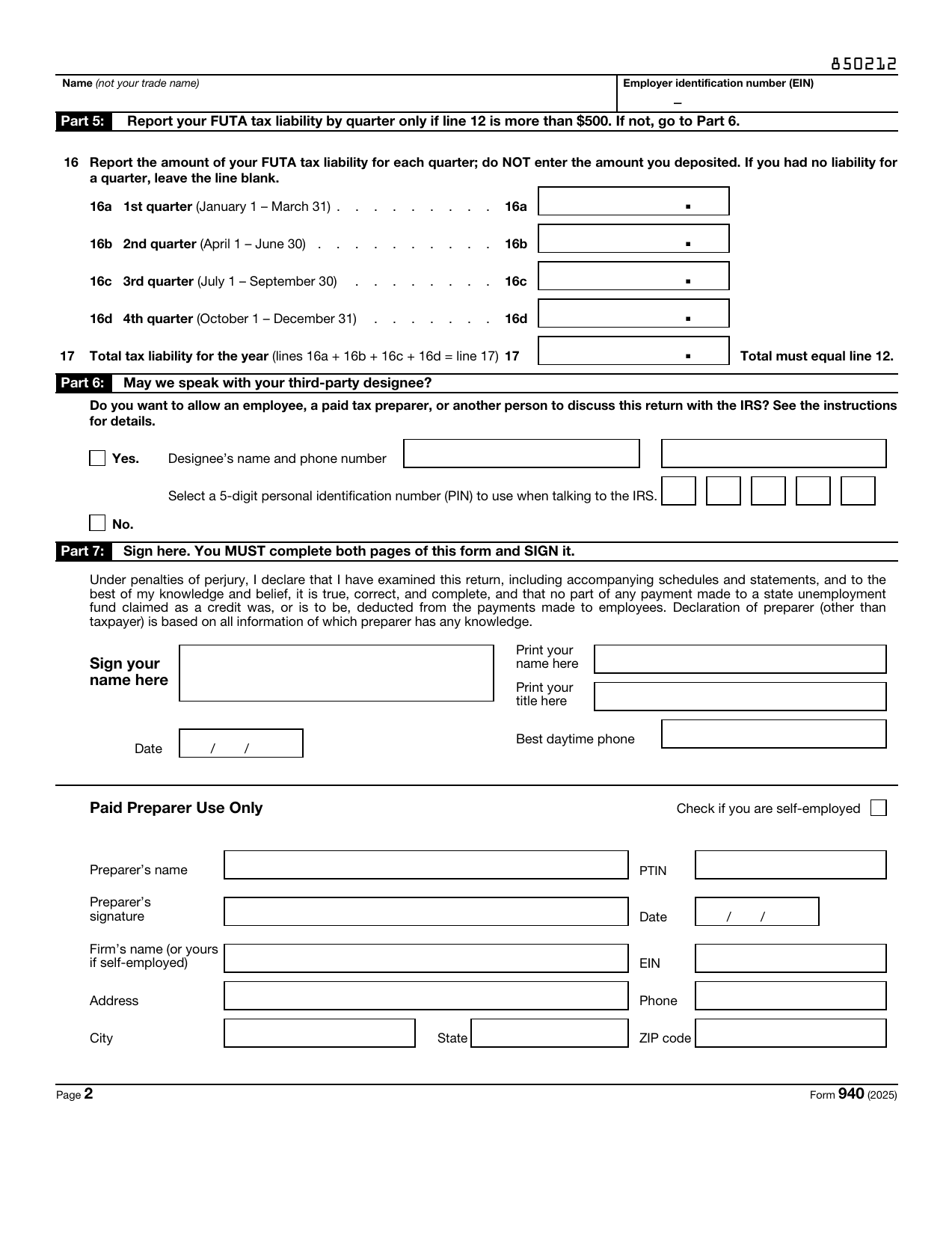
Here’s the real form from the IRS: both pages of Form 940 and the Form 940-V payment voucher. Every line you’ll meet has its own note, using the same one-person S-corp as our Form 1120-S walk-through, and each note says when a one-person S-corp can leave a line blank.
Tap any line on the formHover over any line on the form to see what it means. Click a line to pin its note open so you can use the links. to see what it means. Our example is the one-person S-corp from our Form 1120-S page: an LLC whose S election took effect January 1, 2026. It paid you a $50,000 salary in 2026, $12,500 a quarter, and paid its state unemployment tax on time. Its federal unemployment tax for the year is $42. These are 2026 numbers on the 2025 form.


Swipe sideways to see the whole form.
Every line, in plain English
EIN Employer identification number
The business's own nine-digit EIN, the same one on its payroll returns and your W-2. Never your Social Security number. If the business is still waiting for its EIN when the form is due, you write "Applied For" and the date you applied.
ExampleYou enter your LLC's EIN, the same one on its Form 941s and your W-2.
Our tipThe EIN has to match the IRS's records exactly, or the return can be rejected or delayed.
Name The business's legal name
The legal name the business used when it applied for its EIN. For an LLC taxed as an S-corp, that's the LLC's name, not yours. The name and EIN go on page 2 as well.
ExampleYou write your LLC's full name, "LLC" included.
Trade name A different name you do business under
Only fill this in if the business uses a name that's different from its legal name. If they're the same, leave it blank.
ExampleYour clients know the business by its legal name, so you leave it blank.
Address The business's mailing address
Where the IRS should send mail about this return. The foreign country, province and postal code boxes are only for an address outside the U.S.
ExampleYou enter the address your LLC uses for its mail.
Our tipMoved? Tell the IRS on Form 8822-B. Don't mail that form with your Form 940.
Type of Return Boxes a to d: amended, successor, no payments, final
Check any box that applies. a: you're fixing a Form 940 you already filed, with an explanation attached. b: you bought a business and are counting the seller's payroll. c: you paid no wages at all this year; check it, skip to Part 7 and sign. d: this is the last one, because the business closed or stopped paying wages; attach a note saying who keeps the payroll records and where.
ExampleNone of these fit your 2026 return, so you leave all four blank.
Aggregate filers Only for agents filing for many employers
A box that's new on the 2025 form. It's only for a section 3504 agent, a certified professional employer organization (CPEO) or another third party that combines several employers onto one Form 940.
ExampleYour return covers only your own business, so you leave these blank, even if your payroll service prepares it.
Line 1a The one state you paid unemployment tax to
The two-letter abbreviation of the state where you had to pay state unemployment tax. You fill this in even if your state rate was 0%. You leave it blank only when all the wages you paid were left out of state unemployment tax, and then line 9 applies.
ExampleYour LLC pays unemployment tax in one state, so you enter that state's two letters, like TX for Texas.
Our tipSome states leave an owner's pay out of state unemployment tax. If yours does, your federal credit disappears and the tax on $7,000 becomes $420, not $42. Ask your state unemployment agency how it treats you.
Line 1b You paid unemployment tax in more than one state
Check this if you had to pay state unemployment tax in two or more states, then fill out Schedule A (Form 940) and attach it.
ExampleYou only pay one state, so you leave it blank.
Line 2 Wages in a credit reduction state
A credit reduction state is one that borrowed from the federal government to pay unemployment benefits and hasn't paid it back. Employers there get a smaller credit, so they pay more federal tax. If you paid wages in one, check this box and fill out Schedule A. For 2025 the states were California (1.2%) and the U.S. Virgin Islands (4.5%).
ExampleOur example assumes your state isn't on the list, so you leave it blank.
Our tipSay your LLC had been in California in 2025. Your $7,000 of FUTA wages times 1.2% would add $84, for $126 in all.
Line 3 Total payments to all employees
Everything you paid employees for the year, including salary, bonuses and benefits, even the parts that FUTA doesn't tax. In a one-person S-corp, the only employee is you.
ExampleYou enter $50,000, your salary for 2026.
Our tipDistributions aren't wages, so your $40,000 of distributions stays off this form.
Line 4 Payments exempt from FUTA tax
Payments from line 3 that FUTA doesn't tax, with a box checked for each kind: 4a fringe benefits (such as health plan payments), 4b group-term life insurance, 4c retirement and pension (employer contributions to a 401(k), not the part withheld from your pay), 4d dependent care and 4e other. Only list an amount here if it's already in line 3.
ExampleYour salary is all regular pay, so line 4 is blank.
Our tipIf your S-corp pays your health insurance and puts it on your W-2, it's generally in line 3 and comes back out here under 4a.
Line 5 Pay above $7,000 per employee
FUTA only taxes the first $7,000 you pay each employee in a year. Here you add up everything each person was paid above that, after taking out their exempt payments from line 4.
ExampleYour $50,000 minus $7,000 is $43,000.
Line 6 Subtotal
Line 4 plus line 5: the part of line 3 that FUTA doesn't tax.
ExampleYou enter $43,000.
Line 7 Total taxable FUTA wages
Line 3 minus line 6. With one employee, it's at most $7,000.
ExampleYours is $50,000 minus $43,000, or $7,000. Your first quarter's pay, $12,500, already covered it.
Line 8 FUTA tax before adjustments
Line 7 times 0.006. FUTA is really 6.0%, but you get a credit of up to 5.4% for paying state unemployment tax, which leaves 0.6%. This line assumes you get the full credit, and Part 3 fixes it if you don't.
ExampleYours is $7,000 times 0.006, or $42.
Line 9 All wages left out of state unemployment tax
If none of the wages you paid were subject to state unemployment tax, you don't get the 5.4% credit, so you add it back here: line 7 times 0.054. A 0% state rate doesn't count; this is for pay your state leaves out entirely. If line 9 applies, leave lines 10 and 11 blank.
ExampleYour state covers your pay, so line 9 is blank. If it left your pay out, line 9 would be $378 and your total would be $420.
Line 10 Some wages left out, or state tax paid late
If only some wages were left out of state unemployment tax, or you paid any state unemployment tax after Form 940's due date, you work out a smaller credit on the worksheet in the instructions and enter its line 7 here. State tax paid late still earns a credit, but only 90% of it. Keep the worksheet; don't attach it.
ExampleYour payroll service paid the state on time, so line 10 is blank.
Our tipPay your state unemployment tax by Form 940's due date, February 1, 2027 for 2026, so you keep the whole credit.
Line 11 Credit reduction
The total from Schedule A if you checked line 2. Skip it if line 9 applies.
ExampleYou checked nothing on line 2, so line 11 is blank.
Line 12 Total FUTA tax after adjustments
Lines 8, 9, 10 and 11 added together. This is your FUTA tax for the year.
ExampleYours is $42. It's the same $42 that's inside line 12 of your Form 1120-S, with the company's $3,825 share of Social Security and Medicare, for $3,867.
Line 13 FUTA tax you already deposited
What you deposited during the year, plus any overpayment from last year's Form 940 that you applied to this one. You only have to deposit FUTA once what you owe is more than $500, so a one-person S-corp often has nothing here.
ExampleYour $42 never reached $500, so you deposited nothing and line 13 is blank.
Our tipSome payroll services deposit FUTA every quarter anyway. If yours did, its deposits go here and your balance due is smaller.
Line 14 Balance due
If line 12 is more than line 13, the difference goes here. More than $500 must be deposited electronically. $500 or less you can pay with the return, by EFTPS, IRS Direct Pay, your IRS business tax account or a card, or by check with Form 940-V. Under $1, you don't have to pay it.
ExampleYou enter $42 and pay it through IRS Direct Pay when the return goes in.
Our tipIf you pay electronically, don't send Form 940-V, and mail a paper return to the "without a payment" address.
Lines 15a and 15b Overpayment, and what to do with it
If you deposited more than line 12, the difference goes on 15a. On 15b you check one box: apply it to next year's return, or send a refund. Check neither or both, and the IRS generally applies it to next year.
ExampleYou didn't overpay, so both are blank.
Lines 15c to 15e Direct deposit for a refund
New for 2025: Form 940 refunds now go by direct deposit. Enter the nine-digit routing number, check checking or savings, and enter the account number, up to 17 characters. The IRS isn't responsible for a refund lost to a wrong number, so check them with your bank.
ExampleYou have no refund, so you leave these blank.
Name and EIN The business's name and EIN again
The same legal name and EIN as on page 1, so the pages stay matched.
ExampleYou repeat your LLC's name and EIN.
Lines 16a to 16d FUTA tax by quarter, only above $500
Part 5 is only for employers whose line 12 is more than $500. You enter the FUTA tax for each quarter as you owed it, not what you deposited. A one-person S-corp skips this part: the most FUTA can be on one employee is 6.0% of $7,000, or $420.
ExampleYour line 12 is $42, so you leave Part 5 blank. If you had to fill it in, all $42 would go on 16a, because your first $7,000 of salary was paid by March.
Line 17 Total for the year
Lines 16a to 16d added up. It has to equal line 12. Like the rest of Part 5, it's only filled in when line 12 is more than $500.
ExampleYou leave it blank.
Part 6 Third-party designee
Check Yes to let a specific person, like your payroll provider's contact or your tax preparer, talk to the IRS about this return. Name a person, not a firm, and pick a five-digit PIN they'll use to identify themselves. The permission covers only this form for this year and ends a year after the due date.
ExampleYou check No, so the IRS calls you with any questions.
Part 7 Sign here
Someone has to sign, and both pages have to be filled in. For a corporation, including an LLC taxed as one, that's the president, a vice president or another principal officer. Print your name and title, and add the date and a daytime phone number. A payroll service can sign for you only if it has your power of attorney or a reporting agent authorization (Form 8655) on file.
ExampleYou sign it yourself, print your name and "President", and add your cell number.
Paid Preparer Paid preparer use only
Filled in and signed by someone you paid to prepare the return who isn't your employee, with their PTIN and firm details. A reporting agent with Form 8655 on file usually leaves it blank. If you do the return yourself, so do you.
ExampleYour payroll service prepares the return as your reporting agent, so this stays blank.
Form 940-V, box 1 Your EIN, on the voucher
Only use Form 940-V if you're mailing a check or money order for the line 14 balance due. Box 1 is the same EIN as on the return.
ExampleYou pay online, so you don't use the voucher. If you mailed a check, you'd enter your LLC's EIN here.
Form 940-V, box 2 The amount you're paying
The amount of your check, made payable to "United States Treasury." Write your EIN, "Form 940" and the year on the check. Don't staple the voucher or the check to the return, and never use the voucher for a deposit you were required to make.
ExampleIf you paid by check, you'd enter $42.00.
Form 940-V, box 3 The business's name and address
The same name and address as on the return. Send the voucher, the check and Form 940 together to the "with a payment" address for your state in the instructions.
ExampleYou'd write your LLC's name and address, just as on page 1.
Who has to file Form 940
You file Form 940 if you paid $1,500 or more in wages in any calendar quarter, or had an employee for some part of a day in 20 or more different weeks, this year or last year. A one-person S-corp almost always passes the first test in its first quarter of payroll.
- S-corp owners count as employees. If you work in your S-corp, your salary is wages, so the company owes FUTA on it like any other employer. Here’s how all the payroll taxes on your salary add up.
- Sole proprietors and default LLCs don’t file it for themselves. You’re not your own employee, so there’s no FUTA on your profit. You’d only file Form 940 once you hire someone.
- Distributions don’t count. FUTA is charged on wages only, so the money you take out as distributionsProfit an S-corp pays out to its owner outside payroll. No Social Security or Medicare tax is withheld from it. never appears on Form 940.
Only the employer pays FUTA. The IRS instructions say not to collect or deduct it from employees’ wages, so nothing for it ever comes out of your paycheck.
How a $50,000 salary becomes $42
Our example is the same one-person S-corp as on our Form 1120-S page: your LLC, taxed as an S-corp from January 1, 2026. It pays you a $50,000 salary, $12,500 a quarter, and pays your state’s unemployment tax on time through its payroll service. Here’s your whole Form 940.
| Line | What it is | You, 2026 |
|---|---|---|
| 1a | The state where you paid unemployment tax | Its two letters |
| 3 | Total payments to employees | $50,000 |
| 5 | Pay above $7,000 | $43,000 |
| 6 | Subtotal, lines 4 and 5 | $43,000 |
| 7 | Total taxable FUTA wages | $7,000 |
| 8 | FUTA tax before adjustments, at 0.6% | $42 |
| 12 | Total FUTA tax | $42 |
| 14 | Balance due, paid with the return | $42 |
The full FUTA rate is 6.0%, but employers who pay their state unemployment tax in full and on time get a credit of up to 5.4%. That’s why line 8 multiplies by 0.006. You hit the $7,000 cap in your first quarter, so every paycheck after March carried no FUTA at all.
That $42 isn’t a separate cost you need to track down later. It’s the same $42 that sits inside line 12 of your Form 1120-S, next to the company’s $3,825 share of Social Security and Medicare, for $3,867 in all.
Form 940 doesn’t cover the rest of your payroll. The $6,000 of federal income tax withheld from your pay, $1,500 a quarter, and your $3,100 of Social Security and $725 of Medicare, plus the company’s matching share, go on your quarterly Form 941s instead. Your $2,000 of state income tax withholding goes to your state.
When it’s due and how to pay
Form 940 for 2026 is due February 1, 2027, because January 31 falls on a Sunday. If you deposited all your FUTA tax when it was due, you get until February 10.
- Deposits: you only have to deposit FUTA during the year once what you owe is more than $500. Until then, it carries over to the next quarter.
- Paying with the return: a balance of $500 or less can be paid when you file, through EFTPSThe Electronic Federal Tax Payment System, the Treasury's free website for business tax payments, including payroll tax deposits. Individuals can no longer open new accounts., IRS Direct Pay, your IRS business tax account, a card, or a check with Form 940-V.
- Filing: the IRS encourages e-filing. Your payroll service usually files it for you.
With one employee, FUTA can’t pass $500. The most it can ever be is 6.0% of $7,000, or $420. So you never have to make a FUTA deposit. You pay your $42 through IRS Direct Pay when the return goes in. Some payroll services deposit FUTA every quarter anyway, which is fine too: the deposits then show on line 13.
Most one-person S-corps let a payroll service handle Form 940 along with the 941s and W-2, and just check the numbers it sends. Here are the cheapest payroll services for a one-person S-corp.
What a one-person S-corp can skip
Most of Form 940 is for bigger employers or unusual years. If you’re the only person on payroll in one state, you can usually leave these blank.
- Type of Return and Aggregate Return Filers Only. Only for amended, successor, final or no-wage years, and for agents filing for many employers.
- Lines 1b, 2 and 11. Only if you paid wages in more than one state or in a credit reduction state.
- Line 4. Only if part of your pay was exempt, like health insurance or employer retirement contributions.
- Lines 9 and 10. Only if your state left your pay out of its unemployment tax, or you paid the state late.
- Lines 15a to 15e. Only if you overpaid.
- Part 5, lines 16 and 17. Only if line 12 is more than $500, which one employee can’t reach.
When your FUTA is more than $42
The $42 depends on getting the full 5.4% credit. Three things can shrink it.
- Your state leaves your pay out. The IRS notes that some states exclude corporate officers’ wages from state unemployment tax. If none of your pay was covered, line 9 adds back the whole credit: $7,000 times 0.054 is $378, for $420 in all.
- You pay the state late. State unemployment tax paid after Form 940’s due date earns only 90% of the credit, worked out on line 10.
- Your state is a credit reduction state. For 2025, those were California, at 1.2%, and the U.S. Virgin Islands, at 4.5%. In California, that adds $84 to the $42.
The first one surprises owners most, because states treat owners differently and an LLC taxed as an S-corp can fall into gray areas. Ask your state unemployment agency whether your salary is covered before your first payroll. Here’s what else changes once your LLC is taxed as an S-corp.
FAQ
What is Form 940?
It’s the IRS’s yearly return for federal unemployment tax (FUTA). Employers use it to report the FUTA tax on their employees’ wages for the calendar year and pay whatever they haven’t deposited yet.
Do I need to file Form 940 as a one-person S-corp?
Yes, if you pay yourself a salary. You’re an employee of your corporation, and a salary of $1,500 or more in any quarter means the company has to file.
What’s the difference between Form 940 and Form 941?
Form 941 is filed every quarter and covers Social Security, Medicare and the income tax withheld from pay. Form 940 is filed once a year and covers only federal unemployment tax, which the employer alone pays.
When is Form 940 due for 2026?
February 1, 2027. If you deposited all of your FUTA tax when it was due, you have until February 10, 2027.
Do I have to deposit FUTA tax every quarter?
Only once the amount you owe is more than $500. With just you on payroll it never gets there, so you can pay it with the return.
Do sole proprietors file Form 940?
Not for themselves. A sole proprietor isn’t an employee of their own business, so there’s no FUTA on their profit. They’d file it once they have employees.
Sources
- IRS: About Form 940
- IRS: 2025 Form 940 (PDF)
- IRS: 2025 Instructions for Form 940
- IRS: 2025 Schedule A (Form 940), credit reduction states
- IRS: Topic 759, Form 940 filing and deposit requirements
- IRS: Publication 15 (Circular E), Employer’s Tax Guide
General education, not legal or tax advice. Line numbers are from the 2025 Form 940; examples are for 2026, and state unemployment rules vary, so check your state’s or ask a CPA.