The short answer
For most one-person businesses, a Solo 401(k) is better. At the same profit, it lets you put away two to four times more than a SEP IRA, because you contribute as both the “employee” and the “employer”. It also has a Roth option. A SEP IRA is simpler and can be opened later, which makes it a good last-minute choice, but it caps out much lower unless you earn a lot.
- Solo 401(k): up to $24,500 as the employee, plus 20% of net earnings as the employer, up to $72,000 total in 2026.
- SEP IRA: 20% of net earnings only, up to $72,000.
- At $100,000 of profit: about $43,100 into a Solo 401(k) versus about $18,600 into a SEP IRA.
How much you can put in at your profit
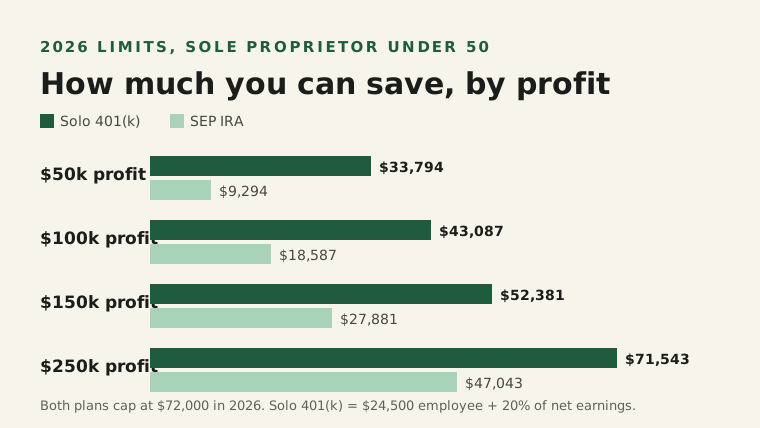
| Profit | Solo 401(k) max | SEP IRA max | Federal income tax saved (Solo 401(k), single) |
|---|---|---|---|
| $50,000 | $33,794 | $9,294 | About $2,700 |
| $100,000 | $43,087 | $18,587 | About $5,200 |
| $150,000 | $52,381 | $27,881 | About $9,200 |
| $250,000 | $71,543 | $47,043 | About $13,700 |
How it’s figured: “net earnings” is your profit minus half of your self-employment tax. The employer part is 20% of that. The Solo 401(k) adds the $24,500 employee part on top. Contributions to the traditional (pre-tax) side lower your income tax, not your self-employment tax. Tax savings assume a single filer with no other income, 2026 brackets and the QBI deduction.
Side by side
| Solo 401(k) | SEP IRA | |
|---|---|---|
| 2026 limit | $24,500 + 20% of net earnings, up to $72,000 | 20% of net earnings, up to $72,000 |
| Age 50+ catch-up | +$8,000 (ages 60–63: +$11,250) | None |
| Roth option | Yes, at most providers | Limited and rarely offered |
| Who can use it | Only you (and a spouse who works in the business); no other employees | Any business, but you must cover eligible employees too |
| Deadline to open | By December 31 to be safe; a brand-new plan can be opened until your April tax deadline | Up to your tax deadline, including extensions |
| Paperwork | Form 5500-EZ each year once the plan holds over $250,000 | None each year |
| Loans | Allowed, if the plan permits | Not allowed |
When a SEP IRA makes sense
- It’s already tax season and you missed the window for a Solo 401(k). You can open and fund a SEP IRA for last year right up to your filing deadline, including extensions.
- You want zero paperwork and your profit is high enough that 20% covers what you want to save anyway.
- You have a 401(k) at a day job and already use up the $24,500 employee limit there. The employee limit is shared across all 401(k)s, so a Solo 401(k)’s main advantage mostly disappears.
- You might hire employees soon. A Solo 401(k) only works while it’s just you (and a spouse).
Deadlines
- Solo 401(k): open it by December 31 to make employee contributions for that year, and tell your provider how much you’ll defer. Under SECURE 2.0, a sole proprietor opening a brand-new plan can set it up after year-end, until the tax deadline without extensions, and still make both kinds of contributions for its first year. Not every provider supports this, so ask first.
- Contributions: the employer part for either plan can be made up to your tax deadline, including extensions.
- SEP IRA: open and fund it by your tax deadline, including extensions (October 15, 2027 for the 2026 tax year).
How to open one
- Pick a provider. Big brokerages like Fidelity, Schwab and E*TRADE offer free Solo 401(k)s and SEP IRAs. Check that the Solo 401(k) has a Roth option if you want one.
- Have an EIN ready. Most Solo 401(k) providers require one, even for sole proprietors. It’s free from the IRS.
- Sign the plan documents (the provider gives you these) and open the account.
- Contribute from your business account and keep a record of what was the employee part and what was the employer part.
- Deduct it on your tax return: the employer part and pre-tax employee part reduce your taxable income. See filing day.
If you’re an S-corp, the math is different: contributions are based on your W-2 salary, not your profit. The employer part is 25% of salary. That’s one reason not to set your salary too low. How S-corp salaries work.
FAQ
Can I have both? Technically yes, but the limits overlap, so for a one-person business there’s rarely a reason to.
Traditional or Roth? Traditional (pre-tax) cuts your taxes now. Roth gives you tax-free withdrawals later. If you’re in a low bracket this year, Roth is often the better deal.
Does this lower my self-employment tax? No. Retirement contributions lower income tax only. For a sole proprietor, the 15.3% self-employment tax is on profit before contributions.
What about a regular IRA? You can contribute up to $7,500 to a traditional or Roth IRA in 2026 on top of either plan, subject to income limits for Roth and deduction limits for traditional. More write-offs here.
Sources
- Self-employed retirement plan limits for 2026
- SECURE 2.0: retroactive first-year Solo 401(k) deferrals
- Solo 401(k) vs. SEP IRA: deadlines and Form 5500-EZ
- IRS: Get an EIN
General education, not tax or investment advice. Contribution math depends on your exact profit and filing status; your tax software or a tax professional can confirm your limit. Should you become an S-corp? Start here.