The short answer
Open a free business checking account, separate from your personal one, and run every business dollar through it. For most one-person businesses, a free online business bank with multiple accounts is the best fit: no monthly fee, no minimum balance, and separate “buckets” for taxes and your own pay.
- Best overall for a business of one: Relay (free, up to 20 checking accounts for tax and pay buckets).
- Best for automatic tax set-asides: Found (built for sole proprietors and freelancers).
- Best if you deposit cash: a local bank or credit union.
Do you really need a separate account?
If you have an LLC, yes: mixing business and personal money is the fastest way to lose the liability protection you formed it for. As a sole proprietor it isn’t legally required, but you should still have one:
- Taxes get easy. Every deposit is income and every charge is a possible write-off. No digging through personal transactions in April.
- Audits get easy. The IRS expects you to keep records that support your income and deductions. A clean business account is most of that work done.
- You see your real numbers. You know what the business earns, what it costs and what’s truly yours.
- Clients trust it. Getting paid by a business account in your business name looks professional.
What to look for
- $0 monthly fee and no minimum balance. There’s no reason to pay $15 a month in 2026.
- Multiple accounts or “buckets”. So taxes and your pay live separately from operating money.
- Accepts sole proprietors, if you don’t have an LLC. Not every online bank does.
- FDIC insurance. Online banks hold your money at partner banks; make sure it’s FDIC-insured.
- Free transfers and payments in. ACH, wires you’ll actually use, and a way for clients to pay you.
- Cash deposits, only if your business takes cash.
- Connects to your bookkeeping app, so transactions flow in automatically.
The best options for a business of one
Prices and features checked October 2026. Online business banks are financial technology companies, not banks; your deposits are held and FDIC-insured at their partner banks.
| Account | Monthly fee | Best for | Watch out for |
|---|---|---|---|
| Relay | $0 (Starter) | Separate tax and pay buckets: up to 20 checking accounts | Cash deposits only through retail partners, for a fee |
| Found | $0 (free plan) | Sole proprietors who want taxes set aside automatically | Lower deposit limits on the free plan; its tax estimates are rough |
| Bluevine | $0 (Standard) | Earning interest on your checking balance | Interest needs monthly activity; cash deposits cost extra |
| Mercury | $0 (base) | LLCs and corporations | Doesn’t open accounts for sole proprietors; no cash deposits |
| Local bank or credit union | Often $0–$15, waivable | Businesses that handle cash or want a branch | Fees, minimum balances, fewer buckets |
The 3-account setup
This is the simplest system that keeps a business of one out of trouble. All you need is a bank that lets you open more than one account.
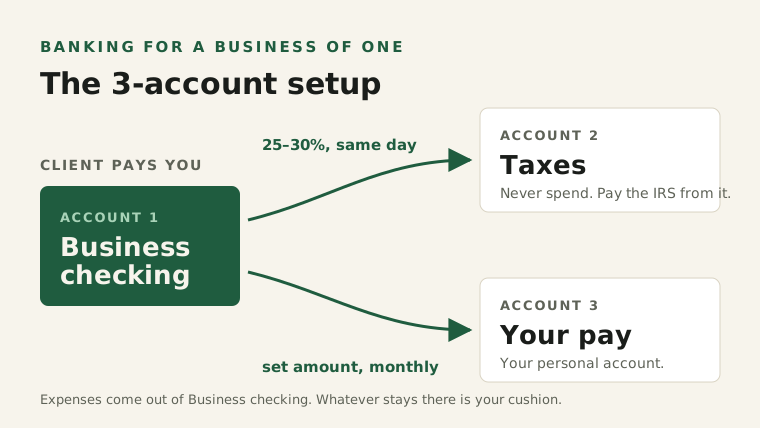
- Business checking: every client payment lands here, and every business expense comes out of here.
- Taxes: move 25 to 30% of each payment here the same day. Never spend it. Pay the IRS from it each quarter. More on where to keep tax money.
- Pay yourself: once or twice a month, move a set amount to your personal account. That’s your paycheck.
If you want your tax money to earn interest, the Taxes account can be a high-yield savings account instead. It just has to be separate.
What you need to open one
- Sole proprietor: your ID and Social Security number. Some banks also ask for an EIN or a DBA (“doing business as”) filing if you use a business name.
- LLC: your approved Articles of Organization, your EIN letter, your operating agreement and your ID. Here’s how to get all of those.
Online banks usually approve accounts in one to three business days.
FAQ
Can I just use a second personal checking account? As a sole proprietor, it works, and it beats mixing everything. But a business account in your business name looks better to clients and connects better to bookkeeping tools. With an LLC, use a real business account.
Are online business banks safe? The good ones place your money at FDIC-insured partner banks, often with coverage well above $250,000 through sweep networks. Check the bank’s disclosures for the exact coverage.
Do I need an LLC to open a business account? No. Many business banks accept sole proprietors. Whether you need an LLC is a separate question.
Should my business account earn interest? It’s a nice bonus, not a reason to pick a bank. The tax account is where interest matters, because that money sits for months.
Sources
- IRS: Recordkeeping for small businesses
- Relay pricing
- Bluevine Business Checking review
- Mercury review (eligibility)
- Found for freelancers: tax set-asides
General education, not financial advice. Bank fees and features change; check each bank’s current terms before opening an account. Some links on this site may be affiliate links; see our affiliate disclosure.