The short answer
You can form an LLC yourself in about an afternoon, for just your state’s filing fee. You file one form on your state’s Secretary of State website, get a free EIN from the IRS, write a one-page operating agreement and open a business bank account. A formation service does the same filing and charges you extra for it.
Not sure you need an LLC yet? Read LLC vs. sole proprietorship first. Many new one-person businesses don’t.
What you need before you start
- A name, plus one or two backups.
- A street address in your state for the registered agent (more on that below).
- Your state’s filing fee: $35 to $500, paid by card online.
- Your Social Security number for the EIN application.
- An hour or two, most of it waiting on forms to load.
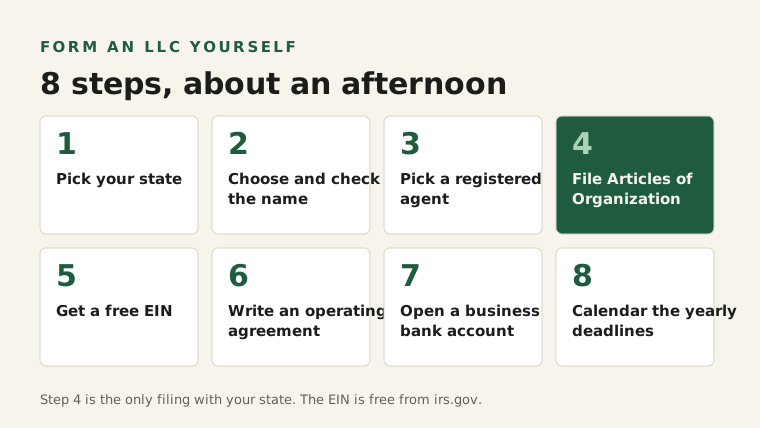
1. Form it in your home state
Form your LLC in the state where you live and work. Delaware and Wyoming get a lot of hype, but a one-person business formed there usually has to register in its home state too, so you pay fees twice. You can see what your state charges in this fee table.
2. Choose and check your name
- End it with “LLC” (or “L.L.C.” or “Limited Liability Company”). Every state requires one of these.
- Search your state’s business name database on the Secretary of State website. Your name has to be different from every business already registered there.
- Check that the domain and social handles are free before you commit. It’s free to look.
3. Pick a registered agent
Every LLC needs a registered agent: the person who officially receives legal papers for the business. You can be your own if you have a street address in your state (not a PO box) where you can accept papers during business hours.
The catch: that address goes on the public record. If you work from home and don’t want your home address searchable, a registered agent service lets you use theirs, for a yearly fee (often around $125).
4. File your Articles of Organization
This is the one form that creates your LLC. Some states call it a Certificate of Formation or Certificate of Organization. File it online on your state’s Secretary of State website and pay the fee. For a single-member LLC, it usually asks for:
- The LLC’s name and address
- Your registered agent’s name and address
- Who manages it (choose member-managed: that’s you)
- Your name as the organizer
Approval takes anywhere from minutes to a few weeks, depending on the state. Save the approved document as a PDF: your bank will ask for it. In New York, you also have to publish a notice in two newspapers within 120 days.
5. Get a free EIN from the IRS
An EIN is your business’s tax ID number. Apply on the IRS website: it takes about 10 minutes and you get the number immediately. Download and save the confirmation letter.
- It’s free. The IRS warns: “You never have to pay a fee for an EIN.” Sites that charge for one are just filling in the same form for you.
- Watch the hours. The online application runs Monday to Friday, 6 a.m. to 1 a.m. Eastern, with shorter weekend hours, and you can’t save it halfway.
- Use only irs.gov. Search results are full of look-alike paid sites.
6. Write a simple operating agreement
An operating agreement says who owns the LLC and how it’s run. For a business of one, it can be a page or two: you own 100%, you manage it, and the LLC’s money stays separate from yours. California, Delaware, Maine, Missouri and New York require one. Even where it’s optional, banks often ask for it, and it helps show the LLC is truly separate from you.
You don’t file it with the state. Sign it, date it and keep it with your records.
7. Open a business bank account
Bring your approved Articles of Organization, your EIN letter, your operating agreement and your ID. Then run every business dollar through this account and nothing personal. Mixing money is the fastest way to lose the protection you just paid for.
8. Put the yearly deadlines on your calendar
- Your state’s annual report and fee, if it has one. Miss it and the state can dissolve your LLC.
- California’s $800 annual tax, due in the fourth month after you form, then every year.
- Local business licenses from your city or county, if your type of work needs them.
- A sales tax permit if you sell physical products.
- A new W-9 for each client, with the LLC’s name and EIN.
What you can skip
- The FinCEN beneficial ownership (BOI) report. In August 2026, FinCEN permanently exempted every company formed in the U.S. from this report. Ignore anyone trying to charge you for it.
- Official-looking letters that offer certificates or “compliance” services for a fee. Your state doesn’t require them; check the sender before you pay anything.
- A formation service’s add-ons: paid EINs, “compliance kits,” corporate seals.
Do it yourself or use a service?
| Do it yourself | Formation service | |
|---|---|---|
| Cost | State fee only | State fee plus the service’s fee and add-ons |
| Time | An afternoon | About 20 minutes of forms |
| Registered agent | You (your address is public) | Theirs, usually free the first year, then a yearly fee |
| Legal protection | Same | Same |
The LLC is identical either way. A service is worth it mainly if you want their registered agent address instead of yours.
FAQ
How long does it take? The work takes an afternoon. State approval ranges from minutes to a few weeks.
Does forming an LLC change my taxes? No. A single-member LLC is taxed like a sole proprietorship unless you elect S-corp status. Here’s why.
Can I turn my sole proprietorship into an LLC? Yes. Form the LLC, get its EIN and bank account, and start invoicing in its name. Your tax return stays the same.
Do I need a lawyer? Not for a simple single-member LLC. Talk to one if you’re bringing on a partner or your work carries real liability risk.
Sources
- IRS: Get an employer identification number
- IRS: Single-member limited liability companies
- Ballard Spahr: FinCEN permanently exempts U.S. entities from beneficial ownership reporting (August 2026)
- Registered agent requirements
- States that require an operating agreement
- LLC filing fees by state (as of June 2026)
General education, not legal advice. Forms and fees vary by state; follow your Secretary of State’s instructions.