The short answer
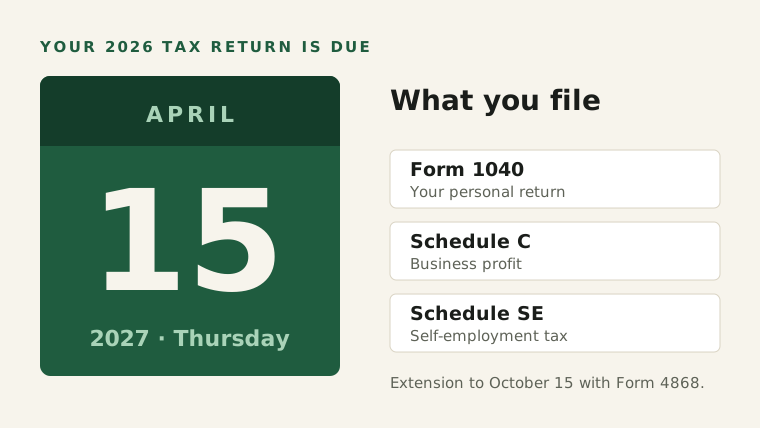
Your 2026 tax return is due Thursday, April 15, 2027. As a self-employed person, you file the same Form 1040 as everyone else, plus two extra schedules: Schedule C for your business profit and Schedule SE for your self-employment tax.
If you’ve followed Chapters 2 through 5, filing day is mostly paperwork: total up your income and expenses, add the quarterly payments you already made, and pay the difference from your tax account.
Simple business, clean records: tax software works fine. Messy year, big income, an S-corp, or more than one state: pay a CPA.
Your document checklist
Gather these in February and March, before the rush.
Income
- 1099-NEC forms from clients who paid you $2,000 or more during 2026. (Before 2026, the threshold was $600.)
- 1099-K forms from payment platforms like PayPal or Stripe. These only arrive if you passed $20,000 and 200 transactions on that platform.
- Your own income records. Invoices or bank deposits. You owe tax on all income, 1099 or not, so your records are the real source.
Expenses
- Business expense totals by category, from your bookkeeping software or bank statements (Chapter 5).
- Mileage log total for the year.
- Home office square footage, if you claim it.
- Health insurance premiums you paid.
- Retirement contributions (Solo 401(k) or SEP-IRA).
Payments
- Your quarterly estimated payments: dates and amounts, with confirmation numbers (Chapter 3). Your IRS Online Account shows them too.
- Last year’s tax return, for reference and for next year’s safe-harbor math.
The forms, in plain English
Tax software fills these in for you from your answers. It still helps to know what they are.
| Form | What it does |
|---|---|
| Form 1040 | Your main personal tax return. Everyone files it. |
| Schedule C | Your business: income minus expenses equals profit. |
| Schedule SE | Calculates your 15.3% self-employment tax from that profit. |
| Schedule 1 | Carries your business profit and adjustments (half of SE tax, health insurance, retirement) to your 1040. |
| Schedule 2 | Adds your self-employment tax to your total tax. |
| Form 8995 | Claims the 20% qualified business income deduction. |
| Form 8829 | Home office, if you use the regular method. The simplified method goes right on Schedule C. |
| Form 2210 | Figures any underpayment penalty, if your quarterly payments came up short. Software checks it automatically. |
Software or a CPA?
Use tax software if: you’re a sole proprietor or single-member LLC, you have one main type of income, your books are clean, and you live and work in one state. Most self-employed versions cost roughly $50 to $200 including a state return, and they walk you through Schedule C question by question.
Hire a CPA or enrolled agent if:
- It’s your first year self-employed and you want it set up right.
- You have an S-corp or partnership (that’s a separate business return).
- You moved states, work in several states, or live abroad.
- You had a big year (roughly $150,000+ in profit), where planning advice pays for itself.
- Your records are a mess, or you got an IRS letter.
A CPA typically charges several hundred dollars or more for a return with a Schedule C; prices vary a lot by city and complexity. The fee for the business part is itself deductible.
Middle option: do your own bookkeeping during the year, then hand a CPA clean totals. You pay for their judgment, not their data entry.
Extensions, and what if you can’t pay
Need more time? File Form 4868 by April 15 for an automatic extension to October 15. It’s free, and tax software can file it in minutes. But it’s an extension to file, not to pay: estimate what you owe and pay it by April 15, or interest and penalties start.
Can’t pay the full amount? File on time anyway. The penalty for not filing is about 10 times bigger than the penalty for not paying: 5% of the unpaid tax per month versus 0.5% per month. Then:
- Pay as much as you can by April 15.
- Set up an IRS payment plan online. A short-term plan (up to 180 days, under $100,000 owed) has no setup fee. A long-term monthly plan (up to $50,000 owed) costs $29 to set up online with automatic payments.
- Interest still runs on the unpaid balance (7% a year right now), so pay it off as fast as you can.
This is exactly the situation the set-aside account from Chapter 4 prevents.
After you file
- Pay what you owe from your tax account (IRS Direct Pay, or have the software debit your bank).
- Look at your total tax on line 24 of your 1040. That number sets next year’s safe-harbor quarterly payments: divide by 4 (or 110% ÷ 4 if your income was over $150,000).
- Schedule your four payments for next year, starting April 15, 2027.
- Recheck your set-aside percentage. If you came up short this year, raise it. If you had a lot left over, you can lower it a little.
- Save a PDF of the return and your records for at least 3 years.
FAQ
My business lost money. Do I still file? Yes, if your total income requires a return, and it’s usually worth filing anyway: a business loss can lower tax on your other income.
I didn’t get a 1099 from a client. What now? Report the income anyway from your own records. Missing 1099s are common and don’t change what you owe.
Can I file my own return and have a CPA do the business part? Not separately: Schedule C is part of your personal return. Either one person prepares everything, or you prepare it and have a CPA review it.
Sources
- IRS: Payment plans (installment agreements)
- IRS: Form 4868, extension of time to file
- IRS: Instructions for Schedule C
- IRS: Failure to file penalty
- Withum: 1099 reporting changes under the 2025 tax law
General education, not tax advice. Dates and rules as of October 2026.