The short answer
Keep your tax money in a separate high-yield savings account that you never spend from. Move your set-aside percentage into it every time a client pays you, and pay the IRS straight out of it each quarter.
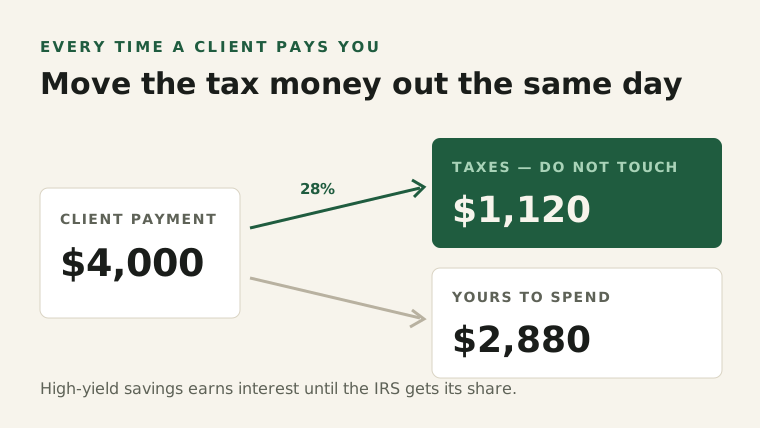
That’s the whole system. No investing, no clever moves. The goal is that when a tax bill arrives, the money is sitting there, earning a little interest, untouched.
If you take one thing from this chapter: the tax money was never yours. It just lives with you for a few months.
Why it has to be separate
If your tax money sits in the same account you spend from, three things go wrong:
- You spend it without noticing. A $12,000 balance feels like $12,000 of runway. If $3,000 of it belongs to the IRS, your real balance is $9,000, and your brain won’t make that adjustment every time you check.
- A slow month eats it. When income dips, the tax money is the easiest thing to borrow from. Then April arrives with a bill and nothing to pay it with.
- You can’t tell if you’re on track. With one pile of money, you can’t answer “do I have enough for taxes?” With a separate account, you look at one number.
A separate account fixes all three. It’s the cheapest, most effective money habit a self-employed person can build.
What kind of account
High-yield savings, not checking. Checking accounts pay close to nothing. As of October 2026, the best online savings accounts pay roughly 3.5% to 4.25% APY, about ten times the national average. On a tax balance that averages $8,000 over the year, that’s around $300 of free money.
FDIC-insured. Make sure the account is FDIC-insured (or NCUA-insured at a credit union), which protects up to $250,000 per depositor, per bank. Every account mentioned here qualifies.
Business or personal? Either works for taxes. As a sole proprietor, your business income and your tax bill are both personal, legally. A personal high-yield account usually pays more. A business bank account keeps everything in one dashboard and can move money automatically. If you have an LLC, keep your business income in a business account; the tax savings account can be either.
What not to do with tax money:
- Don’t invest it in stocks or crypto. A 20% drop in March means a 20% hole in April.
- Don’t lock it up in CDs that end after your payment dates.
- Don’t use it as an emergency fund. Build that separately, after taxes are covered.
Two good setups
| Setup | Best for | How it works |
|---|---|---|
| Business bank + personal high-yield savings | Most solo owners | Client payments land in a free business checking account like Relay. You move your tax percentage to a high-yield savings account at an online bank (Marcus, SoFi, Synchrony and others pay 3.5%+). Highest interest, one manual transfer per payment. |
| All-in-one business bank | People who want it automatic | Banks like Relay let you open several accounts and set a rule that splits a percentage of every deposit into a “Taxes” account. Lower interest (Relay’s savings starts at 1% APY), but you never have to remember. |
The interest difference on a typical tax balance is a few hundred dollars a year. If automation is what makes you actually do it, the all-in-one setup wins.
The setup, start to finish
- Open the savings account and name it “Taxes — do not touch.” Names matter; it makes the money feel spoken for.
- Link it to the account where client payments arrive.
- Pick your percentage with the Chapter 2 calculator, plus your state. Round up.
- Move it every time you’re paid, the same day. Or set an automatic rule if your bank supports one.
- Pay quarterly estimates straight from this account (Chapter 3).
- Check it once a month. If the balance is behind what you’ll owe, top it up. If you’re far ahead after filing, the extra is yours.
Optional upgrade: the “bucket” system. Some owners also split each payment into accounts for Owner’s pay and Profit, so every dollar has a job the moment it lands. Taxes come first either way.
FAQ
Is the interest taxable? Yes, as ordinary income. The bank sends you a 1099-INT if it’s over $10. It’s still free money.
What if my tax account gets bigger than I need? After you file in April and pay what’s due, whatever’s left is yours. Move it to savings, retirement, or your pocket.
I have debt. Should I use tax money to pay it down? No. IRS penalties and interest (7% a year right now) plus the stress aren’t worth it. Pay debt from your own share.
Can I pay the IRS directly from a savings account? Yes. IRS Direct Pay works with savings accounts as well as checking.
Sources
- Yahoo Finance: Best high-yield savings account rates, October 2026
- Relay: Setting up auto-transfer rules
- Relay: Automated savings accounts
- IRS: Direct Pay
General education, not financial advice. Rates as of October 2026 and change often.