The short answer
If you expect to owe $1,000 or more in federal tax when you file, the IRS wants you to pay during the year, in four installments called estimated taxes. Nobody withholds tax from your client payments, so these quarterly payments are how you keep up.
- The four deadlines: April 15, June 15, September 15 and January 15 of the next year.
- The next one: January 15, 2027, for income you earn September through December 2026.
- The easy way to stay safe: pay one quarter of last year’s total tax each time. Do that and you can’t be penalized, even if this year is much bigger.
- How to pay: online with IRS Direct Pay. It’s free, takes 5 minutes, and needs no account.
The deadlines
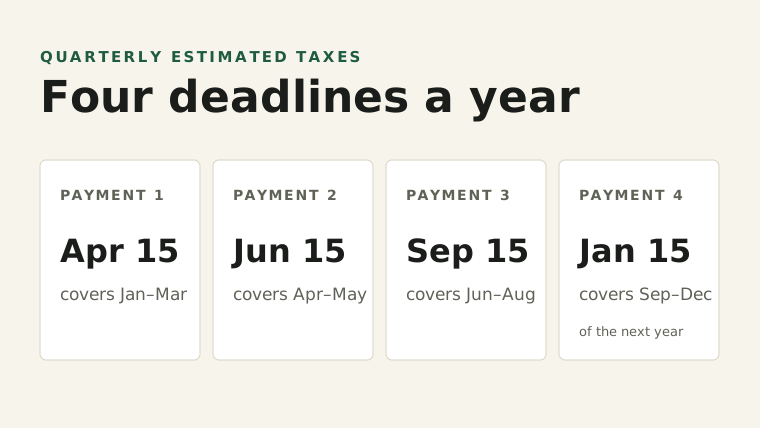
The “quarters” aren’t equal. The second covers only two months and the fourth covers four, which surprises almost everyone.
| Payment | Covers income earned | Due for 2026 | Due for 2027 |
|---|---|---|---|
| 1 | January 1 – March 31 | April 15, 2026 | April 15, 2027 |
| 2 | April 1 – May 31 | June 15, 2026 | June 15, 2027 |
| 3 | June 1 – August 31 | September 15, 2026 | September 15, 2027 |
| 4 | September 1 – December 31 | January 15, 2027 | January 18, 2028 |
When a due date falls on a weekend or federal holiday, it moves to the next business day. That’s why the last 2027 payment is due January 18, 2028.
You can skip the January payment if you file your full return and pay everything by January 31. Most people don’t have their numbers ready that early, so plan on paying it.
How much to pay
Pick one of three methods. The first is the one most solo owners should use.
1. Last year’s tax, split in four (the safe harbor). Find “total tax” on last year’s Form 1040 (line 24), not the amount you owed in April. Divide it by four and pay that each quarter. If last year’s adjusted gross income was over $150,000, use 110% of it instead. As long as you pay this on time, the IRS can’t charge you an underpayment penalty, even if you earn far more this year. You settle the difference in April.
Example: last year’s total tax was $9,000. Pay $2,250 on each of the four due dates. This year you earn more and owe $15,500. You pay the remaining $6,500 in April with no penalty, and your set-aside account already has it.
2. This year’s estimate. Use the set-aside calculator to estimate this year’s federal tax, then pay at least 90% of it across the four payments. This beats method 1 when this year will be smaller than last year, so you don’t overpay.
3. Pay as you earn (annualized). If your income is very lumpy, like a big contract in November, you can pay each quarter based on what you actually earned so far. It takes extra math on Form 2210 (Schedule AI) when you file, so it’s worth asking your tax preparer about. For most people, method 1 is simpler.
The practical version: each quarter, pay the safe-harbor amount from your tax savings account. Whatever is left in that account in April covers the rest.
Your number for the next payment
Type in what you expect to earn this year and, if you have it, last year’s total tax. The calculator picks the cheaper safe method and splits it over the payments you have left.
How to pay
The fastest way is IRS Direct Pay: free, straight from your bank account, no sign-in required.
- Go to irs.gov/directpay and click Make a Payment.
- For reason for payment, choose Estimated Tax. Apply it to 1040ES and the tax year the income belongs to. The January 15, 2027 payment is for tax year 2026.
- Verify your identity with details from a past tax return (name, Social Security number, filing status, address).
- Enter the amount and your bank account, and pick the date.
- Save the confirmation number. You’ll list each payment on your tax return, so keep them all in one place.
Other ways to pay:
- Your IRS Online Account shows every payment you’ve made, which is handy at tax time.
- EFTPS, the Treasury’s payment system, lets you schedule all four payments a year ahead. It takes a few days to enroll.
- Debit or credit card works through IRS-approved processors, but they charge a fee.
- A check with a Form 1040-ES voucher still works, but it’s the slowest and easiest to lose track of.
Don’t forget your state. Most states with an income tax have their own quarterly estimated payments, usually on the same dates. Check your state revenue department’s website for its online payment page.
Missed or short a payment?
Don’t panic. The underpayment penalty isn’t a flat fine. It works like interest on the amount you were short, for the days it was late. The IRS rate is 7% a year through the end of 2026.
Example: you were $2,000 short on the September payment and caught up three months later. The penalty is about $2,000 × 7% × 3/12 ≈ $35. Annoying, not a disaster.
What to do:
- Pay as soon as you notice. The penalty stops growing for that quarter once it’s paid.
- Don’t wait for the next deadline to catch up a missed one. Pay the missed amount now, separately.
- You don’t file anything extra during the year. Any penalty is calculated on your return (Form 2210), and tax software or your preparer does it for you.
The real danger isn’t the penalty. It’s spending the money and having nothing in April. That’s what the set-aside account from Chapter 2 prevents.
FAQ
I also have a W-2 job. Do I still pay quarterly? You can skip it by raising your W-4 withholding at the day job to cover your side income. Withholding counts as paid evenly through the year, even if you only raise it in December.
Can I pay everything in one lump sum in January? You can, but you’d owe the underpayment penalty on the earlier quarters you skipped. Paying each quarter is cheaper.
What if I had a loss one quarter? Pay less, or nothing, that quarter if you’re using method 2 or 3. With method 1 (last year’s tax), keep paying the same amount; it’s your guarantee against penalties.
Do I need to send Form 1040-ES? Only if you pay by check. Paying online replaces the voucher. The 1040-ES worksheet is still useful for estimating your amount.
What about my first year self-employed? If you owed no tax at all last year (a full 12-month year as a U.S. citizen or resident), you won’t owe a penalty this year. You still owe the tax in April, so keep setting money aside.
Sources
- IRS: Estimated taxes
- IRS: Direct Pay
- IRS: Interest rates for the fourth quarter of 2026
- IRS: Form 1040-ES
General education, not tax advice. Dates and rates as of October 2026.