The short answer
Set aside 25% to 30% of every payment you receive after business expenses. That covers federal taxes for most one-person businesses, with room for a typical state income tax.
If you want a sharper number, federal tax alone in 2026 works out to about 17% of profit at $30,000, 21% at $75,000 and 27% at $200,000 for a single filer. Add your state on top. The calculator below gives you your exact percentage in 10 seconds.
When in doubt, round up. Money left over in April is a bonus. Coming up short is a penalty.
Find your number
Why it’s so much
When you had a job, two things happened quietly: your employer withheld income tax from every paycheck, and it paid half of your Social Security and Medicare. Now you do both, and you pay both halves.
So you owe two federal taxes:
- Self-employment tax: 15.3% on 92.35% of your profit. That’s 12.4% for Social Security (up to the 2026 wage base of $184,500) and 2.9% for Medicare (no cap).
- Income tax at your normal bracket, on what’s left after your deductions.
Example: $75,000 of profit, single filer, 2026.
| Step | Amount |
|---|---|
| Self-employment tax (15.3% × $69,263) | $10,597 |
| Income tax, after the standard deduction, half of SE tax and the 20% QBI deduction | $4,898 |
| Total federal tax | $15,495 |
| Share of profit | 20.7% |
The surprise for most people is that self-employment tax is bigger than income tax at this level. That’s the part nobody warned you about.
How much to set aside at your income
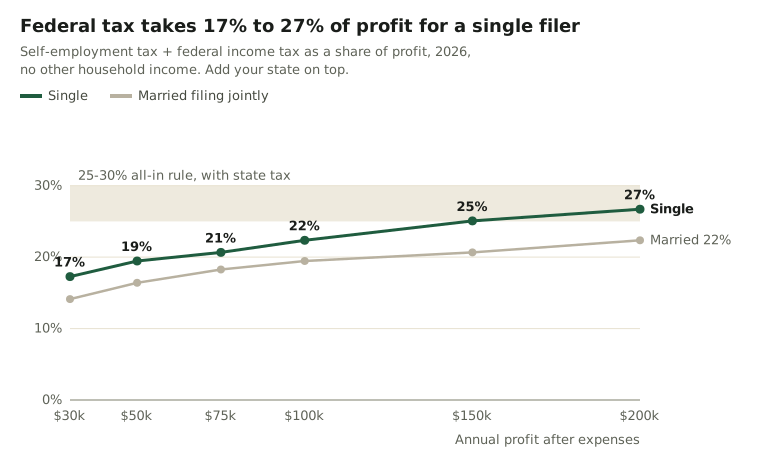
The percentage climbs with income because more of your profit lands in higher brackets. Married couples land lower when the business is the only income, because the brackets and standard deduction are twice as wide. If your spouse has a job, use the single line or the calculator instead.
Don’t forget state tax
The numbers above are federal only. Most states add their own income tax on top.
- No state income tax: Alaska, Florida, Nevada, New Hampshire, South Dakota, Tennessee, Texas, Washington and Wyoming. Federal alone is your number.
- Most other states: add roughly 3% to 6%.
- High-tax states like California, New York, New Jersey, Oregon and Minnesota: add 6% to 9% at middle and higher incomes, and more in New York City.
That’s why 25% to 30% is the safe all-in rule. Look up your state’s rate for your income bracket once, add it to your federal percentage, and you have your number for the year.
The every-payment routine
The percentage only works if the money actually leaves your spending account. Here’s the whole system:
- Open a separate savings account just for taxes. A high-yield savings account is best, so the money earns interest until the IRS gets it. Name it “Taxes — do not touch.”
- Every time a client pays you, move your percentage the same day. $4,000 invoice paid at 28%? Move $1,120. Before you spend anything.
- Pay your quarterly estimates from that account. Four times a year, the IRS gets its share and the account drops back down.
- Check once a quarter. If your income is running higher than you planned, nudge the percentage up.
That’s it. No spreadsheet required, though a simple tracker helps (Chapter 4 covers this in detail).
Some business banks, like Relay, can move a set percentage of every deposit automatically. That’s the easiest version: you never see the tax money at all.
Lumpy income and your first year
If one month brings $15,000 and the next brings $0, set-aside percentages still work, because you only move money when money comes in.
The harder question is how much to send the IRS each quarter when you can’t predict the year. The IRS gives you a safe harbor: you won’t owe an underpayment penalty if your payments during the year cover the smaller of:
- 90% of this year’s tax, or
- 100% of last year’s tax (110% if last year’s adjusted gross income was over $150,000).
So if last year’s total tax was $9,000, paying $2,250 each quarter keeps you penalty-free, even if this year turns out much bigger. You’ll just owe the rest in April, which your set-aside account already holds.
First year self-employed? If you owed $0 in tax last year (for a full 12-month year as a U.S. citizen or resident), you generally owe no penalty this year. You still owe the tax in April, so keep setting it aside. Chapter 3 walks through quarterly payments step by step.
FAQ
Do I set aside a percentage of revenue or profit? Profit: what’s left after business expenses. If your expenses are small and steady, taking the percentage off each payment is close enough.
What if I also have a W-2 job? Your paycheck withholding covers part of your income tax, but nobody withholds self-employment tax on your side income. Set aside at least 15% plus your income-tax bracket on side profit, or raise your W-4 withholding to cover it.
Married filing jointly? Wider brackets mean a lower percentage if your spouse earns little, and a higher one if they earn a lot, since your profit stacks on top of their income. The calculator assumes your business is the household’s only income.
What if I set aside too much? Great. After you file, whatever’s left is yours. Many people treat it as a yearly bonus or move it to retirement.
Does an S-corp change this? Yes, it lowers self-employment tax once profit is high enough. See Chapter 7: Should you become an S-corp?
Sources
- IRS: 2026 tax inflation adjustments
- SSA: 2026 Social Security wage base
- IRS: Estimated taxes
- IRS: Self-employment tax
General education, not tax advice. Numbers are 2026 federal estimates.