Tap any line on the formHover over any line on the form to see what it means. Click a line to pin its note open so you can use the links. to see what it means. Our example is Maya Reyes, a freelance designer in Portland, Oregon, who started working for herself as "Bright Line Design" on January 5, 2026. She's a sole proprietor with no LLC and no employees, and she wants a free EIN so her Social Security number stays off client W-9s. Where a single-member LLC owner would answer differently, the note says so. This is the December 2025 revision, the current form for 2026.
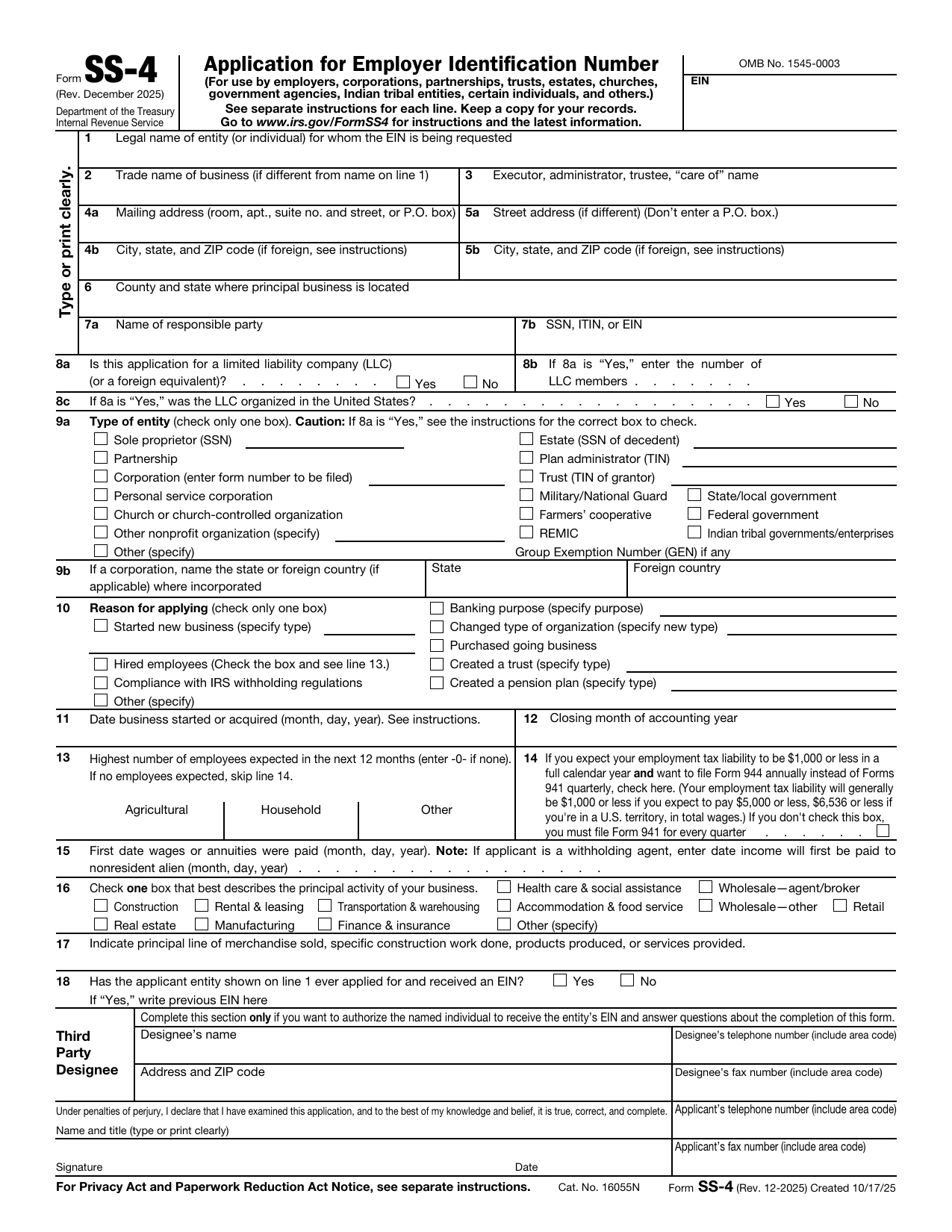
Swipe sideways to see the whole form.
Every line, in plain English
EIN box Where your new number goes
Leave this blank. It's where your EIN gets written once the IRS assigns it. If you apply by phone, which is only for applicants outside the U.S., you write the number you're given here and keep the form for your records.
ExampleMaya applies online, so she never touches the paper form. Her number shows up on screen at the end.
Line 1 Your legal name
The legal name of whoever the EIN is for, exactly as it appears on the Social Security card or the legal paper that created the entity. A sole proprietor enters their own first name, middle initial and last name here, not the business name. No nicknames or abbreviations. An entry is required.
ExampleMaya writes Maya Reyes, exactly as on her Social Security card. If she had formed Bright Line Design LLC and was getting the LLC its own EIN, the LLC's legal name from its state filing would go here instead.
Our tipThe online application asks for the same thing: your own name as it appears on your Social Security card, with the business name in a separate field.
Line 2 Trade name, if you use one
Your "doing business as" name, if it's different from line 1. The IRS says to use one name on all your tax returns: the legal name on line 1, or the trade name if you choose to use that instead. Switching back and forth causes processing delays.
ExampleMaya writes Bright Line Design.
Our tipPutting a trade name on this form doesn't register it with your state or county. That's a separate DBA filing where your state requires one.
Line 3 "Care of" name
For a trust, the trustee. For an estate, the executor or administrator. Any other applicant can name a person to receive its tax mail here. Most sole proprietors write N/A, as the IRS asks for on lines that don't apply.
ExampleMaya gets her own mail, so she writes N/A.
Line 4a Mailing address
The street address, apartment number or P.O. box where the IRS should send your mail. The IRS generally uses this address on all your tax returns, so pick one you'll keep checking. If you move later, you tell the IRS on Form 8822-B.
ExampleMaya enters her apartment address, where she gets her business mail.
Line 4b City, state and ZIP code
The rest of the mailing address from line 4a. Outside the U.S., include the province or state, the postal code and the full country name, not an abbreviation.
ExampleMaya: Portland, OR 97205.
Line 5a Street address, if different
The physical location of the business, but only if it's different from the mailing address on line 4a. No P.O. boxes here.
ExampleMaya works from the same apartment where she gets her mail, so she leaves lines 5a and 5b blank.
Our tipIf you get mail at a P.O. box, this is where your real street address goes.
Line 5b City, state and ZIP for line 5a
The rest of the street address from line 5a. Leave it blank if you left 5a blank.
ExampleMaya leaves it blank.
Line 6 County and state
The county and state where the business is physically based. For a one-person business that's usually where you work.
ExampleMaya writes Multnomah County, Oregon.
Line 7a The responsible party
The person who ultimately owns or controls the business and its money. It must be a real person, not a company, unless the applicant is a government entity. For a sole proprietor that's you, and for a single-member LLC it's the owner.
ExampleMaya writes Maya Reyes.
Our tipIf the responsible party ever changes, you have 60 days to tell the IRS on Form 8822-B.
Line 7b The responsible party's SSN or ITIN
The responsible party's Social Security number or ITIN. Despite the label, an EIN is only allowed here for a government entity. You need a valid SSN, ITIN or EIN to use the online application at all.
ExampleMaya enters her Social Security number.
Our tipThe IRS issues only one EIN per responsible party per day, so if you need two, the second waits until tomorrow.
Line 8a Is this for an LLC?
Yes if the EIN is for a limited liability company formed under state law (or a foreign equivalent). No for a sole proprietor, even one using a business name.
ExampleMaya has no LLC, so she checks No and skips lines 8b and 8c. A single-member LLC owner checks Yes.
Line 8b Number of LLC members
Only if you checked Yes on 8a. Enter how many owners the LLC has. A married couple who own an LLC together in a community property state and choose to treat it as a disregarded entity enter 1.
ExampleMaya skips it. If she had formed Bright Line Design LLC on her own, she'd enter 1.
Line 8c Was the LLC organized in the U.S.?
Only if you checked Yes on 8a. Yes for an LLC formed under the laws of a U.S. state.
ExampleMaya skips it. An Oregon LLC would check Yes.
Line 9a Type of entity: sole proprietor
Check one box. A sole proprietor, someone who reports business income on Schedule C or Schedule F, checks Sole proprietor and writes their SSN (or ITIN) on the line next to it. The instructions are clear that this box isn't a tax election: it doesn't change how you're taxed.
ExampleMaya checks Sole proprietor and writes her Social Security number on the line.
Our tipA single-member LLC doesn't check this box, even though it's taxed like a sole proprietorship. See Other (specify) below.
Line 9a The other entity boxes
These are for every other kind of applicant: partnerships, corporations, estates, trusts, churches, nonprofits, government bodies and so on. A multi-member LLC that keeps its default tax treatment checks Partnership. An LLC that will elect to be taxed as an S-corp on Form 2553 checks Corporation and writes 1120-S on the line, and a single-member LLC adds "Single-member".
ExampleMaya skips all of them. If her single-member LLC planned to elect S-corp status, she'd check Corporation and write "Single-member, 1120-S".
Our tipChecking Corporation with 1120-S isn't the election itself. Form 2553 is still due within 2 months and 15 days of the start of the tax year, and until it's approved the IRS treats you as a Form 1120 filer.
Line 9a Other (specify): where an LLC owner usually lands
For anything not listed above. A single-member LLC that keeps its default tax treatment (a "disregarded entity") checks Other and writes "Disregarded entity" when it needs an EIN for employment or excise taxes or a state requirement. Someone hiring a nanny or other household employee checks Other and writes "Household employer". The Group Exemption Number on the right is only for nonprofits covered by a parent organization's exemption.
ExampleMaya leaves it blank. If she had formed Bright Line Design LLC on her own and kept the default treatment, she'd check Other and write "Disregarded entity".
Our tipYou still report the profit on Schedule C either way. The LLC's EIN is for payroll, excise taxes, the state and the bank.
Line 9b State of incorporation
Only for a corporation: the state or foreign country where it was incorporated.
ExampleMaya isn't a corporation, so she leaves it blank.
Line 10 Reason for applying
Check exactly one box. Started new business is for a new business that needs an EIN, and you write what kind of business it is. Hired employees is for an existing business that needs an EIN because it's hiring, but don't apply again if you already have one. Compliance with IRS withholding regulations is mainly for foreign applicants who need an EIN for withholding forms. Other covers anything else, and you write the reason.
ExampleMaya started Bright Line Design this year, so she checks Started new business and writes Graphic design.
Our tipDon't apply for a second EIN just because you open another location or start a second line of work. A sole proprietor generally needs only one EIN, however many businesses they run.
Line 10 The other reasons
Banking purpose is for groups that need an EIN only to open an account, like a bowling league collecting dues or an investment club, not for a business. Changed type of organization is for a business that incorporated or became a partnership, which needs a new EIN. Purchased going business is for buying an existing business. The trust and pension plan boxes are for setting up those accounts.
ExampleNone fits Maya, so she leaves this side blank.
Our tipChanging your business name, or how an existing entity is taxed, doesn't call for a new EIN.
Line 11 Date the business started
For a new business, the day it started. If you bought a business that was already running, the date you acquired it. If you're changing the form of ownership, like incorporating, the date the new entity began.
ExampleMaya writes 01/05/2026, the day she started working for herself.
Line 12 Closing month of your accounting year
The last month of your tax year. For individuals, including sole proprietors, that's generally December, because your tax year is the calendar year.
ExampleMaya writes December.
Line 13 Employees you expect in the next 12 months
The most employees you expect at once in the next 12 months, split into agricultural, household and other. Enter 0 in each box if you don't expect any. Freelancers you pay on a 1099 aren't employees and don't count. If you expect no employees, skip line 14.
ExampleMaya pays another freelancer now and then, but has no employees. She enters 0 in all three boxes and skips line 14.
Line 14 File Form 944 once a year?
Only for employers. If you expect your payroll taxes to be $1,000 or less for a full year (roughly $5,000 or less in total wages, or $6,536 in a U.S. territory), you can check this box to file Form 944 once a year instead of Form 941 every quarter. If you don't check it, you file Form 941 quarterly.
ExampleMaya has no employees, so she skips it.
Our tipOnce you check it, you keep filing Form 944 until the IRS tells you to switch, even if your payroll grows.
Line 15 First date you paid wages
The date the business first paid, or will first pay, wages to employees. If you don't plan to have employees, enter N/A. Withholding agents enter the date they first pay income to a nonresident alien.
ExampleMaya writes N/A.
Line 16 Your principal activity
Check the one box that best describes what the business mainly does. If none fits, check Other and describe it. You have to check a box. Retail is for selling goods to the public, including online, and Real estate covers renting, managing or selling property for others.
ExampleDesign work isn't on the list, so Maya checks Other (specify) and writes Graphic design services.
Line 17 What you sell, in more detail
A more specific description of your main products or services. An entry is required. The IRS example is "General contractor for residential buildings" for someone who checked Construction.
ExampleMaya writes Graphic design for small businesses, the same description she uses on Schedule C.
Our tipKeep it consistent with the business description on your Schedule C.
Line 18 Ever had an EIN before?
Whether the person or entity on line 1 has ever applied for and received an EIN. If yes, you write the old number. A sole proprietor who already has one usually doesn't need another, even for a new business or a new name. You'd need a new one if you incorporate or take on a partner.
ExampleMaya has never had one, so she checks No.
Third Party Designee Letting someone else get the number for you
Fill this in only if you want to authorize someone, like your accountant, to receive your new EIN and answer the IRS's questions about the form. Their authority ends as soon as the EIN is assigned, and the authorization only counts if you sign the form. If the designee's address or phone number matches yours, the form has to be mailed or faxed.
ExampleMaya applies herself, so she leaves the whole section blank.
Our tipA site that charges you for an EIN is filling in this same free form for you. You can do it yourself on irs.gov in minutes.
Signature Name, title, signature and date
Print your name and title, then sign and date the form. For an individual, including a sole proprietor, you sign yourself. For a corporation, it's the president or another principal officer, and for a partnership or other unincorporated group, a responsible member or officer. Signing means you declare the answers are true.
ExampleMaya prints Maya Reyes, Owner, signs and dates it. Online, there's no paper form to sign.
Phone and fax How the IRS reaches you
Your phone number and, if you're faxing the form, your fax number. The IRS faxes the EIN back to the fax number you give, generally within 4 business days. By mail, the number arrives in about 4 weeks.
ExampleMaya applies online and gets her EIN on screen in minutes, so these don't matter for her. On paper, she'd add her cell number.
Our tipOnline is the fastest route for anyone in the U.S. or a U.S. territory, and it's the method the IRS recommends.
