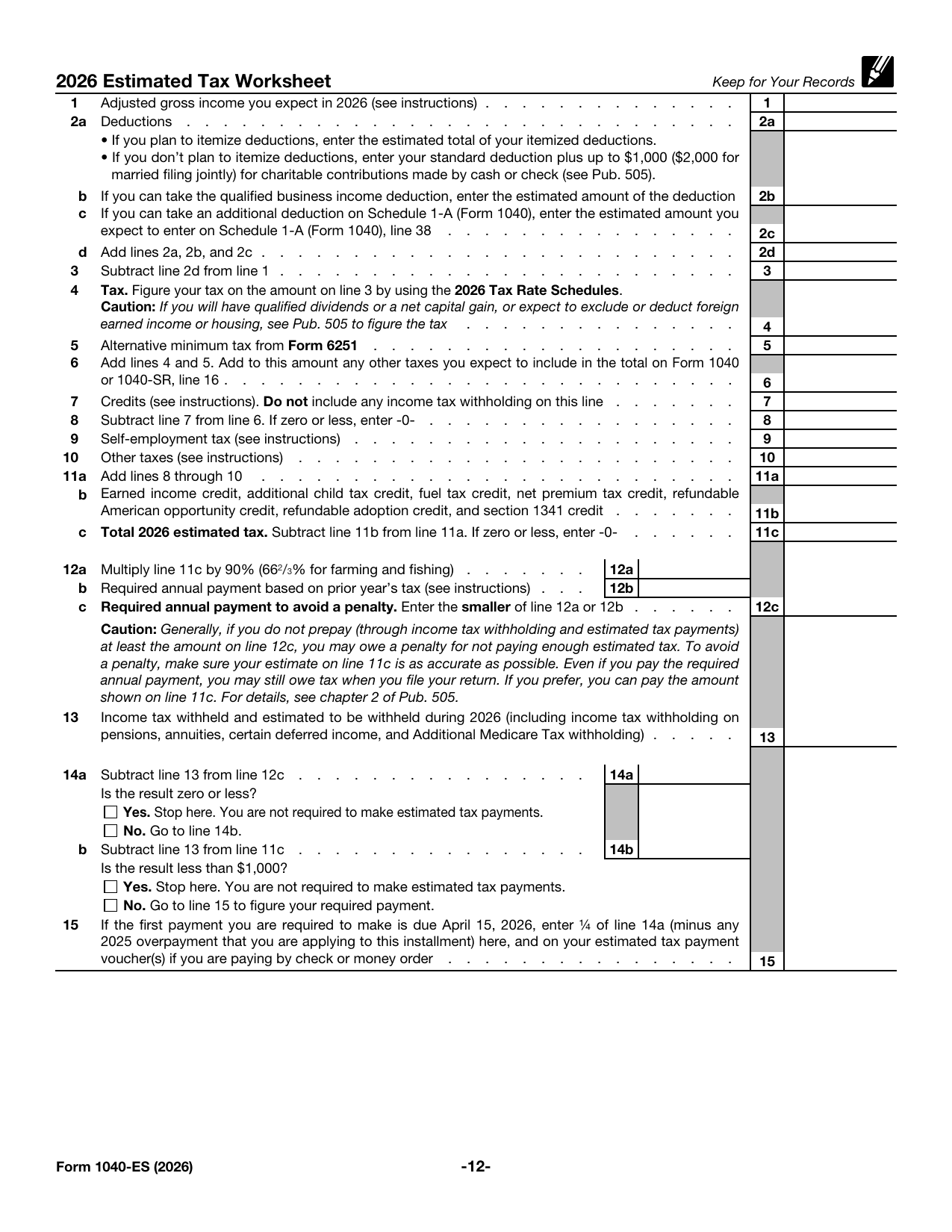
Tap any line on the formHover over any line on the form to see what it means. Click a line to pin its note open so you can use the links. to see what it means. Our example is Maya, a freelance designer with $72,825 of net profit in 2026, the same numbers as our Schedule C walk-through. We assume she files single, has no other income or withholding, takes the standard deduction, and owed $12,000 of total tax on her 2025 return.


Swipe sideways to see the whole form.
Every line, in plain English
Line 1 Your expected income for the year
Your best guess at your 2026 adjusted gross income: all your income, minus adjustments like half your self-employment tax. If you're self-employed, fill in the worksheet on the next page first, because its line 11 is one of the amounts you subtract here.
ExampleMaya expects $72,825 of profit and no other income. She subtracts $5,145 (half her self-employment tax), so line 1 is $67,680.
Our tipUse last year's return as a starting point, then adjust for what you know has changed. A rough number you update is better than none.
Line 2a Standard or itemized deduction
Most people enter the standard deduction. For 2026 it's $16,100 if you're single, $32,200 if married filing jointly and $24,150 for head of household. If you don't itemize, you can add up to $1,000 ($2,000 jointly) of cash gifts to charity, new for 2026.
ExampleMaya files single and doesn't itemize, so she enters $16,100.
Line 2b Qualified business income deduction
Many freelancers and sole proprietors can deduct up to 20% of their business profit, after subtracting half the self-employment tax. It's capped at 20% of taxable income before this deduction. New for 2026, it's at least $400 if you have $1,000 or more of qualified business income from a business you actively run.
ExampleMaya's 20% of $67,680 is $13,536, but the cap is 20% of $51,580 ($67,680 − $16,100), so she enters $10,316.
Our tipTax software figures this on Form 8995. For an estimate, 20% of the smaller number is close enough.
Line 2c New Schedule 1-A deductions
The deductions added for 2026 on Schedule 1-A: qualified tips, qualified overtime, interest on a loan for a personal vehicle bought after 2024, and the enhanced deduction for seniors. If none apply, enter 0.
ExampleMaya has none of these, so she enters 0.
Line 2d Total deductions
Lines 2a, 2b and 2c added together.
ExampleMaya: $16,100 + $10,316 + $0 = $26,416.
Line 3 Expected taxable income
Line 1 minus line 2d. This is the income your income tax is figured on.
ExampleMaya: $67,680 − $26,416 = $41,264.
Line 4 Income tax on that amount
Look up line 3 in the 2026 Tax Rate Schedules on page 10 of the 1040-ES package. Each schedule gives a base amount plus a percentage of the income over a cutoff. If you have qualified dividends or capital gains, Pub. 505 has a different worksheet.
ExampleMaya is single and between $12,400 and $50,400, so her tax is $1,240 plus 12% of $28,864 ($41,264 − $12,400): $4,704.
Line 5 Alternative minimum tax
A separate tax figured on Form 6251 that mostly hits high earners with large special deductions. Most freelancers enter 0.
ExampleMaya: 0.
Line 6 Tax before credits
Line 4 plus line 5, plus any other taxes that would be part of your Form 1040, line 16. For most people it's the same as line 4.
ExampleMaya: $4,704.
Line 7 Credits
Nonrefundable credits you expect, like the child tax credit or education credits. Don't put tax withheld from a paycheck here. That goes on line 13.
ExampleMaya has no credits, so she enters 0.
Line 8 Income tax after credits
Line 6 minus line 7, and never less than 0.
ExampleMaya: $4,704.
Line 9 Self-employment tax
Social Security and Medicare tax on your own business profit. You figure it on the Self-Employment Tax and Deduction Worksheet (page 2 of this decoder) and copy its line 10 here.
ExampleMaya: $10,289.
Our tipFor most freelancers this is the biggest number on the whole worksheet, bigger than the income tax.
Line 10 Other taxes
Less common taxes that end up on your return, such as the Additional Medicare Tax, the Net Investment Income Tax, or household employment taxes for a nanny. Most freelancers enter 0.
ExampleMaya: 0.
Line 11a Total tax before refundable credits
Lines 8, 9 and 10 added together.
ExampleMaya: $4,704 + $10,289 = $14,993.
Line 11b Refundable credits
Credits the IRS pays out even if they're more than your tax, like the earned income credit, the additional child tax credit and the net premium tax credit for Marketplace health insurance.
ExampleMaya has none, so she enters 0.
Line 11c Your total 2026 estimated tax
Line 11a minus line 11b. This is your best guess at the total federal tax for the year. It isn't what you have to prepay yet. Lines 12a to 12c work that out.
ExampleMaya expects to owe $14,993 for 2026.
Our tipKeep this number. It's what your set-aside account should hold by April, whatever you prepay.
Line 12a 90% of this year's tax
Line 11c times 90%. Paying at least this much on time is one way to avoid the underpayment penalty. Farmers and fishermen use 66⅔% instead.
ExampleMaya: $14,993 × 90% = $13,494.
Line 12b 100% of last year's tax
Your total tax from your 2025 return, roughly line 24 of Form 1040 minus a few items the instructions list. If your 2025 adjusted gross income was over $150,000 ($75,000 married filing separately), use 110% of it. If you didn't file for 2025, or it wasn't a full 12-month year, skip this line.
ExampleMaya's 2025 return showed $12,000 of total tax, and her AGI was under $150,000, so she enters $12,000.
Our tipUse "total tax", not the amount you owed or got back in April.
Line 12c The least you need to prepay
The smaller of 12a and 12b. Pay at least this through withholding and estimated payments, on time, and you won't owe an underpayment penalty, even if you owe more in April.
ExampleMaya: the smaller of $13,494 and $12,000 is $12,000.
Our tipLast year's tax is the number we'd use if your income is growing. It's fixed, so you know your four payments in advance.
Line 13 Tax already being withheld
Federal income tax you expect to have withheld in 2026, from a W-2 job, a pension or other payments. Withholding counts toward the safe harbor just like estimated payments.
ExampleMaya has no paycheck, so she enters 0.
Our tipHave a day job too? Raising your W-4 withholding can replace quarterly payments altogether.
Line 14a Is withholding already enough?
Line 12c minus line 13. If it's 0 or less, your withholding already covers the safe amount and you don't have to make estimated payments.
ExampleMaya: $12,000 − $0 = $12,000, so she checks No.
Line 14b Will you owe less than $1,000?
Line 11c minus line 13. If you expect to owe less than $1,000 after withholding, you don't have to make estimated payments.
ExampleMaya: $14,993, well over $1,000, so she checks No and goes on to line 15.
Line 15 Each quarterly payment
One quarter of line 14a, minus any 2025 overpayment you're applying to the first payment. This is what you pay on each due date, online or with a voucher.
ExampleMaya: $12,000 ÷ 4 = $3,000 on each of the four dates.
Our tipLine 15 assumes your first payment is due April 15. If your income started later in the year, Pub. 505 shows how to split the amount over the dates you have left.
SE line 1a Your expected business profit
The net profit you expect for 2026, from Schedule C line 31 (or Schedule F, or box 14 of a partnership K-1). Use profit after expenses, not what clients paid you.
ExampleMaya: $72,825.
Our tipNo Schedule C yet this year? Take your income so far, subtract expenses, and scale it up to a full year.
SE line 1b Conservation Reserve Program payments
Only for people who have farm income and also get Social Security retirement or disability benefits. Everyone else enters 0.
ExampleMaya: 0.
SE line 2 Line 1a minus line 1b
For almost everyone, the same as line 1a.
ExampleMaya: $72,825.
SE line 3 The part of your profit that's taxed
Line 2 times 92.35%. Self-employment tax applies to 92.35% of your profit, not all of it. The 7.65% left out matches the employer half of the tax, which employees aren't taxed on.
ExampleMaya: $72,825 × 92.35% = $67,254.
SE line 4 Medicare part (2.9%)
Line 3 times 2.9%. The Medicare part has no income cap.
ExampleMaya: $67,254 × 2.9% = $1,950.
SE line 5 Social Security wage base
Already filled in: $184,500, the most earned income that Social Security tax applies to in 2026.
SE line 6 Wages from a job
W-2 wages you expect that already have Social Security tax taken out. They use up part of the $184,500 first.
ExampleMaya has no W-2 job, so she enters 0.
SE line 7 Room left under the wage base
Line 5 minus line 6. If it's 0 or less, your wages already hit the cap and you skip the Social Security part.
ExampleMaya: $184,500.
SE line 8 Profit subject to Social Security tax
The smaller of line 3 and line 7.
ExampleMaya: $67,254.
SE line 9 Social Security part (12.4%)
Line 8 times 12.4%.
ExampleMaya: $67,254 × 12.4% = $8,339.
SE line 10 Your self-employment tax
Line 4 plus line 9. Copy it to line 9 of the Estimated Tax Worksheet.
ExampleMaya: $1,950 + $8,339 = $10,289, the "about $10,290" from our Schedule C example.
SE line 11 Half of it, which you deduct
Line 10 times 50%. You get to deduct this half from your income, so subtract it when you work out line 1 of the Estimated Tax Worksheet.
ExampleMaya: $10,289 × 50% = $5,145, so line 1 is $72,825 − $5,145 = $67,680.
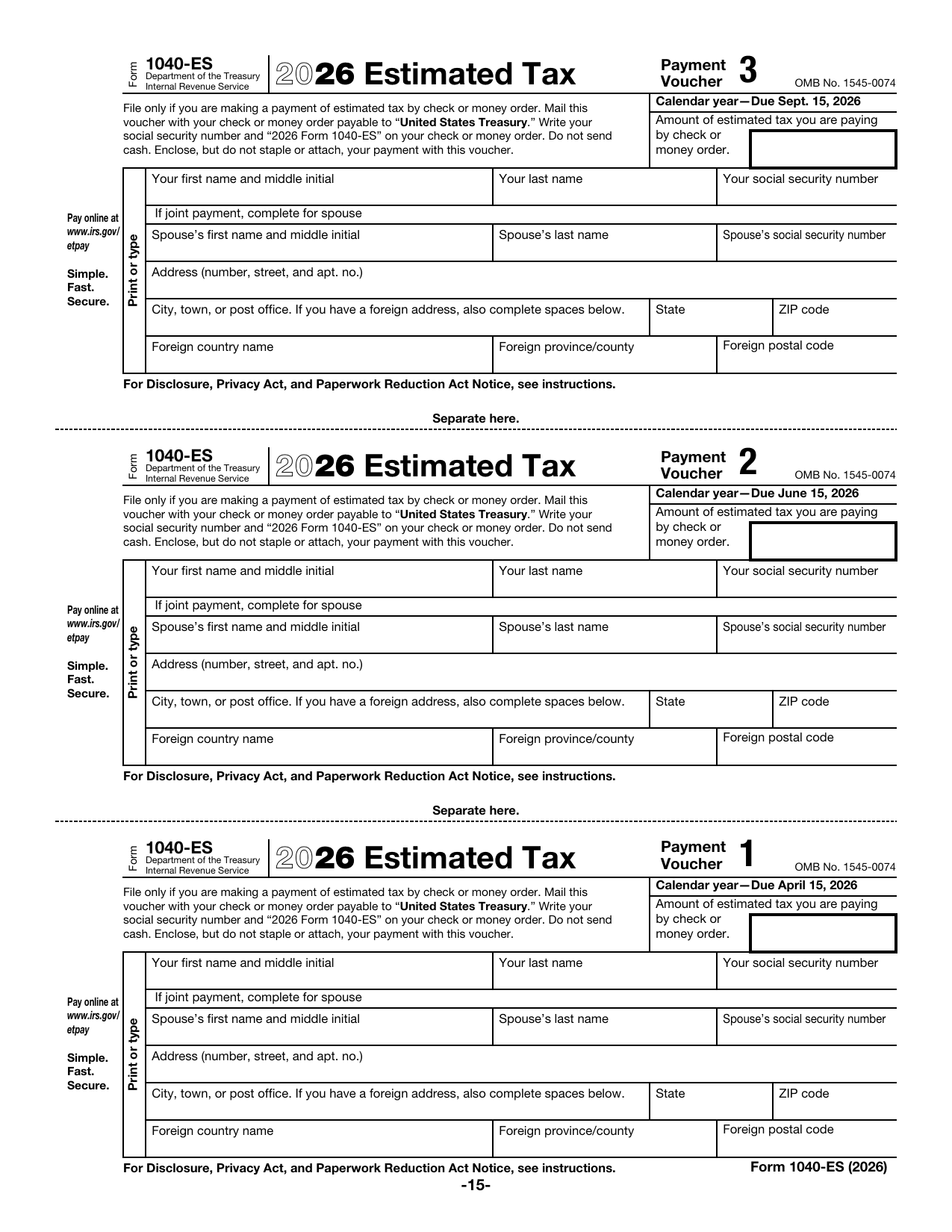
Voucher 3 Third payment, due September 15, 2026
The same voucher as number 1, for the payment due September 15, 2026. Fill it in the same way and mail it only if you pay that installment by check.
ExampleIf Maya paid by check, she would mail this with $3,000.
Voucher 2 Second payment, due June 15, 2026
The voucher for the payment due June 15, 2026. It covers just two months of income, April and May, but under the safe harbor the amount is the same as the others.
ExampleMaya: $3,000.
Voucher 1 Which payment, and when it's due
Each voucher is printed with its payment number and due date. Voucher 1 is for April 15, 2026. The fourth voucher, for January 15, 2027, is on page 14 of the package. Use the voucher that matches the payment.
Our tipPaying online? Skip the vouchers completely. They're only for checks and money orders.
Voucher 1 How to send a check
Make the check or money order payable to "United States Treasury". Write your Social Security number and "2026 Form 1040-ES" on it. Put it in the envelope with the voucher, but don't staple or attach it.
ExampleMaya writes her SSN and "2026 Form 1040-ES" on the memo line of a $3,000 check.
Our tipMail it several days early. The 2026 instructions warn that the postmark is the date the Postal Service processes it, which can be after the day you drop it off.
Voucher 1 Amount you're paying
Only the amount on the check or money order in this envelope. If you applied a 2025 refund to your 2026 estimates, don't include it here.
ExampleMaya enters $3,000.
Voucher 1 Your name
Your first name, middle initial and last name, printed or typed.
Voucher 1 Your Social Security number
Your own SSN, or your ITIN if you have one instead. It's how the IRS puts the payment on your account, so check every digit.
Voucher 1 Spouse, for a joint payment
Fill this in only if you and your spouse are making a joint payment because you'll file a joint return. List the names in the same order you'll use on the return. If you'll file separately, use separate vouchers.
ExampleMaya is single, so she leaves it blank.
Voucher 1 Your address
Your home address, city, state and ZIP code. The foreign address boxes are only for people who live outside the U.S. The mailing address for the envelope depends on your state and is listed in the 1040-ES instructions. It isn't the address in the Form 1040 instructions.
Our tipMoved since your last return? File Form 8822 so IRS letters reach you.
Record Payment numbers and due dates
The four due dates for 2026, already printed: April 15, June 15 and September 15, 2026, and January 15, 2027. You can skip the January payment if you file your 2026 return by February 1, 2027 and pay everything you owe with it.
Column (a) Amount due
What you planned to pay on each date, usually your line 15 amount.
ExampleMaya writes $3,000 on each row.
Column (b) Date paid
The day the payment actually went in.
Column (c) Check number or confirmation number
The check or money order number, or the confirmation number you got for an online or card payment.
ExampleFor an online payment, Maya copies the confirmation number from the IRS payment screen.
Our tipKeep these together. Your tax software asks for every estimated payment when you file.
Column (d) Amount paid
What you actually paid, without any card processing fee. The total row adds them up.
ExampleMaya: $3,000 four times, $12,000 in total.
Column (e) 2025 overpayment applied
If you told the IRS to apply part of your 2025 refund to 2026, write that amount on the row it counted toward, usually the first.
ExampleMaya took her 2025 refund as cash, so she leaves it blank.
Column (f) Total paid and credited
Column (d) plus column (e) for each row. The total is what goes on your 2026 Form 1040 as estimated tax payments.
ExampleMaya: $12,000. When she files, she'll owe the other $2,993 or so, with no penalty.
