How worried to be
The payment plan that keeps collection away is about to end. Paying the missed amount, or calling the IRS, before the termination date can keep the plan in place.
When your reply is due
The IRS's usual window is 30 days from the notice date. Enter the date to see yours.
The IRS's CP523 page says to contact it as soon as possible but no later than 30 days from the notice date. The notice says the installment agreement will be terminated 30 days from the notice date if the past due amount isn't paid.
Tap any part of the letterHover over any part of the letter to see what it means. Click a part to pin its note open so you can use the links. to see what it means. Our made-up example: Jordan Ellis, a freelance photographer, has a $275-a-month payment plan for a 2024 balance and missed the June and July payments.
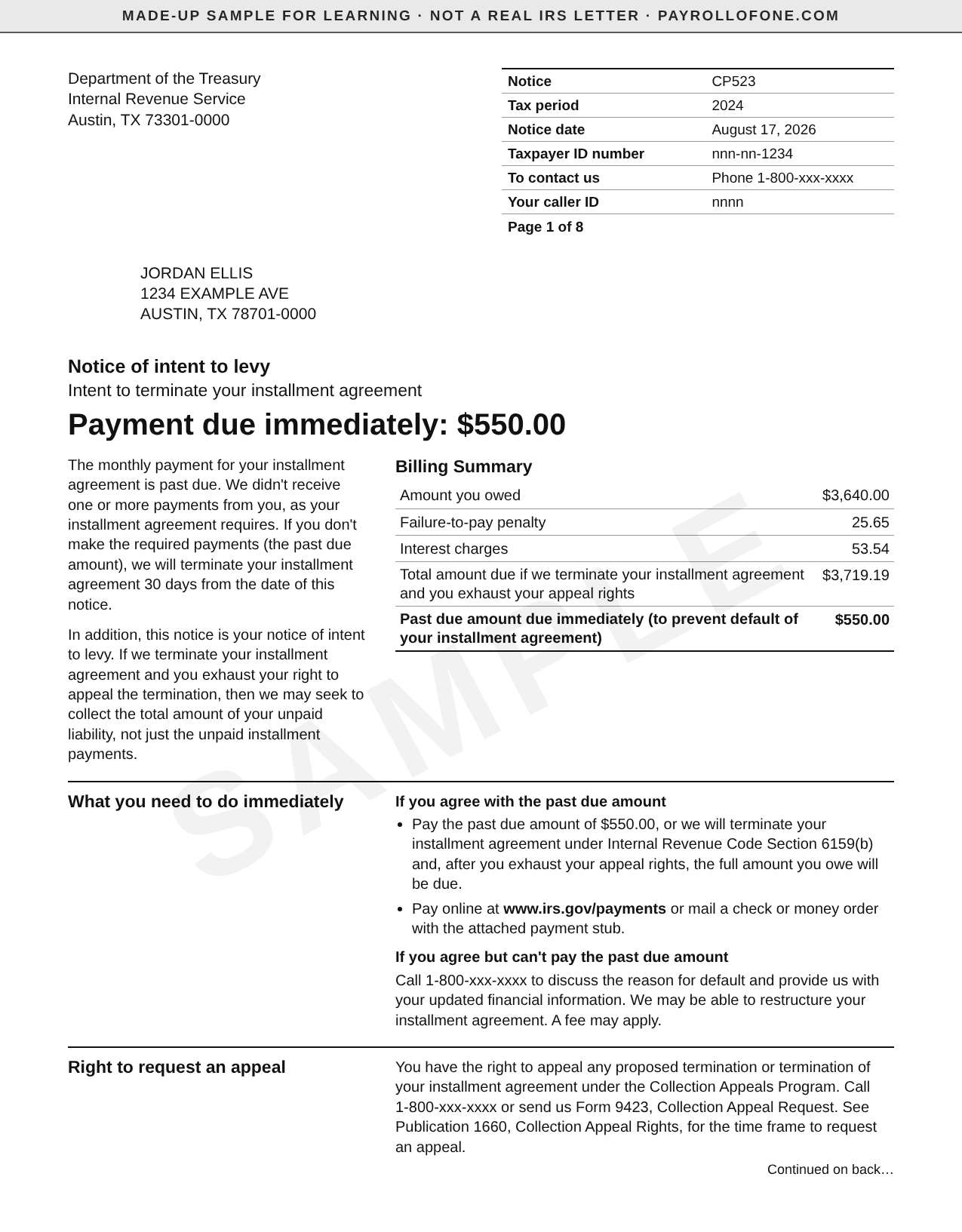
Swipe sideways to see the whole letter.
Every part, in plain English
Notice The notice code
CP523 tells you the IRS intends to end your installment agreement, the formal name for a payment plan, and to levy, because the agreement is in default. The IRS's page says the same notice can also come as CP523 (SP) or CP623.
ExampleType CP523 into our lookup and you land on this page.
Tax period Which balance the plan covers
The tax year of the balance in your payment plan. The IRS's older sample says you get a notice for each tax period you owe, but the past due amount only has to be paid once.
ExampleJordan's plan covers the 2024 return, so this notice is for 2024.
Good to knowA plan that covers two years can mean two CP523s in one week. Read the past due amount before you pay twice.
Notice date The date the 30 days count from
The notice says the agreement will be terminated 30 days from this date unless the past due amount is paid. The IRS's CP523 page says to contact it no later than 30 days from the notice date.
ExampleJordan's notice is dated August 17, 2026, so the termination date is September 16, 2026.
Good to knowEnter this date in the box above the letter to see your own 30-day date.
To contact us The number to call right away
Call to see if the agreement can be reinstated, to talk about why you defaulted, or if you disagree. The IRS's page asks people who have already fixed the problem to call anyway, so its records show it and it can reinstate the agreement.
ExampleIf Jordan already paid the $550 on August 20, a call confirms the IRS has it.
Good to knowIf you can't pay what's past due, the IRS says to call and give updated financial information. It may be able to restructure the plan.
Two warnings Intent to terminate, and intent to levy
Two things in one notice. The IRS intends to end the payment plan, and the notice counts as your Notice of Intent to Levy under Internal Revenue Code section 6331(d). Once the plan ends and appeal rights run out, the IRS can move to collect the whole balance.
ExampleJordan's plan has kept the IRS from levying since it began. This notice says that protection is about to end.
Good to knowThe older IRS sample says that after termination, the IRS can levy most property only if it has already sent you a Collection Due Process notice, like an LT11. Without one, it can still take a state tax refund.
Payment due Payment due immediately
Just the missed payments, not the whole balance. Paying this amount before the termination date is how the IRS says to keep the agreement from being terminated.
Example$550.00: two missed payments of $275.
Good to knowPaying online gives instant confirmation, which matters with a deadline this close.
Why you got it The reason for the default
The IRS's page says the notice tells you why it's taking this action. Here it's missed monthly payments. The IRS also says a plan stays in good standing only if you file all required returns on time and pay new taxes in full, so a new unpaid balance can trigger it too.
ExampleJordan's reason is the simplest one: the June 28 and July 28 payments never arrived.
Good to knowThe IRS applies your future refunds to the debt until it's paid, and says to keep making scheduled payments even when it does.
Amount you owed What's left on the plan
The remaining balance on your agreement after the payments you've made: tax, penalty and interest charged up to your last payment.
Example$3,640.00 was left after Jordan's May 28 payment, $3,420 of it unpaid tax.
Penalty Failure-to-pay penalty
For people who filed on time, the late-payment penalty drops from 0.5% to 0.25% of the unpaid tax a month while an approved plan is in effect. That lower rate applies only during the plan.
ExampleThree months at 0.25% on Jordan's $3,420 of unpaid tax: $25.65.
Good to knowKeeping the plan alive keeps the lower rate. That's part of what's at stake here.
Interest Interest charges
Interest keeps compounding daily on the balance during a payment plan, at the IRS's rate for each quarter: 6% a year from April to June 2026 and 7% from July.
Example$53.54 on Jordan's $3,640 balance in the 81 days since the last payment.
Good to knowPaying more than the minimum shortens the plan and cuts the interest.
If terminated Total due if the plan ends
What the IRS can try to collect in full if it terminates the agreement and you've used up your appeal rights: the whole remaining balance, not just the missed payments.
Example$3,719.19 for Jordan, against $550 to catch up now.
Good to knowThe IRS says it can't levy until 30 days after it terminates a plan, and not while a timely appeal of the termination is pending.
Past due Past due amount
The amount that cures the default. It's the same number as the headline, shown here next to the full balance so you can compare them.
Example$550.00, due immediately.
Good to knowYou may have to pay a fee to reinstate the plan, or pay any new tax balance in full, says the IRS's CP523 page.
What to do Pay, or call to restructure
If you agree, pay the past due amount before the termination date. If you agree but can't pay it, call to discuss the reason for the default and give updated financial information. The IRS may be able to restructure the plan, and a fee may apply.
ExampleJordan could pay $550 online, or call to lower the monthly payment if $275 no longer works.
Good to knowThe IRS lists "reinstate after default" among the changes you can make to a plan in your Online Account. In 2026, changing a plan online costs $6, against $89 by phone, mail or in person.
Appeal Collection Appeals Program
You can appeal a proposed termination under the Collection Appeals Program by phone or with Form 9423. Publication 1660 says to ask within 30 days of the notice date, and that the right continues for 30 more days after a termination. The decision is binding and can't be taken to court.
ExampleJordan agrees the payments were missed, so an appeal wouldn't help here.
Good to knowIf you appeal before the termination takes effect, Publication 1660 says you can't appeal the same decision again once it does.
