The short answer
Stop budgeting off what came in this month. Let every client payment land in your business account, take taxes off the top, and pay yourself the same amount every month, based on your lowest month, not your average. Good months refill the buffer; slow months draw from it. Your personal budget only ever sees one steady paycheck.
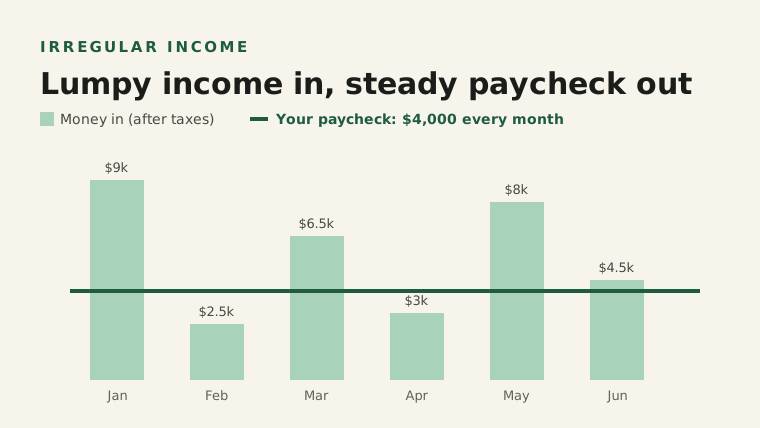
Step 1: Find your baseline
- Look at the last 12 months of business income after expenses.
- Take out taxes: 25 to 30%.
- Find the lowest month (or the average of your three lowest, if one month was a fluke).
- That’s your starting paycheck. It’s what you can count on even in a bad month.
New to self-employment with no history? Start with your bare-bones monthly expenses and pay yourself exactly that until you have a few months of real numbers.
Step 2: Build a bare-bones budget
Split your personal spending into two lists:
- Must-pay: rent or mortgage, utilities, groceries, insurance (including health insurance), minimum debt payments, transportation.
- Flexible: eating out, subscriptions, travel, shopping, extra debt or savings payments.
Your baseline paycheck must cover the must-pay list. If it doesn’t, that’s the number to work on, either by cutting fixed costs or raising your rates.
Step 3: Set up the money flow
- Client pays you: it lands in business checking.
- Same day: move 25 to 30% to your tax account.
- The rest stays in business checking as your buffer.
- On the 1st (and 15th, if you like): transfer your fixed paycheck to personal checking.
- Bills come out of personal checking, on autopay where you can.
Step 4: Decide what good months are for
When the business buffer grows past 2 to 3 months of your paycheck, the extra is a real surplus. Use it in this order:
- Personal emergency fund, until it covers 6 to 12 months of expenses.
- High-interest debt.
- Retirement: a Solo 401(k) cuts your taxes at the same time.
- A raise: bump your fixed paycheck, but only if the higher amount holds up for 6+ months.
- Fun money for something you’ve been putting off.
Step 5: Check in once a quarter
When you pay your quarterly taxes, also look at the buffer. Is it growing or shrinking? Shrinking for two quarters in a row means your paycheck is too high or your income is dropping, and it’s time to adjust before it becomes a problem.
Common mistakes
- Living off your best month. A $12,000 month isn’t a raise until it happens again and again.
- Forgetting yearly and quarterly bills: taxes, insurance renewals, software subscriptions. Divide them by 12 and set that aside monthly.
- Counting invoices as money. It’s money when it’s in the bank.
- No buffer at all. Without one, a single late client becomes a missed rent payment.
FAQ
Isn’t the buffer the same as an emergency fund? No. The buffer smooths normal ups and downs and lives in the business. The emergency fund is for real emergencies, like losing your biggest client or a health problem, and lives in personal savings.
How big should the business buffer be? Aim for 1 to 3 months of your paycheck plus business expenses. More if your income swings a lot.
What if I can’t cover my must-pays with my lowest month? Then the budget is telling you something important: raise prices, find steadier clients (like retainers), or lower fixed costs.
Sources
General education, not financial advice.