The short answer
Most self-employed people buy a plan on the ACA Marketplace (HealthCare.gov or your state’s site) during open enrollment, which runs November 1, 2026 to January 15, 2027 for 2027 coverage on HealthCare.gov. Two money moves make it much cheaper:
- Subsidies: if your household income is under about 400% of the poverty line (about $64,000 for a single person), you can get a premium tax credit that lowers your monthly premium.
- The self-employed health insurance deduction: you can deduct 100% of your premiums for yourself and your family, up to your business profit.
Your options
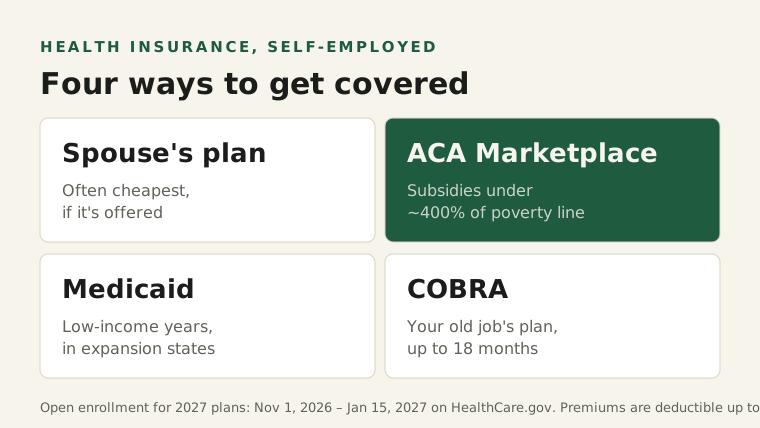
| Option | Best for | Watch out for |
|---|---|---|
| A spouse’s employer plan | Usually the cheapest coverage, if it’s offered | Being eligible for it means you can’t take the self-employed deduction |
| ACA Marketplace | Most self-employed people; subsidies if your income qualifies | Premiums can be steep above the subsidy cutoff |
| Medicaid | Low-income years, in states that expanded it (up to about 138% of the poverty line) | Rules and limits vary by state |
| COBRA | Keeping your old job’s plan for up to 18 months while you get started | You pay the full premium, often more than a Marketplace plan |
Leaving a job counts as a “qualifying life event,” so you can sign up on the Marketplace within 60 days of losing coverage, even outside open enrollment.
Subsidies and the 400% cliff
The extra pandemic-era subsidies expired at the end of 2025. Since 2026, premium tax credits stop completely once your household income goes over 400% of the federal poverty level: about $63,840 for a single person or $132,000 for a family of four. Earn $1 over and the whole subsidy disappears.
Why this matters more when you’re self-employed: the income that counts is roughly your adjusted gross income, and you have more control over it than an employee does.
- Business write-offs lower your profit, so they lower the income the Marketplace counts.
- Pre-tax retirement contributions lower it too. Putting money into a Solo 401(k) or SEP IRA can pull you back under the cliff and keep a subsidy worth thousands.
- Estimate your income honestly when you apply. The credit is settled on your tax return; if you earn more than you estimated, you may have to pay some or all of it back.
The self-employed health insurance deduction
If you have a business profit and aren’t eligible for an employer plan (including through a spouse) in a given month, you can deduct your health insurance premiums for that month:
- Who it covers: you, your spouse, your dependents and children under 27.
- What counts: medical, dental and vision premiums, Medicare premiums, and long-term care insurance (up to age-based limits).
- The limit: it can’t be more than your business profit.
- How: figure it on Form 7206 and claim it on Schedule 1. It lowers your income tax, but not your self-employment tax.
- With a subsidy: you can only deduct what you actually paid after the premium tax credit. Tax software handles the math.
HSAs: now open to more self-employed people
Starting in 2026, Bronze and Catastrophic Marketplace plans count as HSA-eligible. A health savings account is one of the best tax deals there is: contributions are deductible, growth is tax-free, and withdrawals for medical costs are tax-free.
- 2026 limits: $4,400 for self-only coverage, $8,750 for family, plus $1,000 if you’re 55 or older.
- Open one yourself at a bank or brokerage that offers HSAs; you don’t need an employer.
How to pick a plan
- Estimate next year’s income as accurately as you can, after expenses and retirement contributions.
- Check your subsidy on HealthCare.gov or your state’s site before choosing a plan.
- Compare total yearly cost: premiums times 12, plus the deductible you’d realistically hit. The cheapest premium isn’t always the cheapest plan.
- Check your doctors and prescriptions are covered.
- If you’re healthy, a Bronze plan with an HSA can be the lowest-cost, highest-tax-savings option.
- Budget premiums like any bill. Here’s how to budget on irregular income.
FAQ
Can my business pay my health insurance? As a sole proprietor or single-member LLC, paying from the business account is fine, but it’s still deducted on your personal return through the self-employed health insurance deduction, not as a business expense on Schedule C.
I’m an S-corp owner. Is it different? Yes. The S-corp pays the premiums and adds them to your W-2 wages, then you take the deduction personally. Ask your payroll provider or tax preparer to set it up.
What if I miss open enrollment? You need a qualifying life event, like losing other coverage, moving, marriage or a new baby, to sign up mid-year.
Sources
- Marketplace deadlines for 2027 coverage
- The return of the subsidy cliff (2026)
- 2026 subsidy income limits
- Self-employed health insurance deduction guide
- Bronze and Catastrophic plans become HSA-eligible in 2026
- 2026 HSA contribution limits
General education, not insurance, tax or medical advice. Subsidy rules and deadlines vary by state and can change; check HealthCare.gov or your state’s Marketplace.