Tap any line on the formHover over any line on the form to see what it means. Click a line to pin its note open so you can use the links. to see what it means. Our example is Maya, a freelance designer. In October 2026 she turned her sole proprietorship into Bright Line Design LLC in Oregon, with herself as the only member. She files Form 2553 in November 2026 so the LLC is taxed as an S-corp from January 1, 2027. The form is the December 2017 revision, which is still the one the IRS uses.

Swipe sideways to see the whole form.
Every line, in plain English
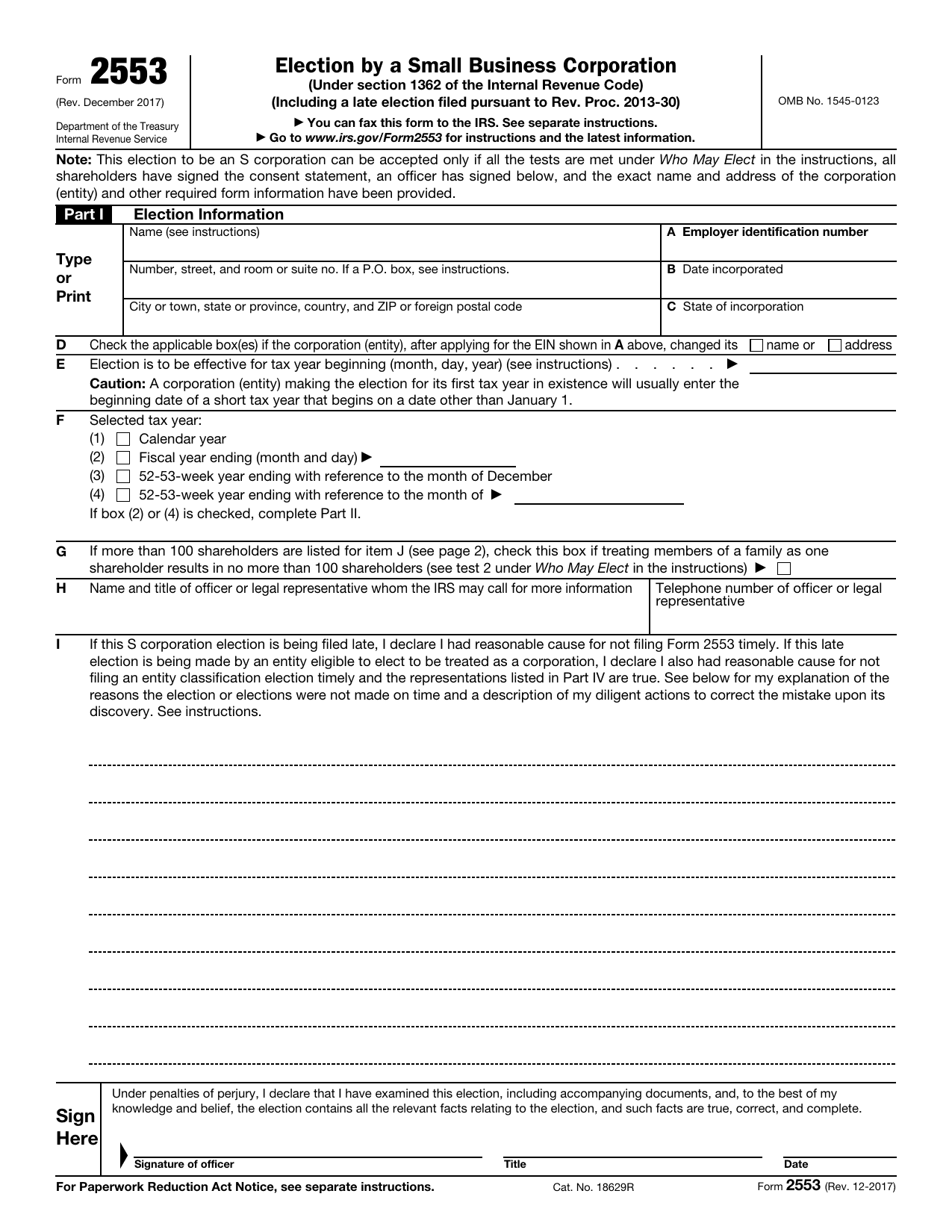
Name Your LLC's exact legal name
The name exactly as it appears on the document that created the business. For an LLC, that's the articles of organization your state approved. If the business uses someone else's mailing address, such as yours, the instructions say to add "C/O" and that person's name after the business name.
ExampleMaya writes "Bright Line Design LLC". The LLC's mail goes to her home, so she adds "C/O" and her full name after it.
Our tipThe note at the top of the form says the election can be accepted only if the exact name and address are given, so copy them carefully.
Address Street address
The business's street address, with the suite, room or unit number after it. Only use a P.O. box if the post office doesn't deliver to the street address.
ExampleMaya enters her home street address, the same one the LLC uses with the state.
City City, state and ZIP code
The rest of the mailing address. The IRS uses it to tell you whether the election was accepted, so make sure mail actually reaches you there.
ExampleMaya enters Portland, OR and her ZIP code.
A Employer identification number
The LLC's own EIN, not your Social Security number. If the business doesn't have one yet, it has to apply first. Online at IRS.gov/EIN, the number comes right away. If it still hasn't arrived when the form is due, the instructions say to write "Applied For" and the date you applied.
ExampleMaya enters the EIN she got online for Bright Line Design LLC in October 2026.
Our tipOnce the election starts, your LLC gives clients its own EIN on Form W-9, not your Social Security number.
B Date incorporated
The date the business was legally created. The form was written for corporations, so for an LLC we'd use the date your state formed it, shown on your approved articles of organization.
ExampleMaya enters 10/01/2026, the day Oregon approved her LLC.
C State of incorporation
The state where the business was formed. For an LLC, that's the state that approved its articles of organization.
ExampleMaya enters Oregon.
D Name or address changed since you got the EIN
Check a box if the business changed its name or its address after it applied for the EIN in item A. That tells the IRS to match the form to the old record.
ExampleMaya hasn't moved or renamed the LLC, so she leaves both boxes blank.
E The date the S-corp election starts
The first day of the first tax year you want S-corp treatment. For an existing calendar-year LLC, that's January 1. The form is due no more than 2 months and 15 days after that date, which is March 15 for a January 1 start. You can also file any time during the year before. A business electing for its very first tax year enters the earliest of the day it first had owners, first had assets or began doing business.
ExampleMaya enters 01/01/2027. Her deadline is March 15, 2027, but she files in November 2026, during the year before, which also counts.
Our tipThe election doesn't reach back. Maya's 2026 profit still goes on her Schedule C, and the LLC's first Form 1120-S covers 2027 and is due March 15, 2028.
F The tax year the S-corp will use
Check box (1) if your tax year runs January through December, as it does for almost every one-person business. Boxes (2) and (4) are for a fiscal year, and checking either one means you also have to fill in Part II on page 3. Box (3) is a 52-53-week year that ends near December.
ExampleMaya checks box (1), calendar year, so she skips Part II.
G More than 100 shareholders
An S-corp can have no more than 100 shareholders. This box is only for a business that lists more than 100 in item J but gets under the limit by counting family members as one. A one-owner LLC never needs it.
ExampleMaya has one owner, herself, so she leaves it blank.
H Who the IRS should call
The name and title of an officer or legal representative the IRS can call if it has questions about the form. In a one-person LLC, that's usually you.
ExampleMaya writes her full name and "Managing member", the same title she signs under.
H Their phone number
A number where the person named in item H actually answers.
ExampleMaya enters her cell phone number.
I Only if you're filing late
Leave this blank if you're on time. If you missed the deadline, this is where you explain your reasonable cause for filing late and what you did to fix it once you noticed. An LLC filing late also declares that the statements in Part IV on page 4 are true. Late relief generally needs the form filed within 3 years and 75 days of the date in item E, with "FILED PURSUANT TO REV. PROC. 2013-30" written at the top of page 1.
ExampleMaya is filing months before her deadline, so she leaves item I blank.
Our tipIf you need this box, have a CPA look at the form before you send it.
Sign here An officer authorized to sign for the business signs, writes a title and dates the form. The instructions are clear that an unsigned Form 2553 isn't treated as filed on time. For a one-person LLC, the officer is you. This is the first of two signatures: you also sign as the owner on page 2.
Maya signs, writes "Managing member" as her title and dates it November 2, 2026. Her LLC is in Oregon, so she faxes it to the Ogden number, 855-214-7520.
ExampleIf you fax it, keep the original signed form with your permanent records, along with the fax confirmation.
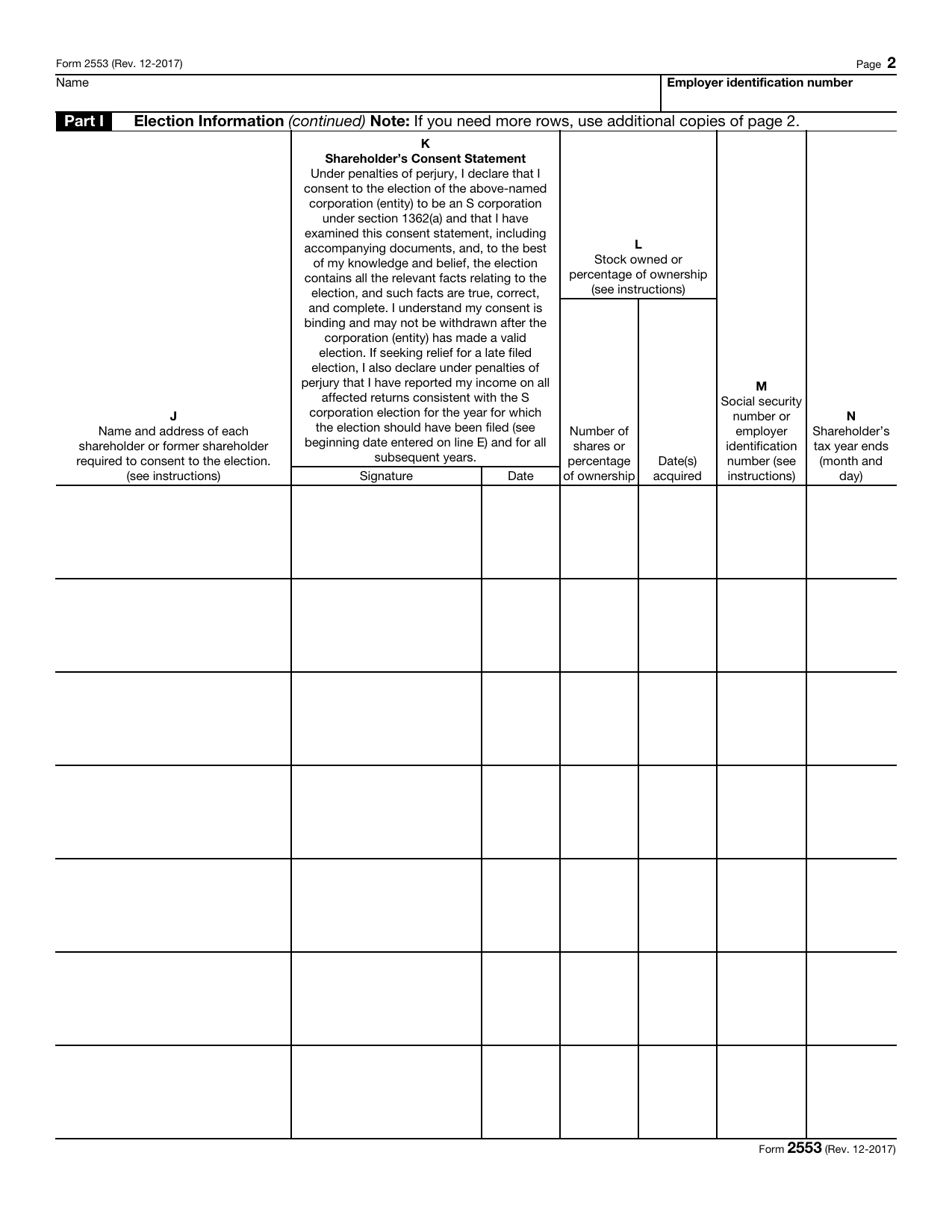
Name and EIN The business's name and EIN again
Repeat the name and EIN from page 1, so the page can be matched to the form if the pages get separated.
ExampleMaya enters "Bright Line Design LLC" and its EIN.
Column J Each owner's name and address
One row for each shareholder who has to consent. In an LLC, the members are the shareholders. If you file before the date in item E, only the people who own part of the business on the day you file need to be listed. If you file on or after that date, anyone who owned part of it since then has to be listed too.
ExampleMaya fills in one row: her name and home address.
Our tipNeed more rows? Use another copy of page 2, or a separate consent statement with the business's name, address and EIN.
Column K Each owner signs and dates
Every shareholder consents by signing and dating here, and the consent can't be withdrawn once the election is valid. A few special rules decide who signs. For example, if a married owner's spouse has a community property interest in the business or its income, both spouses must sign.
ExampleMaya signs and dates her row, November 2, 2026. With her signature on page 1, that's her second signature.
Our tipMarried and living in a community property state such as California or Texas? Check with a CPA whether your spouse needs to sign too.
Column L How much each owner has, and since when
A corporation lists the number of shares. An LLC has no stock, so the instructions say to enter each member's percentage of ownership and the date or dates it was acquired.
ExampleMaya enters 100% and 10/01/2026, the day she formed the LLC.
Column M Each owner's Social Security number
The Social Security number of each person in column J. An estate, a qualifying trust or an exempt organization that owns shares gives its EIN instead.
ExampleMaya enters her own Social Security number here, not the LLC's EIN.
Column N When each owner's tax year ends
The month and day each shareholder's own tax year ends. For nearly every person, that's December 31.
ExampleMaya files a normal calendar-year personal return, so she enters 12/31.
Part II, item O Only for a fiscal tax year
Part II is only for a business that checked box (2) or (4) in item F, asking for a tax year that doesn't end in December. Item O says whether it's a new corporation adopting that year, an existing one keeping it or an existing one changing to it. A calendar-year LLC skips all of page 3.
ExampleMaya checked calendar year in item F, so she leaves page 3 blank.
Item P Automatic approval of a fiscal year
For a business that qualifies for automatic approval of a fiscal year, either because it matches its natural business cycle or because the owners holding most of the shares use the same year. The natural business year route needs 47 months of monthly gross receipts.
ExampleMaya skips it.
Item Q Asking for a fiscal year for a business reason
For a business that wants a fiscal year and has to show the IRS a business reason for it. Checking box Q1 means a user fee and, the instructions say, usually about 90 more days before the election is accepted. Boxes Q2 and Q3 set up what happens if the request is turned down.
ExampleMaya skips it.
Item R A section 444 election
Another way to keep a fiscal year, which also takes Form 8716. Box R2 agrees to switch to a December year if the business turns out not to qualify.
ExampleMaya skips it.
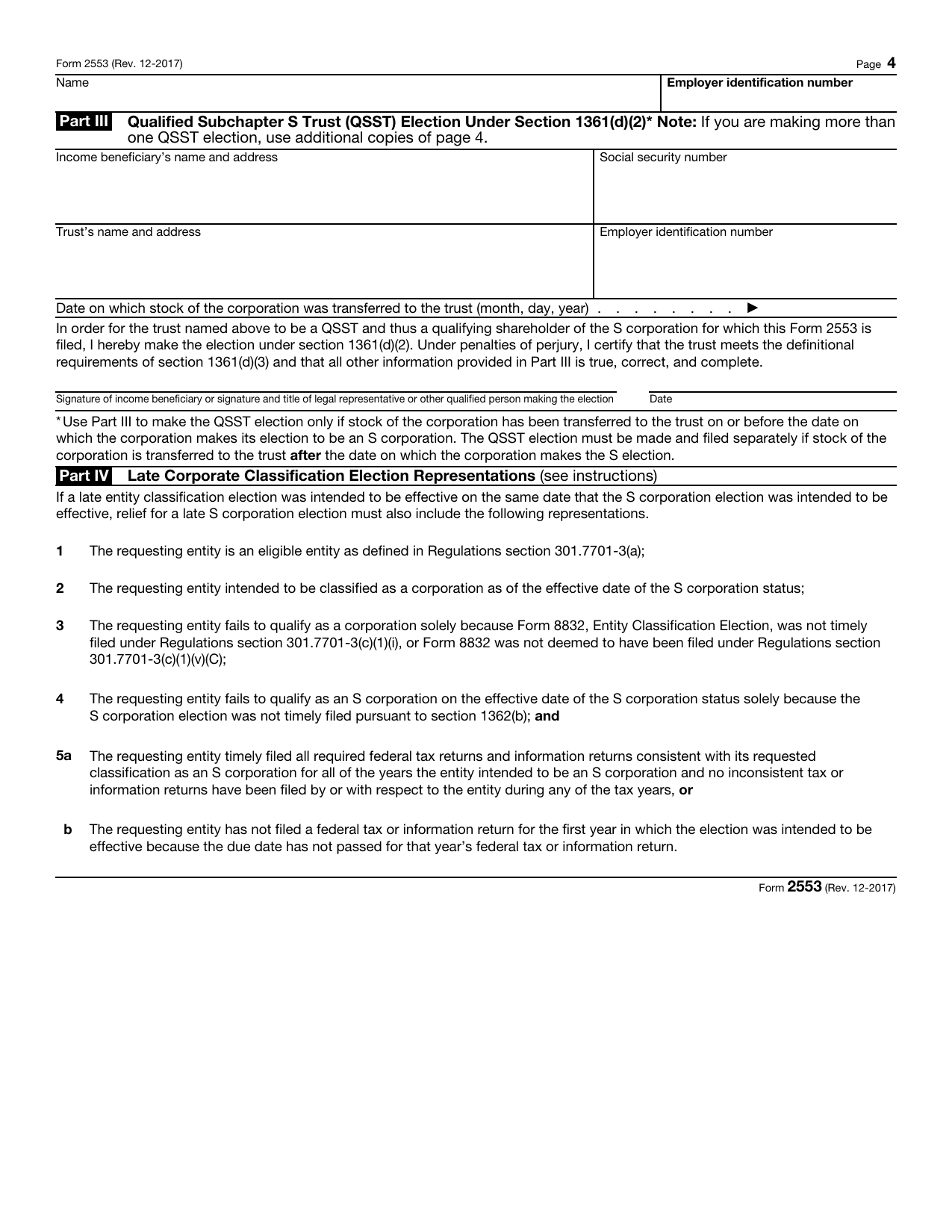
Part III Only if a trust owns shares
For a business where a trust owns part of it. The trust's income beneficiary uses this part to elect to be a qualified subchapter S trust (QSST), so the trust can be an allowed shareholder. It can't be filed on its own, only with Part I.
ExampleNo trust owns any of Maya's LLC, so she leaves Part III blank.
Part IV Only for an LLC that's filing late
An LLC that files Form 2553 on time is treated as a corporation automatically and doesn't need Form 8832. An LLC that misses the deadline missed both, so when it asks for late relief it attaches these five statements: that it's an eligible entity, that it meant to be a corporation and an S-corp from the date in item E, that it missed only because the forms were late, and that its tax returns match S-corp status or aren't due yet.
ExampleMaya is filing on time, so she leaves Part IV blank.
Our tipIf you're here because you missed March 15, read the late-election section of this page and talk to a CPA.
